

Wall Street Equities Fall as Rising Treasury Yields and Disappointing Walmart Results Weigh
The Dow Jones Industrial Average dropped 703 points on August 20 as rising bond yields and disappointing earnings from retail titan Walmart pressured equity markets.
By The Global Wire Newsroom · Reported from straitstimes.com
Link preview · horizonglobalnews.com
Wall Street Equities Fall as Rising Treasury Yields and Disappointing Walmart Results Weigh
The Dow Jones Industrial Average dropped 703 points on August 20 as rising bond yields and disappointing earnings from retail titan Walmart pressured equity markets.
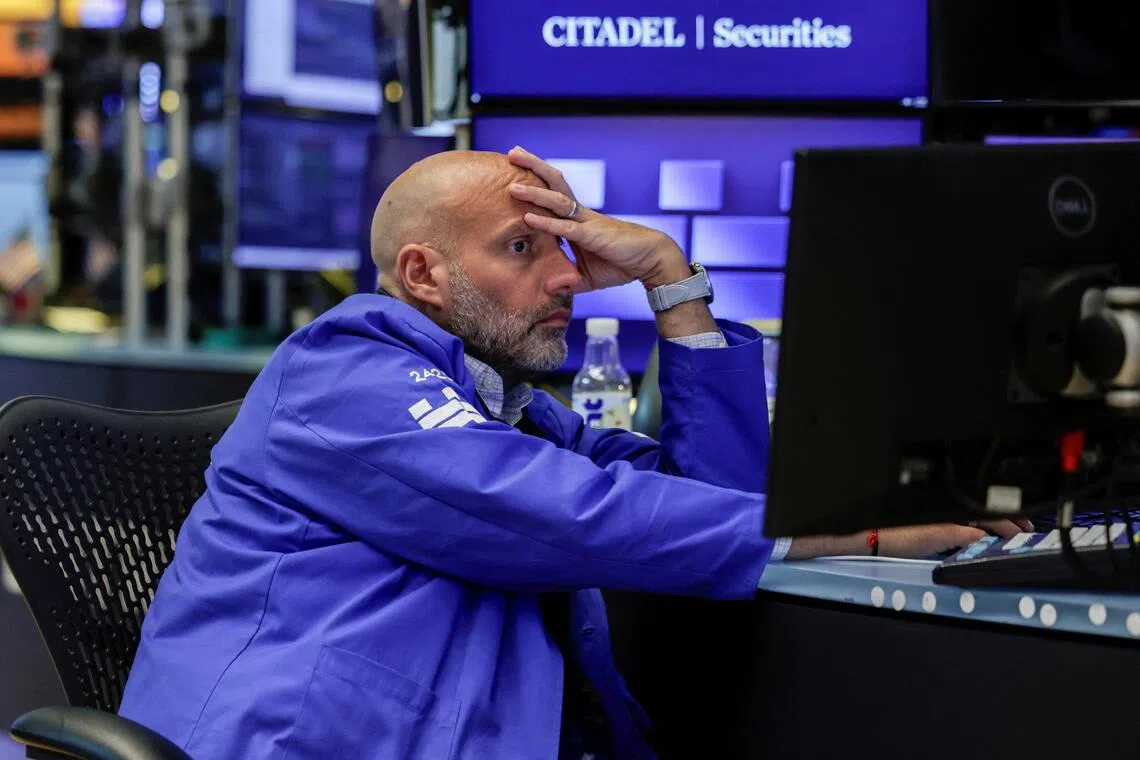
On August 20, 2026, major American equity markets closed sharply lower as climbing benchmark bond yields and disappointing financial results from retail giant Walmart weighed heavily on investor sentiment across Wall Street. The Dow Jones Industrial Average dropped 703.84 points, or 1.32 percent, to close at 52,759.21, according to initial market coverage by The Straits Times. The decline highlighted growing anxiety among market participants regarding the persistent burden of elevated borrowing costs and the potential softening of consumer demand, which serves as a primary pillar of economic growth in the United States.
Key facts
What happened
The trading session on August 20, 2026, was defined by a synchronized pull-back across equities, driven by pressure from both the fixed-income sector and disappointing earnings performance from major corporate bellwethers. The Dow Jones Industrial Average, an index tracking 30 prominent American industrial and commercial enterprises, experienced sustained selling pressure from the open, ultimately losing 703.84 points—a 1.32 percent drop—to finish at 52,759.21, as detailed by The Straits Times.
A primary driver of the downward momentum was the movement in bond yields. When U.S. Treasury yields rise, fixed-income instruments yield higher relative returns, increasing the cost of capital for corporations and reducing the relative attractiveness of higher-risk equities. This dynamics often leads institutional managers to reallocate capital away from equities and into government bonds, while simultaneously compressing corporate valuation models that rely on future discounted cash flows.
Compounding the pressure from fixed income was the quarterly earnings report from Walmart Inc., the largest U.S. grocery retailer and a critical proxy for household spending health. Walmart’s quarterly numbers disappointed market expectations, signaling that consumers may be cutting back on discretionary purchases, shifting spending toward lower-margin essential items, or facing increased financial stress due to persistent inflation and elevated borrowing costs. Given Walmart’s extensive footprint and supplier network across the consumer economy, negative guidance or weaker-than-expected top- and bottom-line figures from the company frequently trigger sector-wide re-evaluations among retail, consumer discretionary, and consumer staples equities.
The combination of higher discount rates stemming from climbing yields and weakened corporate fundamentals led to broad-based risk aversion, leaving equity indices in negative territory by the close of business.
Why it matters
The market movements of August 20 hold substantial implications for institutional investors, everyday market participants, corporate executives, and broader macroeconomic planning. When blue-chip indices like the Dow Jones Industrial Average experience single-session losses exceeding 700 points, it underscores a shift in how financial markets price future economic risk and business performance.
For equity investors and pension funds, rising bond yields alter fundamental portfolio allocation frameworks. Higher risk-free yields make government debt an increasingly viable alternative to equity investments, particularly during periods when corporate profit margins face downward pressure. Furthermore, equity valuation models use government bond yields as the baseline benchmark discount rate. As yields increase, the present value of future corporate earnings decreases, leading to multiple contraction across listed equities even if baseline corporate profits remain flat.
Walmart’s disappointing earnings performance carries additional macroeconomic significance. Household consumption accounts for roughly two-thirds of U.S. gross domestic product, making retail earnings reports a crucial real-time health diagnostic of consumer financial health. When Walmart reports disappointing results, it suggests that lower- and middle-income households may be adjusting their shopping patterns, prioritizing essential commodities over non-essential merchandise, or feeling the cumulative strain of cumulative price increases and elevated credit card borrowing rates.
Additionally, elevated bond yields directly influence real-economy financing conditions. Benchmark Treasury rates set the baseline for commercial lending, corporate debt issuance, municipal financing, and residential mortgage rates. Persistent upward pressure on yields tightens broader financial conditions independent of direct central bank action, potentially dampening corporate investment, real estate transactions, and capital expenditures.
The background
Understanding the relationship between government bond yields, retail earnings, and equity market indices requires examining the institutional mechanics of modern capital markets and recent economic history.
The Dow Jones Industrial Average, created in 1896, is one of the oldest and most widely followed equity indices in the world. Unlike market-capitalization-weighted indices such as the S&P 500 or the Nasdaq Composite, the Dow is a price-weighted index comprising 30 major U.S. publicly traded companies. Because it is price-weighted, movements in higher-priced constituent stocks exert a disproportionate impact on the index's point changes. Large corporate constituents such as Walmart, along with major industrial, financial, and technology firms, serve as barometers for the overall health of the U.S. corporate sector.
Bond yields represent the effective interest rate earned on debt securities issued by the U.S. Department of the Treasury. These yields move inversely to bond prices: when investors sell bonds, bond prices drop and yields rise. Yield movements are influenced by several factors, including market expectations regarding future interest rate decisions by the Federal Reserve, sovereign debt supply, inflation expectations, and global macroeconomic liquidity. Historically, periods of rising bond yields present headwinds for equity markets, particularly when economic growth is perceived to be slowing or when corporate earnings growth fails to outpace rising borrowing costs.
Walmart Inc. holds a unique position in global commerce. Founded in 1962 and headquartered in Bentonville, Arkansas, the retail giant operates thousands of stores worldwide and serves as the largest private employer in the United States. Due to its enormous operational scale and supply chain reach, Walmart's financial performance provides critical insights into consumer sentiment, supply chain inflation, inventory management, and discretionary spending trends across demographics. Analysts closely track Walmart’s quarterly earnings reports to gauge whether American families are maintaining their purchasing power or paring back spending under macroeconomic pressure.
Reaction
Following major single-day equity declines driven by fixed-income shifts and retail earnings reports, reactions typically span financial market participants, corporate executive suites, and research analysts. Equity research desks across major investment banks routinely issue adjusted price targets and earnings estimates for constituent retail companies following earnings disappointments, while portfolio managers recalibrate portfolio weightings between growth, value, and fixed-income assets.
While formal commentary from regulatory bodies or central banks is rarely issued in response to single-day stock price moves, corporate executives at major retail firms often face rigorous questioning from institutional analysts during earnings conference calls regarding inventory management, pricing strategies, and forward-looking profit margins. Fixed-income traders concurrently monitor secondary market bond yields and Treasury auction demand to assess whether yield increases represent technical market adjustments or structural shifts in underlying economic policy expectations.
What we don't know yet
Several critical details regarding the August 20 market selloff remain unresolved based on initial summary reporting. First, specific operational drivers behind Walmart’s earnings shortfall—such as whether margins were squeezed by elevated labor expenses, supply chain bottlenecks, promotional markdowns, or outright sales declines in discretionary merchandise categories—were omitted from initial market summaries.
Second, the full performance metrics for parallel equity benchmark indices, including the S&P 500 and the technology-heavy Nasdaq Composite, were not specified in initial reports, leaving incomplete the broader picture of relative sector performance across capital markets. Additionally, it remains unverified whether the rise in bond yields was driven primarily by short-term supply dynamics from government debt auctions, shifts in inflation metrics, or altered expectations regarding upcoming central bank interest rate decisions. The duration of both the bond market shift and retail sector re-pricing will depend on upcoming financial and economic disclosures.
What to watch
In the days and weeks following the August 20 market downturn, several key indicators will determine whether the decline represents a short-term consolidation or the start of a broader trend:
This news report was developed based on original financial market coverage and data published by The Straits Times.
How this story was produced
This report was written by The Global Wire newsroom from reporting first published by straitstimes.com. We verify the core facts against the original report, write our own account, and add the background and consequences a short wire item leaves out. Drafting is AI-assisted inside an editor-supervised pipeline, and every story is checked for accuracy of attribution, structure and duplication before it appears — full detail in our AI and funding disclosure.
Spotted an error? Tell us at corrections@horizonglobalnews.com and read our corrections policy or editorial standards.





Reader comments
Loading comments…