

USA and Mexico Renew Historic Soccer Rivalry in Glendale International Friendly
The United States and Mexico met in an autumn international friendly in Glendale, Arizona, continuing North America's premier international soccer rivalry.
By The Global Wire Newsroom · Reported from ESPN
Link preview · horizonglobalnews.com
USA and Mexico Renew Historic Soccer Rivalry in Glendale International Friendly
The United States and Mexico met in an autumn international friendly in Glendale, Arizona, continuing North America's premier international soccer rivalry.
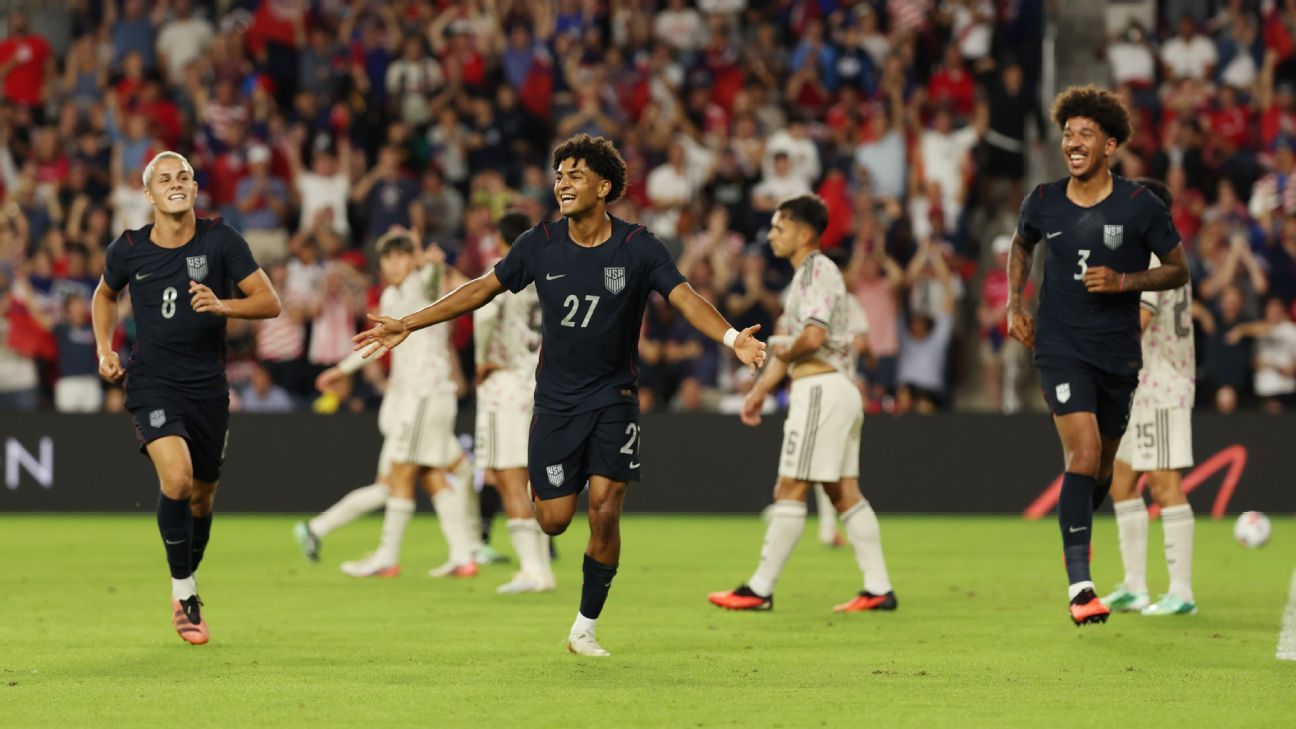
GLENDALE, Ariz. — The men's national soccer teams of the United States and Mexico renewed their historic regional rivalry in an international friendly match in Glendale, Arizona, on Oct. 4, 2026 (UTC). According to reporting by ESPN, the contest formed part of an ongoing slate of autumn fixtures on the international soccer calendar. Held in Maricopa County in the Phoenix metropolitan area, the fixture brought together the two dominant forces of North American soccer for another chapter in a rivalry that spans nearly a century of competitive and friendly meetings.
Key facts
What happened
According to reporting by ESPN, the United States men's national team faced Mexico in an international friendly match in Glendale, Arizona. The fixture was scheduled during the autumn international window, a designated period on the FIFA match calendar during which professional club competitions temporarily pause to allow players to join their respective national teams.
International friendly matches played during these windows serve critical operational and athletic purposes for national team programs. Head coaches use non-tournament games to test tactical formations, evaluate squad depth, integrate young or fringe players into the national team system, and refine squad cohesion against high-level opponents. Unlike official competition matches in tournaments such as the Concacaf Nations League or the FIFA World Cup, friendly matches permit a higher number of player substitutions, giving managers increased flexibility to manage physical workloads and examine tactical variations across 90 minutes of play.
The selection of Glendale, Arizona, as the host site provided a high-capacity venue in a region with deep cultural and sporting ties to both nations. Large fan bases representing both the U.S. and Mexican national programs typically create a highly energetic atmosphere at Arizona venues. Operating under international fixture protocols, the match required extensive logistical coordination between the U.S. Soccer Federation (USSF), the Mexican Football Federation (Federación Mexicana de Fútbol, or FMF), Concacaf, and local stadium authorities in Glendale. ESPN provided live match updates as the two continental rivals competed on the pitch.
Why it matters
While labeled as a friendly, any encounter between the United States and Mexico carries significant strategic, commercial, and symbolic weight within international soccer. In the Concacaf region, the U.S.-Mexico fixture is widely recognized as the preeminent international rivalry, driving broadcast viewership, ticket sales, and media coverage far beyond typical exhibition matches.
From a sporting perspective, international friendlies during FIFA window periods affect the official FIFA Men's World Ranking. FIFA's ranking algorithm assigns points based on match outcomes, opponent strength, and match importance. Although friendlies carry a lower weighting factor than competitive tournament matches, a win or loss against a highly ranked regional rival still directly influences a national team's overall ranking points. International rankings are used by FIFA to determine seedings for major tournament draws, including world championship qualifying groups and final tournament pots.
Furthermore, matches between top Concacaf teams offer national team technical staff crucial data points. Coaching staffs evaluate how tactical schemes hold up under the intense pressure characteristic of rivalry games. For individual players, strong performances in high-profile friendlies can secure inclusion in upcoming competitive rosters, while mistakes can diminish a player's standing within the national team depth chart. Commercially, fixtures of this caliber demonstrate the robust appetite for international soccer in major U.S. metropolitan markets, serving as an operational benchmark for host cities and stadium management teams.
The background
The athletic rivalry between the United States and Mexico is one of the most storied cross-border rivalries in international sports. The two nations first met on May 24, 1934, in Rome, Italy, in a qualifying match for the 1934 FIFA World Cup, which the United States won 4-2. For several decades following that initial meeting, Mexico held near-total dominance over the series, maintaining an unbroken home winning streak against the U.S. for more than 70 years and regularly securing dominant victories in regional tournaments.
The competitive balance began to shift in the late 1980s and 1990s, parallel to the growth of Major League Soccer (MLS) and the development of elite U.S. training infrastructure. A landmark moment in the rivalry occurred during the 2002 FIFA World Cup in South Korea and Japan, when the United States defeated Mexico 2-0 in the Round of 16 in Jeonju—marking the only time the two rivals have met in the knockout stage of a World Cup. That victory solidified the scoreline "Dos a Cero" (Two to Zero) as a cultural touchstone among U.S. supporters, a moniker reinforced by a series of identical 2-0 U.S. victories over Mexico in Columbus, Ohio, during World Cup qualifying campaigns in 2001, 2005, 2009, and 2013.
In recent years, the rivalry has been defined by tense, high-stakes encounters in Concacaf competitions. The U.S. and Mexico frequently contend for supremacy in the Concacaf Gold Cup, the region's biennial continental championship, and the Concacaf Nations League, a tournament introduced in 2019 to provide regular competitive fixtures for member associations. Matches between the two sides are known for high intensity, physical play, and dramatic tactical adjustments.
Glendale, Arizona, has established itself as a premier venue for major soccer events in the United States. State Farm Stadium, a multi-purpose retractable-roof venue opened in 2006, has hosted numerous international friendlies, Concacaf Gold Cup matches, and Copa América fixtures. The venue's modern infrastructure and location make it a recurring destination for international soccer federations seeking to host high-attendance neutral or friendly events in the American Southwest.
Reaction
Following major international fixtures, public statements and tactical analysis are traditionally delivered by the head coaches, players, and federation officials of both participating nations. In post-match press conferences, national team managers typically address tactical performance, squad rotation, individual player evaluations, and physical conditioning. Players frequently provide commentary on key match moments, pitch conditions, and the intensity of competing against a historic rival.
Supporters' organizations—including the American Outlaws for the United States and various Mexican fan associations across North America—engage heavily around U.S.-Mexico fixtures, reflecting the deep cultural significance of the rivalry. Media outlets across the U.S., Mexico, and the broader international soccer landscape analyze match statistics, tactical setups, and roster implications following the final whistle. According to ESPN, real-time match events and commentary were tracked throughout the duration of the contest in Glendale.
What we don't know yet
Because initial wire coverage focused on live match proceedings, several specific details regarding the fixture's final outcome and statistical profile remain to be fully detailed in post-match documentation:
These details are essential for assessing the overall tactical success of each program and evaluating the immediate impact of the match on national team selection choices.
What to watch
In the aftermath of the Glendale friendly, several key developments will indicate the trajectory for both national team programs:
This report is based on original news coverage and live reporting provided by ESPN.
How this story was produced
This report was written by The Global Wire newsroom from reporting first published by ESPN. We verify the core facts against the original report, write our own account, and add the background and consequences a short wire item leaves out. Drafting is AI-assisted inside an editor-supervised pipeline, and every story is checked for accuracy of attribution, structure and duplication before it appears — full detail in our AI and funding disclosure.
Spotted an error? Tell us at corrections@horizonglobalnews.com and read our corrections policy or editorial standards.





Reader comments
Loading comments…