

Samaiden Signs Pact With Parkland to Explore 1,000 MW of Clean Power in Malaysia
Samaiden Sdn Bhd has formed a preliminary pact with Parkland Renewable Energy to evaluate up to 1,000 megawatts of clean energy projects across Peninsular Malaysia.
By The Global Wire Newsroom · Reported from thestar.com.my
Link preview · horizonglobalnews.com
Samaiden Signs Pact With Parkland to Explore 1,000 MW of Clean Power in Malaysia
Samaiden Sdn Bhd has formed a preliminary pact with Parkland Renewable Energy to evaluate up to 1,000 megawatts of clean energy projects across Peninsular Malaysia.
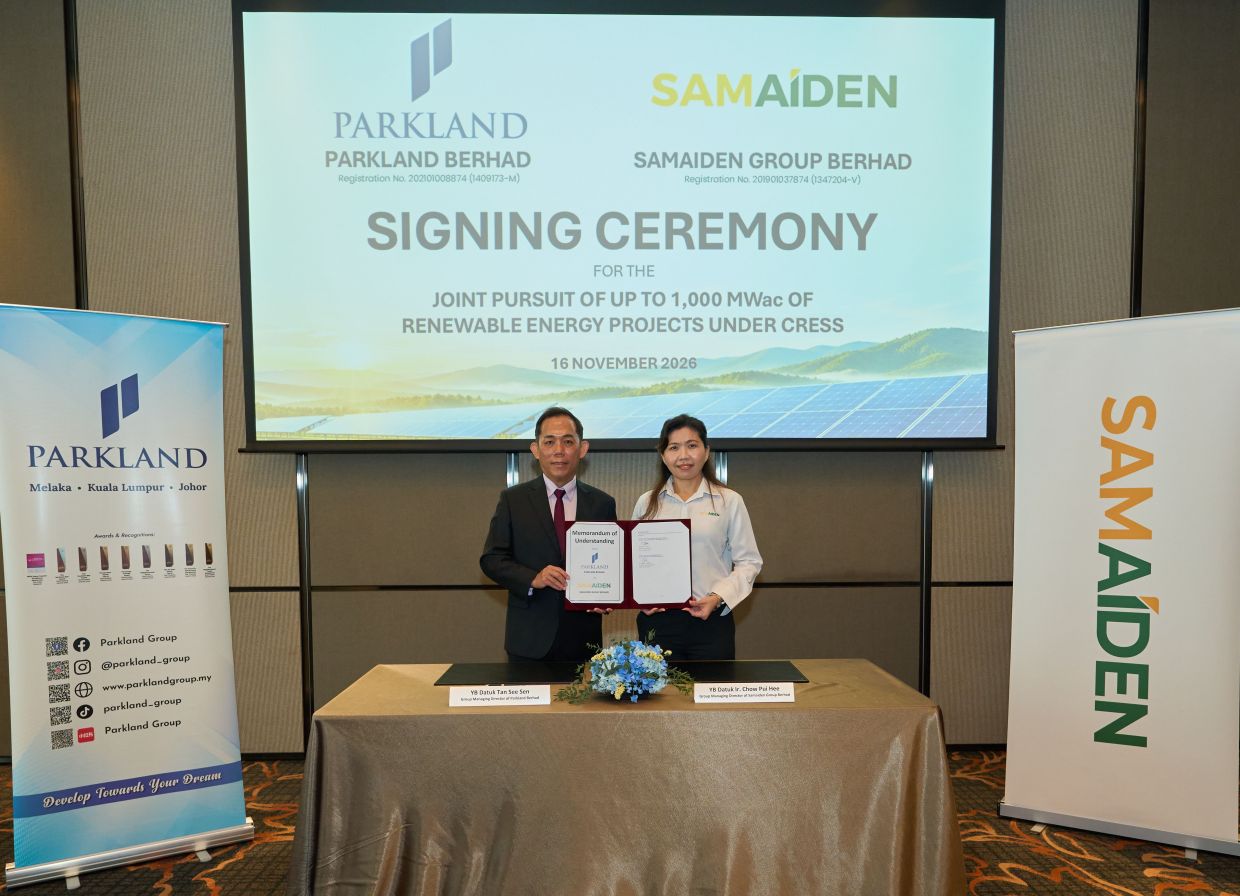
KUALA LUMPUR — Samaiden Group Bhd's wholly owned engineering and clean energy arm, Samaiden Sdn Bhd, has entered into a memorandum of understanding with Parkland Renewable Energy Sdn Bhd to explore the joint development of renewable power assets across Peninsular Malaysia, targeting a total potential capacity of up to 1,000 megawatts alternating current (MWac). The framework agreement establishes a preliminary working relationship between the clean energy infrastructure specialist and the regional development firm as both entities seek commercial opportunities aligned with Malaysia's expanding utility-scale and commercial decarbonization initiatives.
Key facts
What happened
Under the terms of the memorandum of understanding, Samaiden Sdn Bhd and Parkland Renewable Energy have agreed to collaborate on feasibility assessments, site identification, technical design, and regulatory planning for utility-scale clean power facilities throughout Peninsular Malaysia. The initiative seeks to build a project pipeline capable of generating up to 1,000 MWac over several development phases, according to reporting by thestar.com.my.
Samaiden brings to the partnership its core operational experience as an engineering, procurement, construction, and commissioning (EPCC) contractor, alongside its capabilities in asset management, technical advisory, and interconnection studies. Parkland Renewable Energy, a development-focused entity tied to property and land asset holdings, brings access to potential land parcels, civil development resources, and localized site execution capabilities.
While the announcement establishes a mutual intent to develop up to a gigawatt of generation capacity, the execution will depend on feasibility studies evaluating irradiation levels, topography, grid injection capacity, environmental impact assessments, and off-take mechanisms. The two entities have not yet disclosed the precise allocation of equity, commercial capital requirements, or specific geographical sites earmarked for initial construction. Instead, the memorandum serves as an umbrella arrangement to allow preliminary technical due diligence and jointly position the partners for competitive bids and private corporate off-take agreements.
Why it matters
An aggregate development pipeline of 1,000 MWac represents an enormous scale in the Southeast Asian renewable energy landscape. In practical terms, one gigawatt of alternating current solar capacity requires roughly 3,000 to 4,000 acres of suitable land, depending on terrain, module efficiency, and single-axis tracking systems. If fully brought to commercial operation, an asset portfolio of this magnitude would produce enough electricity to power several hundred thousand Malaysian households, displacing substantial amounts of fossil-fuel generation.
For Malaysia's power sector, the scale of this planned pipeline indicates mounting private-sector appetite to capture capacity allocations under state decarbonization policies. Peninsular Malaysia's power mix has historically leaned heavily on coal and piped natural gas. Transitioning the system toward solar, biomass, and small hydro requires developers capable of assembling land parcels and securing balance sheets strong enough to withstand high initial capital expenditure.
For engineering firms like Samaiden, forming upstream development alliances with landholders and property developers provides a crucial hedge against competitive bidding pressures in the open EPCC market. By co-developing projects from inception, technical specialists secure proprietary engineering and construction mandates rather than fighting for shrinking profit margins in competitive procurement tenders. Conversely, landholders mitigate development risks by partnering with accredited technical operators who understand grid compliance, inverter dynamics, and the rigorous standards imposed by national utility off-takers.
The background
Malaysia has rapidly overhauled its clean energy policy architecture over the past several years, positioning itself as a central hub for clean power investments in the Association of Southeast Asian Nations. The government unveiled the National Energy Transition Roadmap (NETR) to steer the country away from its reliance on fossil generation. The roadmap lifted previous caps on clean energy deployment and raised the national ambition from an earlier target of 40 percent renewable installed capacity by 2035 to 70 percent by 2050. Achieving this long-term objective requires an estimated 180 billion ringgit (roughly $40 billion) in cumulative investment across renewable generation, grid reinforcement, energy storage systems, and regional interconnection infrastructure.
Historically, the deployment of large-scale solar in Peninsular Malaysia has been governed by structured bidding cycles overseen by the Energy Commission (Suruhanjaya Tenaga). Beginning in 2016, the Large Scale Solar (LSS) competitive rounds allocated successive tranches of capacity, expanding from a few hundred megawatts in LSS1 to multi-gigawatt targets in subsequent rounds, such as LSS4 and LSS-Peralihan Tenaga SuSuria (LSS5). Parallel to government-backed power purchase agreements, the government established the Corporate Green Power Programme (CGPP), which introduced virtual power purchase agreements allowing commercial and industrial consumers to contract directly with solar plant developers.
Furthermore, the Ministry of Energy Transition and Water Transformation introduced the Corporate Renewable Energy Supply Scheme (CRESS), which offers open-access third-party grid usage, enabling green power producers to wheel electricity directly through the national grid to corporate buyers. This policy shift created a strong incentive for commercial alliances capable of securing land and grid interconnection rights in advance of regulatory allocation windows.
Founded in 2013 and listed on the Main Market of Bursa Malaysia, Samaiden has grown from a specialized rooftop solar contractor into one of the country's prominent utility-scale EPCC players, progressively expanding into small hydropower, biomass, and regional energy markets in Southeast Asia. Parkland Group, known primarily for property development and construction across Melaka, Johor, and Selangor, has increasingly diversified into green infrastructure, reflecting a broader trend of Malaysian real estate developers leveraging land holdings to generate recurring infrastructure yields.
Reaction
The initial market disclosure has signaled corporate intent without formal public comments from regulatory bodies. Government regulators, including the Energy Commission of Malaysia and the single buyer entity within the national grid operator Tenaga Nasional Bhd (TNB), typically refrain from commenting on early-stage corporate memorandums of understanding until formal applications for generation licenses, planning permissions, or grid connection feasibility studies are formally submitted.
Industry analysts and market participants generally view such framework agreements through a pragmatic lens. Analysts routinely observe that while memorandums demonstrate ambition and pipeline growth, execution risks remain tethered to regulatory quotas, transmission constraints, and off-take pricing. Institutional investors closely monitor Samaiden's transition from a pure-play engineering contractor into a joint asset owner, as co-ownership yields higher recurring revenues but requires substantial equity financing and project debt mobilization.
What we don't know yet
Several fundamental operational and financial parameters remain unverified and undisclosed in the preliminary reporting. It is not yet clear whether the 1,000 MWac capacity will be pursued primarily as single-buyer utility-scale solar farms through future government LSS bidding programs, as private corporate off-take installations under the CGPP or CRESS frameworks, or as decentralized commercial solar parks.
The capital structure and estimated total development cost have not been shared. Standard utility-scale solar development in Southeast Asia generally requires capital outlays ranging from $600,000 to $800,000 per megawatt, indicating that a 1,000 MWac portfolio could ultimately demand between $600 million and $800 million (approximately 2.7 billion to 3.6 billion ringgit) in total project investment. How the two partners plan to structure equity contributions, project debt, and debt-to-equity ratios remains unknown.
Furthermore, the announcement does not specify the intended timelines for financial close, commercial operation dates, or the specific states in Peninsular Malaysia where land rights are being negotiated. Whether Parkland has already acquired the required parcels or holds long-term lease options remains an open question that will determine how quickly these proposals can move to the engineering phase.
What to watch
The most immediate milestone to monitor will be the transition from a non-binding memorandum of understanding to a definitive joint-venture agreement or shareholding subscription contract. Any subsequent filings by Samaiden Group Bhd on Bursa Malaysia will detail the exact corporate structure, ownership percentages, and initial capital outlays agreed upon by both entities.
Another critical factor is the timing and eligibility criteria of forthcoming regulatory rounds announced by the Energy Commission. Observers should watch whether the Samaiden-Parkland consortium submits bids under pending LSS allocations or applies for wheeling arrangements under the CRESS framework. The approval of system impact assessments by TNB will serve as a technical gatekeeper; grid capacity bottlenecks in northern and central Peninsular Malaysia have previously constrained rapid injection of solar energy, making interconnection permits a vital leading indicator of actual project viability.
Additionally, corporate procurement trends among energy-intensive multinational corporations operating in Malaysia—especially data centers expanding across Johor, Selangor, and Kedah—will dictate off-take demand. Agreements signed between clean energy developers and major commercial consumers will indicate whether multi-megawatt merchant assets can achieve bankability without traditional state-backed feed-in tariffs.
This report is based on original reporting by thestar.com.my.
How this story was produced
This report was written by The Global Wire newsroom from reporting first published by thestar.com.my. We verify the core facts against the original report, write our own account, and add the background and consequences a short wire item leaves out. Drafting is AI-assisted inside an editor-supervised pipeline, and every story is checked for accuracy of attribution, structure and duplication before it appears — full detail in our AI and funding disclosure.
Spotted an error? Tell us at corrections@horizonglobalnews.com and read our corrections policy or editorial standards.






Reader comments
Loading comments…