

Pennsylvania Governor Condemns Trump Foreign Policy and National Security Record
Governor Josh Shapiro criticized former President Donald Trump over relations with Moscow and military actions concerning Iran, asserting executive leadership has compromised American interests.
By The Global Wire Newsroom · Reported from ET Online
Link preview · horizonglobalnews.com
Pennsylvania Governor Condemns Trump Foreign Policy and National Security Record
Governor Josh Shapiro criticized former President Donald Trump over relations with Moscow and military actions concerning Iran, asserting executive leadership has compromised American interests.
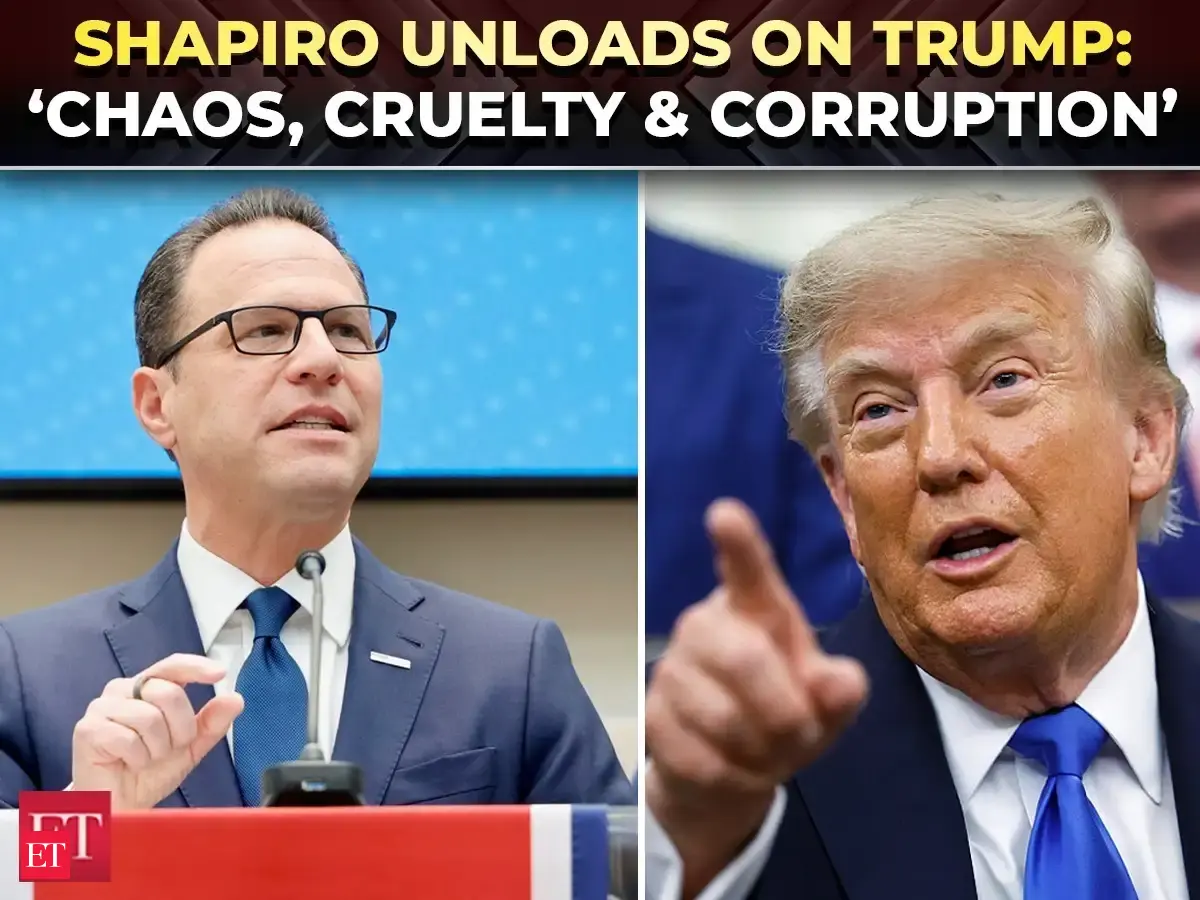
Pennsylvania Governor Josh Shapiro delivered a sharp public rebuke of Donald Trump, asserting that the former president's approach to governance and foreign affairs has compromised the security and economic standing of the United States. In remarks reported by ET Online, Shapiro accused Trump of placing personal motivations ahead of national interests through his posture toward Russian President Vladimir Putin and characterized the broader administrative record as one defined by systemic disorder, severity, and ethical misconduct. The governor specifically targeted military decisions regarding Iran, arguing that aggressive escalations have undermined long-term American stability and weakened the nation's standing abroad.
Key facts
What happened
In an address detailing his assessment of the country's national direction, Governor Josh Shapiro mounted an expansive critique of Donald Trump, focusing heavily on national defense, diplomacy, and executive integrity. According to coverage published by ET Online, Shapiro argued that the trajectory set by Trump has diminished both domestic prosperity and international security.
A central focus of Shapiro's address was the relationship between Trump and Moscow. The Pennsylvania governor argued that sovereign American interests were compromised by diplomatic overtures that favored Russian President Vladimir Putin, suggesting that such accommodations were guided by private incentives rather than established diplomatic norms or collective security commitments. Shapiro argued that this posture degraded traditional alliances and compromised fundamental geopolitical objectives.
Shapiro also directed specific scrutiny toward military posturing in the Middle East, particularly decisions surrounding conflict with Iran. According to the account provided by ET Online, the governor challenged executive military initiatives that precipitated armed hostility, arguing that entering military confrontations without clear, sustainable strategic objectives jeopardized American personnel and regional equilibrium. Throughout his critique, Shapiro framed these disparate policy choices not as isolated errors in judgment, but as elements of a broader pattern of executive governance that he described as sustained institutional dysfunction, callous policy execution, and personal enrichment at the expense of the public trust.
Why it matters
Shapiro's public challenge carries significant implications for national political discourse, party messaging, and the ongoing debate over the boundaries of presidential authority in foreign affairs. Governors frequently focus their communications on regional economic development, infrastructure, and state-level statutory obligations. When the chief executive of the nation's fifth most populous state—possessing 19 crucial Electoral College votes—chooses to deliver an extensive indictment of national security conduct, it signals a deliberate effort to shape federal policy arguments ahead of upcoming electoral contests.
From a policy perspective, the critique touches on the fundamental division between traditional internationalism and non-interventionist or transactional foreign policy doctrines. For decades following the 1949 establishment of the North Atlantic Treaty Organization, American foreign policy maintained a bipartisan presumption that European territorial integrity and opposition to Russian expansion were core national security interests. By explicitly framing accommodation of Moscow as an abdication of national duty, Shapiro is reinforcing the establishment position among national security professionals that unchecked aggression in Eastern Europe destabilizes international trade and imperils democratic allies.
Furthermore, the focus on military action involving Iran highlights ongoing legislative and legal tensions over executive warmaking. Discretionary military strikes frequently bypass congressional authorization, testing the limits of the War Powers Resolution and triggering volatility across global crude oil markets. Instability in the Persian Gulf directly influences maritime transit through the Strait of Hormuz, where roughly one-fifth of the world's petroleum consumption passes annually. A governor connecting these federal security decisions to domestic economic vitality underscores how geopolitical disruptions translate into tangible consumer costs, such as domestic fuel prices and industrial manufacturing supply constraints.
The background
The political and diplomatic terrain underpinning Shapiro's remarks is shaped by years of contentious debate surrounding presidential discretion, diplomatic alignments, and executive conduct. Trump's tenure reshaped standard diplomatic protocols, particularly regarding Eastern Europe and the Middle East. From his 2016 campaign through his presidency, Trump consistently questioned the financial contributions of NATO member states and expressed a willingness to negotiate directly with authoritarian leaders, including an unprecedented joint press conference with Vladimir Putin in Helsinki in July 2018 that drew bipartisan domestic condemnation.
Simultaneously, United States policy toward Tehran underwent radical shifts during the same era. In May 2018, the Trump administration unilaterally withdrew the United States from the Joint Comprehensive Plan of Action, known colloquially as the Iran nuclear deal, which had been negotiated in 2015 alongside the five permanent members of the United Nations Security Council and Germany. Following that withdrawal, Washington instituted a sweeping "maximum pressure" sanctions campaign aimed at dismantling Iran's oil export revenues and curbing its ballistic missile development.
These economic measures escalated military frictions in the Persian Gulf, culminating in a series of direct and proxy military engagements. In January 2020, American forces carried out a targeted drone strike in Baghdad that killed Major General Qasem Soleimani, commander of the Islamic Revolutionary Guard Corps' Quds Force, an action that led to Iranian ballistic missile counterstrikes against Al Asad Airbase in Iraq. Throughout these developments, constitutional scholars and members of Congress repeatedly debated whether such strikes exceeded Article II executive powers without an Authorization for Use of Military Force approved under Article I legislative prerogatives.
On the domestic political front, Josh Shapiro was elected governor of Pennsylvania in November 2022 after serving two terms as the state's attorney general. During his tenure as attorney general, Shapiro built a national profile through high-visibility civil litigation against federal policy mandates and corporate settlements. His victory in 2022 by a nearly 15-percentage-point margin in a perennially divided swing state positioned him as a prominent voice in national Democratic politics. Pennsylvania's unique demographic composition, blending dense urban centers in Philadelphia and Pittsburgh with industrial hubs and rural conservative valleys, makes its statewide leaders natural barometers for broader national sentiment.
Reaction
While the original report by ET Online did not document immediate formal responses from Trump's official representatives, counterarguments from Trump's political apparatus and congressional allies adhere to well-established positions. Representatives for Trump consistently maintain that his direct diplomacy with foreign heads of state averted major international conflicts during his term in office, arguing that his willingness to challenge multilateral institutions and confront adversaries with decisive military force projected strength and deterrence.
In congressional forums and public commentary, political allies of Trump regularly defend assertive operations against Iran as necessary countermeasures against state-sponsored militancy and regional destabilization. They also frequently dismiss criticisms from Democratic state executives as partisan maneuvers intended to boost personal national profiles rather than constructive contributions to foreign policy debate. State-level Republican lawmakers in Pennsylvania are similarly expected to question whether a sitting governor should devote public attention to international geopolitical disputes rather than state fiscal management, education funding, and municipal governance.
What we don't know yet
Several substantive details remain unclarified in the available reporting. The account published by ET Online provides excerpts and thematic summaries of Shapiro's remarks but does not specify the precise venue, audience, or operational context in which the governor delivered the address. It remains unclear whether the comments were delivered during a formal policy address, an impromptu press gaggle, or a campaign-style political gathering.
Additionally, the wire account leaves an evidentiary gap regarding the specific military hostilities with Iran referenced by the governor. The summary does not delineate whether Shapiro was critiquing past executive actions, such as the 2020 Soleimani strike and subsequent naval standoffs, or responding to more recent regional military engagements and rhetorical threats. Without the full transcript, readers cannot determine what legislative reforms, if any, Shapiro advocates to curtail executive warmaking authority or what specific diplomatic policies he proposes regarding future bilateral relations with Russia.
What to watch
In the coming weeks, political observers will monitor whether Shapiro expands these national security criticisms into a formalized platform, including whether he participates in national security forums or issues joint statements with other governors. His travel schedule outside of Pennsylvania will serve as an indicator of whether these remarks represent an isolated critique or the opening salvo of an organized national messaging effort.
Attention will also focus on Capitol Hill, where ongoing debates concerning defense appropriations and war powers authorizations provide a recurring legislative vehicle for lawmakers to contest the limits of presidential military engagement. Any formal response from Trump, whether via political rallies or official campaign communications, will clarify how his team intends to rebut charges concerning Russian diplomacy and Middle East military strategies. Finally, public opinion polling within key industrial and battleground states like Pennsylvania will demonstrate whether voters prioritize international foreign policy cohesion over domestic economic issues when assessing national leadership.
This report is based on original news reporting by ET Online.
How this story was produced
This report was written by The Global Wire newsroom from reporting first published by ET Online. We verify the core facts against the original report, write our own account, and add the background and consequences a short wire item leaves out. Drafting is AI-assisted inside an editor-supervised pipeline, and every story is checked for accuracy of attribution, structure and duplication before it appears — full detail in our AI and funding disclosure.
Spotted an error? Tell us at corrections@horizonglobalnews.com and read our corrections policy or editorial standards.




Reader comments
Loading comments…