

Meteoritic Ribose Solubilized Boron on Early Earth to Enable RNA Formation, Study Finds
A study reported by TOI Science Desk reveals that space-delivered ribose kept boron dissolved in primordial waters, creating stable conditions for early RNA synthesis.
By The Global Wire Newsroom · Reported from TOI Science Desk
Link preview · horizonglobalnews.com
Meteoritic Ribose Solubilized Boron on Early Earth to Enable RNA Formation, Study Finds
A study reported by TOI Science Desk reveals that space-delivered ribose kept boron dissolved in primordial waters, creating stable conditions for early RNA synthesis.
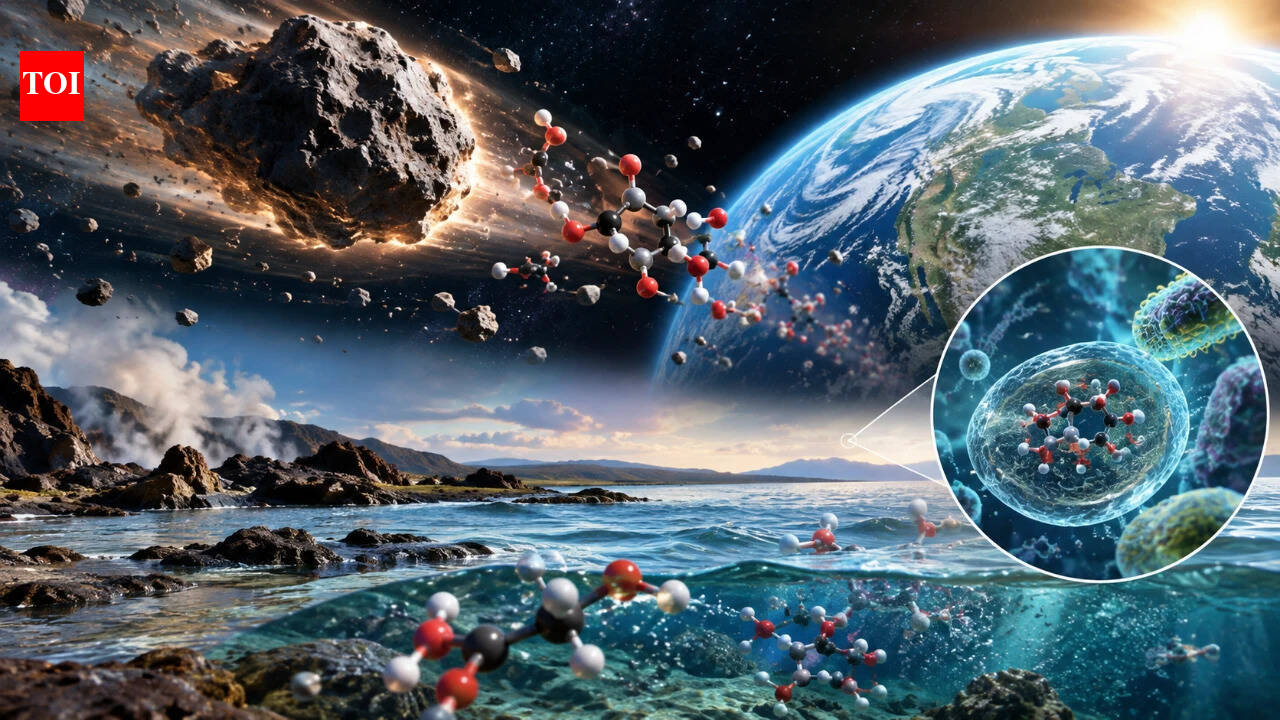
Scientists investigating the chemical origin of life on Earth have uncovered a novel mechanism by which space-delivered organic molecules helped set the stage for early biology. According to reporting published on Oct. 1, 2026, by TOI Science Desk, a new study reveals that ribose—a five-carbon sugar transported to Earth aboard ancient meteorites—played a critical geochemical role by keeping the element boron dissolved in primordial waters. Ribose is widely recognized in modern molecular biology as the indispensable structural component of ribonucleic acid (RNA), the nucleic acid responsible for storing genetic code and directing protein synthesis in primitive organisms. The new findings indicate that long before ribose was incorporated into self-replicating genetic structures, it acted as a solubilizing agent, preserving dissolved boron in early aqueous environments where life's molecular precursors were coalescing.
Key facts
What happened
The newly reported research examined the chemical interactions between ribose and boron ions in simulated early-Earth aquatic environments. Under standard geochemical conditions on the early planet, boron existed primarily as borate minerals or dissolved borate ions in primordial pools and shallow seas. However, dissolved borate ions readily precipitate out of solution when exposed to abundant cations such as calcium or magnesium, forming insoluble mineral deposits such as ulexite or colemanite. Once precipitated into solid mineral beds, boron becomes chemically inert and unavailable to participate in reactions in the surrounding liquid.
According to the reporting by TOI Science Desk, researchers demonstrated that when ribose—delivered to early Earth through carbonaceous meteorite impacts—dissolves in primordial waters, it forms tight chemical complexes with borate ions. This organo-borate binding effectively insulates the boron ions from precipitation factors. The bound ribose acts as a solubilizing ligand, holding the boron in a stable, dissolved state throughout the body of water.
This mutual stabilization solves a critical paradox in prebiotic chemistry. While earlier geochemical models established that boron can stabilize fragile ribose molecules against rapid environmental degradation, those models assumed boron was already present and freely available in solution in sufficient concentrations. The new research demonstrates a reciprocal relationship: ribose actively solubilizes boron, which in turn prevents the ribose itself from breaking down into unreactive organic tars. By maintaining both ingredients in an active liquid phase, early bodies of water could sustain the complex chemical cascades required to assemble nucleosides and nucleotides—the fundamental building blocks of early RNA chains.
Why it matters
Understanding how prebiotic molecules interacted before cellular life emerged is central to evaluating the "RNA World" hypothesis. First formulated in detail during the late 20th century, the hypothesis posits that early life relied on RNA both to store genetic information and to catalyze biochemical reactions, prior to the evolutionary emergence of deoxyribonucleic acid (DNA) and complex proteins. However, creating RNA under abiotic conditions presents severe chemical hurdles, often referred to by origin-of-life chemists as the "ribose problem" or the "asphalt problem."
In unguided abiotic chemical reactions, such as the formose reaction where simple formaldehyde molecules polymerize into sugars, ribose is generated only in minuscule quantities alongside dozens of competing sugar isomers. Furthermore, free ribose in warm, alkaline water degrades within hours or days, decomposing into biologically useless brown polymers resembling asphalt.
The finding reported by TOI Science Desk provides a plausible mechanism for how early Earth overcame this hurdle. By showing that meteoritic ribose keeps boron in solution, the study establishes a self-reinforcing geochemical loop. Planetary impacts during the early history of the Solar System continuously supplied ribose to terrestrial waters. As ribose dissolved, it mobilized localized boron reserves, creating persistent aqueous microenvironments where ribose was stabilized against decay. This mechanism significantly expands the potential geographic and chemical footprint on early Earth where primordial RNA synthesis could have taken place, offering astrobiologists a clearer framework for evaluating prebiotic habitability on other planetary bodies.
The background
To contextualize this finding, it is necessary to examine the history of meteorite analysis, prebiotic sugar chemistry, and planetary formation during Earth's earliest geological period, known as the Hadean eon (spanning from Earth's formation approximately 4.5 billion years ago to 4.0 billion years ago).
During the Hadean eon and subsequent Early Archean eon, Earth experienced intense extraterrestrial bombardment, a period often referred to as the Late Heavy Bombardment. Meteorites from this era, specifically carbonaceous chondrites, contained rich reservoirs of organic compounds synthesized in interstellar clouds and the early solar nebula. The study of extraterrestrial organic matter gained major momentum in 1969 following the recovery of the Murchison meteorite in Victoria, Australia. Analytical testing of the Murchison sample confirmed the presence of amino acids, purines, pyrimidines, and complex hydrocarbons of non-terrestrial origin.
In 2019, an international research team led by NASA scientists confirmed the first direct detection of ribose and other biologically relevant sugars, such as arabinose and xylose, inside carbonaceous meteorites, including Murchison and NWA 801. That discovery confirmed that simple sugars were synthesized in space and delivered directly to the early Earth surface.
Concurrently, geochemical research into boron reached a major milestone in 2004 when chemist Steven Benner and his colleagues demonstrated that borate minerals could selectively bind to ribose, stabilizing its ring structure and preventing its degradation. However, Benner's model left an open question regarding how sufficient quantities of borate could remain dissolved in open prebiotic waters without settling out as mineral precipitates. The new discovery reported by TOI Science Desk fills this gap by demonstrating that ribose itself provides the necessary solubilization mechanism, completing the bridge between meteoritic delivery and aqueous geochemistry.
Reaction
While specific public comments from independent institutions were not detailed in the initial report, researchers across prebiotic chemistry, planetary geology, and astrobiology are expected to evaluate the findings through peer review and laboratory replication.
Geochemists are expected to scrutinize the thermodynamic stability constants of the ribose-boron complexes across a range of environmental variables, including fluctuating pH levels, salinity concentrations, and temperatures representative of early Earth environments. Scientists favoring alternative origin-of-life settings—such as deep-sea hydrothermal vents versus shallow volcanic terrestrial pools—will debate whether meteoritic ribose could maintain boron solubility in high-pressure, high-temperature marine vents or if the process was restricted to land-based geothermal basins.
Furthermore, astrobiology teams connected with space agencies like NASA, the European Space Agency (ESA), and the Japan Aerospace Exploration Agency (JAXA) are expected to incorporate these findings into ongoing planetary exploration frameworks. Investigators studying data from Mars rovers, such as NASA's Perseverance, may utilize the ribose-boron solubilization model to contextualize localized borate and organic mineral detections in ancient Martian lake beds like Jezero Crater.
What we don't know yet
Despite the insight provided by the new study, several critical questions remain unaddressed. First, the precise concentrations of meteoritic ribose delivered to early Earth remain uncertain. While carbonaceous meteorites contain ribose, it is unclear whether impact rates were sufficient to supply the localized concentrations needed to keep boron continuously dissolved across large water bodies.
Second, early waters contained a complex mix of other space-delivered sugars, such as arabinose, lyxose, and xylose, as well as terrestrial organic compounds. It remains unknown whether these competing sugars also form stable complexes with boron, and whether their presence would assist or hinder the selective stabilization of ribose.
Third, researchers have yet to determine how the dissolved ribose-boron complex transitioned into full nucleotides without the presence of high phosphate concentrations, or how the boron was ultimately detached from the ribose ring once the structural backbone of RNA was successfully assembled.
What to watch
In the coming months and years, several specific milestones will test and expand upon this research. Scientists will watch for laboratory studies replicating wet-dry cycles in primordial environments, testing whether ribose-boron solutions can form long-chain RNA polymers under simulated Hadean atmospheric conditions dominated by carbon dioxide and nitrogen.
Additionally, astrobiologists will follow ongoing laboratory analysis of returned asteroid samples. Materials collected from asteroid Ryugu by JAXA's Hayabusa2 mission and from asteroid Bennu by NASA's OSIRIS-REx mission are undergoing detailed molecular characterization; further measurements of sugar abundances and borate interactions in these pristine samples will provide ground-truth data on space-based sugar delivery.
Finally, future geochemical field surveys targeting Earth's oldest preserved rock formations, such as the 3.5-billion-year-old Pilbara Craton in Western Australia and the Barberton Greenstone Belt in South Africa, may yield new data on ancient borate deposits and co-located organic carbon signatures.
This report is based on original scientific news coverage published by TOI Science Desk on Oct. 1, 2026.
How this story was produced
This report was written by The Global Wire newsroom from reporting first published by TOI Science Desk. We verify the core facts against the original report, write our own account, and add the background and consequences a short wire item leaves out. Drafting is AI-assisted inside an editor-supervised pipeline, and every story is checked for accuracy of attribution, structure and duplication before it appears — full detail in our AI and funding disclosure.
Spotted an error? Tell us at corrections@horizonglobalnews.com and read our corrections policy or editorial standards.


Reader comments
Loading comments…