

Fife's Buried Heritage: How 18 Ancient Egyptian Relics Were Discovered in a Scottish Schoolyard
Decades of chance discoveries at Melville House in Scotland uncovered 18 ancient Egyptian antiquities spanning millennia, shedding light on 19th-century collecting and estate history.
By The Global Wire Newsroom · Reported from Muskan Singh; ET Science Desk
Link preview · horizonglobalnews.com
Fife's Buried Heritage: How 18 Ancient Egyptian Relics Were Discovered in a Scottish Schoolyard
Decades of chance discoveries at Melville House in Scotland uncovered 18 ancient Egyptian antiquities spanning millennia, shedding light on 19th-century collecting and estate history.
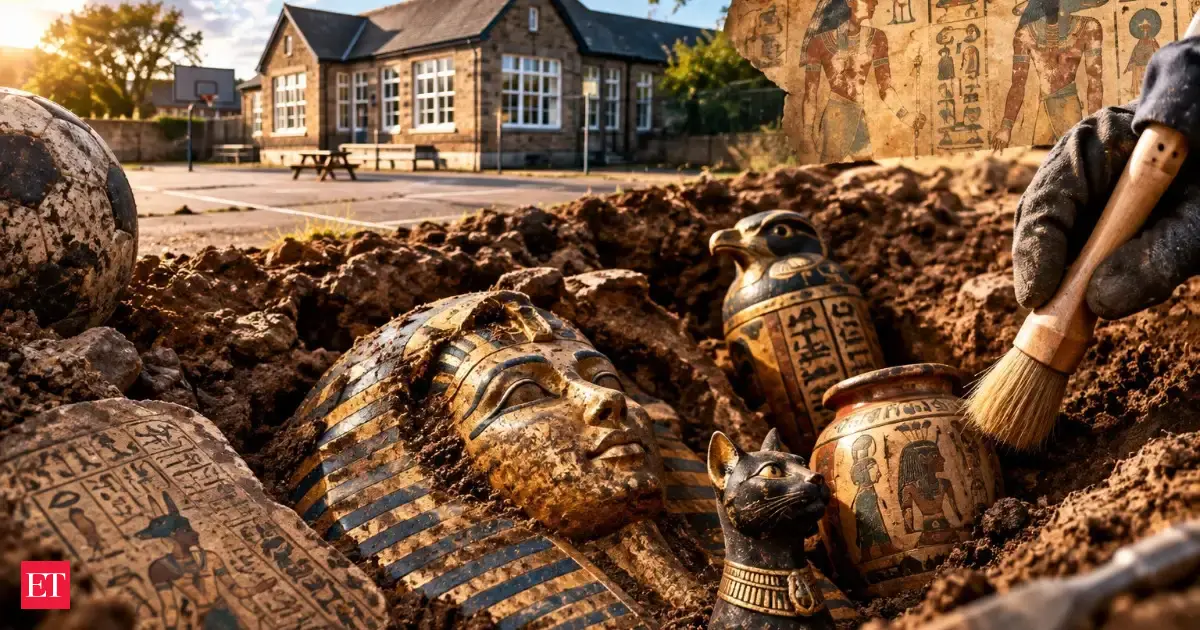
In 1952, a schoolboy assigned to garden duties at Melville House, a historic estate in Fife, Scotland, struck a hard object while digging for potatoes. Expecting a routine rock, the boy instead unearthed a finely sculpted red sandstone head belonging to an ancient Egyptian statue. The discovery marked the beginning of an extraordinary archaeological saga spanning more than three decades, during which successive chance finds on the estate grounds revealed a total of 18 ancient Egyptian antiquities. Dating back more than 2,500 years and spanning several distinct eras of ancient Egyptian history, the artifacts left researchers and Egyptologists with an unprecedented historical mystery. The sequence of discoveries, reported by the ET Science Desk, highlights the surprising presence of Nile Valley heritage buried deep within the soil of rural Scotland.
Key facts
What happened
The unfolding story of the Melville House antiquities is one of the most unusual chapters in modern British archaeology. Following the initial 1952 discovery of the sandstone statue head, the grounds of the estate remained quiet for fourteen years. In 1966, another pupil walking through the school grounds spotted a metallic object protruding from the soil. Upon extraction, the item was identified as an ancient Egyptian bronze statuette depicting the sacred Apis bull, a divine representation associated with fertility and strength in ancient Egyptian religion.
Eighteen years later, in 1984, history repeated itself a third time. A pupil exploring the estate with a metal detector received a strong signal that led to the excavation of a third major artifact: a bronze figurine depicting the goddess Isis nursing her infant son, Horus. This motif was central to ancient Egyptian religious devotion and later influenced iconography throughout the Mediterranean basin.
Following these repeated accidental discoveries, formal archaeological investigations and archival assessments were conducted to evaluate the property. Over time, researchers cataloged a total of 18 distinct ancient Egyptian objects retrieved from the Melville House estate. The collection includes stone sculptures, cast bronze statuettes, and small ceremonial objects. Scientific examination and stylistic analysis revealed that the artifacts were not uniform in age; rather, they originated from multiple distinct eras of Egyptian antiquity, extending from the Middle Kingdom through the Late Period and into the Ptolemaic era, with individual pieces created more than 2,500 years ago.
Why it matters
The recovery of 18 ancient Egyptian artifacts from a Scottish schoolyard provides a vivid case study in how global history, colonial-era trade, and elite travel transformed local landscapes thousands of miles from the Nile Delta. For modern museum curation and provenance studies, the Melville House assemblage offers rare insight into how private collections were assembled, relocated, and occasionally lost to history during the 19th and 20th centuries.
The findings highlight the challenges that historians face when contextualizing antiquities that lack formal excavation documentation. When artifacts enter private hands through 19th-century art markets, their precise archaeological context in Egypt—such as the specific tomb, temple, or settlement from which they were taken—is frequently lost. The discovery of such objects in non-traditional settings like a Scottish garden forces researchers to piece together provenance using estate inventories, diplomatic correspondence, and travel diaries alongside material analysis.
Furthermore, the discovery underscores the importance of public awareness regarding chance heritage finds. Without the curiosity of the schoolboys who recognized the unusual nature of the objects in 1952, 1966, and 1984, these significant artifacts might have remained unrecognized or permanently damaged by agricultural and landscape maintenance activities.
The background
To understand how 2,500-year-old Egyptian sculptures came to be buried beneath the soil of Fife, it is necessary to examine the history of Melville House and the broader cultural phenomenon of Victorian Egyptomania. Melville House was constructed between 1697 and 1700 as a country seat for George Melville, 1st Earl of Melville. For generations, the estate served as a primary residence for the Earls of Leven and Melville, a prominent Scottish noble family deeply involved in national politics, military service, and international affairs.
During the 19th century, European interest in Egyptian antiquities exploded. Following Napoleon Bonaparte's campaign in Egypt from 1798 to 1801 and Jean-François Champollion's decipherment of the Rosetta Stone in 1822, wealthy European elites developed an intense fascination with ancient Egyptian culture. Travel to Egypt became a fashionable component of the Grand Tour for young aristocrats, who often traveled up the Nile River to collect antiquities as souvenirs and prestige symbols.
Historical records indicate that Alexander Leslie-Melville, Viscount Balgonie (1831–1857), the eldest son of the 8th Earl of Leven, traveled to Egypt in 1856 to recover his health after serving in the Crimean War. During his stay in Egypt, Lord Balgonie acquired a collection of ancient artifacts from local dealers and excavation sites. Following his premature death in 1857, his collection was brought back to Melville House, where it was initially displayed in the family residence.
In the mid-20th century, as the economic realities of maintaining large country estates changed across the United Kingdom, Melville House was sold and repurposed. The building was converted into a residential school for boys. During this transition, or perhaps during earlier domestic reorganizations, parts of the family's antiquity collection were misplaced, discarded, or deliberately buried in the grounds, setting the stage for the accidental discoveries that began in 1952.
Reaction
The unveiling of the Melville House findings has drawn significant interest from the international archaeological community and Egyptologists worldwide. Curators at National Museums Scotland, who have worked to analyze and conserve the recovered artifacts, noted that the collection provides an extraordinary window into 19th-century antiquities collecting and private domestic displays.
Archaeologists have commended the preservation of the objects despite their decade-long burial in Scottish soil, which typically possesses higher moisture levels and different acidity compared to the arid desert climate of Egypt. Heritage experts in Scotland have pointed to the site as an example of how rural European estates can hold unexpected global historical treasures. Meanwhile, local historical societies in Fife have embraced the discoveries as a compelling element of the region's rich cultural narrative, bridging Scottish country house history with ancient Mediterranean civilization.
What we don't know yet
Despite extensive historical and archaeological research, several key questions about the Melville House collection remain unanswered. Researchers have yet to establish the exact reasons why the artifacts ended up buried underground. It remains unclear whether the items were interred deliberately for safekeeping during a period of estate renovation, discarded after sustaining accidental damage, or hidden by pupils as part of a forgotten prank or game.
Additionally, archaeologists cannot say with absolute certainty whether the 18 recovered artifacts represent the entirety of the collection buried on the estate. Given that the items were discovered in separate locations across decades of chance finds, additional antiquities could remain buried elsewhere on the property. Finally, because the original 19th-century purchase records are incomplete, the precise Egyptian archaeological sites where the items were originally excavated in the 1800s remain speculative.
What to watch
In the coming years, several developments are expected to further clarify the history of the Melville House artifacts. Researchers and curators are continuing to conduct non-invasive material analyses, including X-ray fluorescence and microscopic examination, to determine the exact geological origins of the stones and metals used in the objects.
Historians are also searching national and family archives for additional diaries, letters, or auction catalogs that might detail Lord Balgonie's 1856 trip to Egypt, which could confirm the exact purchase points of specific items. Furthermore, heritage authorities and academic institutions may organize targeted geophysical surveys using ground-penetrating radar across the unexcavated portions of the Melville House grounds to determine if additional buried artifacts exist. Public exhibitions featuring the reassembled collection are scheduled to take place at major museum facilities, allowing audiences to view these unique artifacts alongside the story of their Scottish discovery.
This report relies on original coverage provided by Muskan Singh for the ET Science Desk.
How this story was produced
This report was written by The Global Wire newsroom from reporting first published by Muskan Singh; ET Science Desk. We verify the core facts against the original report, write our own account, and add the background and consequences a short wire item leaves out. Drafting is AI-assisted inside an editor-supervised pipeline, and every story is checked for accuracy of attribution, structure and duplication before it appears — full detail in our AI and funding disclosure.
Spotted an error? Tell us at corrections@horizonglobalnews.com and read our corrections policy or editorial standards.






Reader comments
Loading comments…