

China Opens Pinglu Canal to Connect Southwestern Hinterland Directly to Maritime Trade Routes
The 134-kilometer engineering project in Guangxi cuts export distances for landlocked provinces and aims to accelerate economic integration with Southeast Asian markets.
By The Global Wire Newsroom · Reported from Malay Mail
Link preview · horizonglobalnews.com
China Opens Pinglu Canal to Connect Southwestern Hinterland Directly to Maritime Trade Routes
The 134-kilometer engineering project in Guangxi cuts export distances for landlocked provinces and aims to accelerate economic integration with Southeast Asian markets.
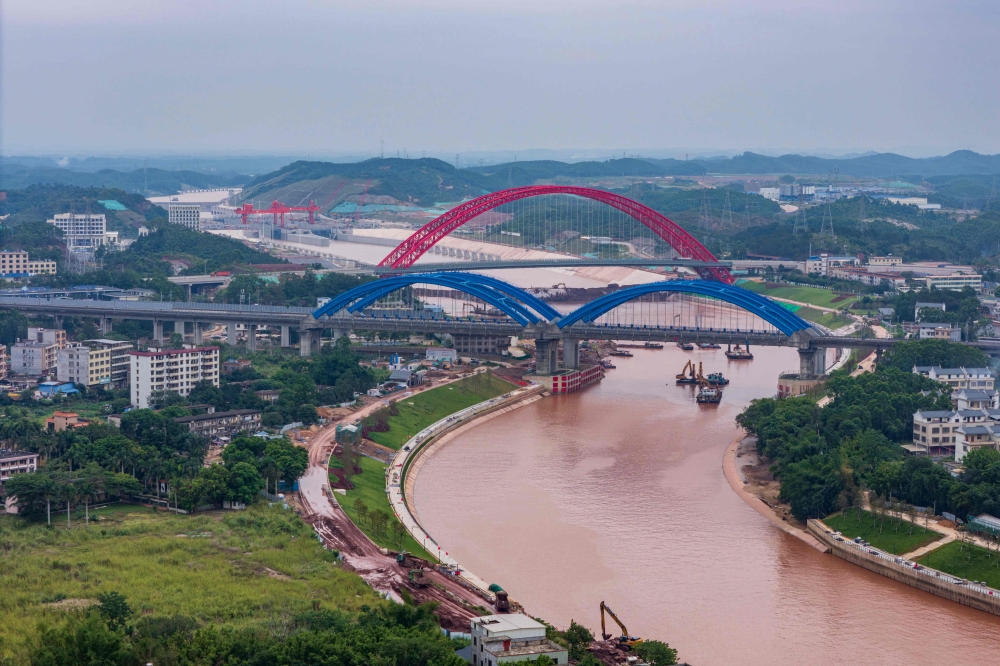
BEIJING — Chinese authorities officially opened the Pinglu Canal on September 16, 2026, inaugurating a transformative 134-kilometer artificial waterway engineered to connect the river systems of the country's southwestern hinterland directly to the ocean. Traversing the Guangxi Zhuang Autonomous Region, the newly operational channel establishes a direct water connection between the Yujiang River—a major upper tributary of the Pearl River system—and the Beibu Gulf at Qinzhou Port. By establishing an ocean-bound outlet in China's southern frontier, the infrastructure mega-project provides landlocked industrial regions across Sichuan, Yunnan, and Guizhou provinces, alongside the municipality of Chongqing, with a significantly shorter logistics corridor to Southeast Asia and global maritime trade routes, bypassing historic shipping bottlenecks in eastern coastal estuaries.
Key facts
What happened
According to reporting by Malay Mail, Chinese state media announced the operational launch of the Pinglu Canal on September 16, 2026, signaling the completion of one of China's most complex hydraulic engineering achievements in recent history. The opening initiated regular vessel movement along the artificial channel, allowing freight barges loaded with industrial goods, construction materials, and bulk commodities to traverse directly from inland river ports along the Xi River system down to deep-water marine berths on the Gulf of Tonkin.
Construction of the canal involved excavating more than 300 million cubic meters of earth and rock, cutting a navigable pathway across mountainous terrain and agricultural plains in Guangxi. Engineers constructed three massive lock structures—Luowu, Maling, and Qingnian—designed to navigate changing water levels and regulate hydraulic flow. These lock systems utilize automated water-saving mechanisms to maintain operating depths during dry seasons while blocking seawater from migrating upstream into agricultural reservoirs.
Before the Pinglu Canal came online, freight originating in landlocked southwestern regions like Sichuan, Guizhou, and Yunnan had to follow a circuitous route eastward down the Xi River to ports in Guangdong province, such as Guangzhou or Shenzhen, before being reloaded onto ocean vessels. Alternatively, producers relied on long-distance overland rail or road transit to access coastal export outlets. The Pinglu Canal diverts cargo traffic directly south from Nanning toward Qinzhou Port, transforming what was previously a thousands-of-kilometers long eastern shipping loop into a direct southern gateway to the sea.
Why it matters
The operational opening of the Pinglu Canal alters the economic landscape of southwestern China by lowering transport costs and reducing turnaround times for international trade. In freight logistics, waterborne shipping is dramatically cheaper per ton-kilometer than highway trucking or rail transport. By transferring high-volume heavy industrial outputs, raw minerals, chemical products, and agricultural goods onto river barges, manufacturers in inland provinces can significantly reduce logistics expenditures, making their goods more price-competitive across international markets.
The canal plays a strategic role in expanding trade between China and the Association of Southeast Asian Nations (ASEAN) under the framework of the Regional Comprehensive Economic Partnership (RCEP). ASEAN serves as China's largest trading partner, and establishing a direct maritime outlet in Guangxi reduces sailing times to major regional ports in Vietnam, Malaysia, Singapore, and Indonesia by several days compared to coastal departures from the Pearl River Delta or Yangtze River Delta.
Additionally, shifting freight traffic from highways and railways to inland waterways lowers energy consumption and greenhouse gas emissions per unit of transported cargo. The canal also provides relief to congested shipping channels along the lower Pearl River, offering a secondary logistical artery that enhances supply chain resilience against potential disruptions in eastern maritime hubs.
The background
The concept of constructing a navigable canal connecting Guangxi's inland river systems to the Gulf of Tonkin dates back to the late Qing dynasty and early 20th-century national infrastructure planners, who identified the strategic disadvantage of southwestern China's geography. Historically, landlocked southwestern provinces were isolated by mountainous topography, forcing industrial producers to rely on extended eastern river networks or costly mountain rail lines to move heavy cargo.
In 2019, the Chinese government integrated the canal project into its national development strategy for the New Western Land-Sea Corridor, an initiative aimed at connecting interior provinces with ocean trade networks through synchronized rail, sea, and river infrastructure. Official authorization followed, leading to the start of construction on the Pinglu Canal in August 2022. It represents the first comprehensive artificial shipping canal built in China since the expansion of the historic Grand Canal, which was originally constructed over two millennia ago to connect Beijing with eastern agricultural regions.
The project highlights China's ongoing strategy of using large-scale civil infrastructure investments to stimulate interior economic growth while balancing regional development. Historically, China's economic output was heavily weighted toward the eastern seaboard due to immediate maritime access. Interior regions, despite possessing rich natural resources and abundant labor, faced persistent cost disadvantages due to elevated freight tariffs. By building ocean access directly into Guangxi, planners aim to attract manufacturing, heavy industry, and processing sectors into interior industrial parks where operational overhead remains lower than in traditional eastern manufacturing zones.
Reaction
Industrial enterprises, freight operators, and maritime logistics companies throughout southern China have anticipated the canal's opening, expecting reduced transit fees and faster customs throughput along southern trade lanes. Municipal authorities in interior provinces including Sichuan, Chongqing, and Guizhou have developed specialized river-rail intermodal hubs designed to connect local manufacturing hubs with the Pinglu Canal corridor.
Logistics analysts and trade monitors note that the operational canal is likely to shift competitive dynamics among southern Chinese ports. While major maritime hubs in Guangdong will continue to dominate high-value containerized freight and international consumer exports, deep-water port terminals along the Beibu Gulf are structured to capture an expanding share of bulk raw material shipments, industrial equipment, and agricultural exports destined for Southeast Asia.
Environmental organizations and regional marine researchers have called for ongoing monitoring of local ecosystems, focusing on water quality preservation, fish migration patterns, and salinity balance near the canal's outlet in the Gulf of Tonkin. Chinese construction authorities stated that environmental protections, including ecological fish ladders and bio-engineered canal banks, were embedded into the construction framework to mitigate environmental impacts.
What we don't know yet
Despite the official launch of operations, several operational parameters remain to be seen. Toll rates, locking fees, and exact administrative pricing structures for commercial shipping lines navigating the canal have not been fully disclosed, making it difficult for logistics firms to calculate exact cost savings relative to existing rail and maritime routes.
Furthermore, the canal's capacity during extreme weather conditions—such as extended droughts affecting the upper Yujiang basin or severe typhoon seasons in the Gulf of Tonkin—remains untested under full-scale operational conditions. It also remains uncertain how quickly regional logistics providers will adjust existing supply chain contracts from Guangdong ports to the new Guangxi corridor, and whether connecting port infrastructure in Qinzhou can smoothly process increased barge traffic without experiencing localized delays.
What to watch
Key developments over the coming months will provide a clearer picture of the Pinglu Canal's operational integration and trade impact. Industry analysts will watch monthly freight volume and barge traffic data published by transport authorities in Guangxi to gauge commercial adoption rates among shipping lines.
Attention will also turn to the expansion of direct maritime routes operating out of Qinzhou Port, as ocean carriers evaluate new shipping schedules connecting the canal's sea terminal to major Southeast Asian ports like Singapore, Port Klang, and Haiphong. Additionally, observers will monitor local government investments in industrial infrastructure surrounding Nanning and Hengzhou, where local authorities are establishing inland trade zones and cold-chain storage facilities designed to capitalize on the new waterway.
This report is based on original news coverage and reporting provided by Malay Mail.
How this story was produced
This report was written by The Global Wire newsroom from reporting first published by Malay Mail. We verify the core facts against the original report, write our own account, and add the background and consequences a short wire item leaves out. Drafting is AI-assisted inside an editor-supervised pipeline, and every story is checked for accuracy of attribution, structure and duplication before it appears — full detail in our AI and funding disclosure.
Spotted an error? Tell us at corrections@horizonglobalnews.com and read our corrections policy or editorial standards.




Reader comments
Loading comments…