

Athletics Place Right-Hander J.T. Ginn on 15-Day Injured List With Elbow Impingement
The Athletics have sidelined starting pitcher J.T. Ginn due to an elbow impingement in his pitching arm, creating a roster opening as Major League Baseball enters its final regular-season month.
By The Global Wire Newsroom · Reported from Associated Press
Link preview · horizonglobalnews.com
Athletics Place Right-Hander J.T. Ginn on 15-Day Injured List With Elbow Impingement
The Athletics have sidelined starting pitcher J.T. Ginn due to an elbow impingement in his pitching arm, creating a roster opening as Major League Baseball enters its final regular-season month.
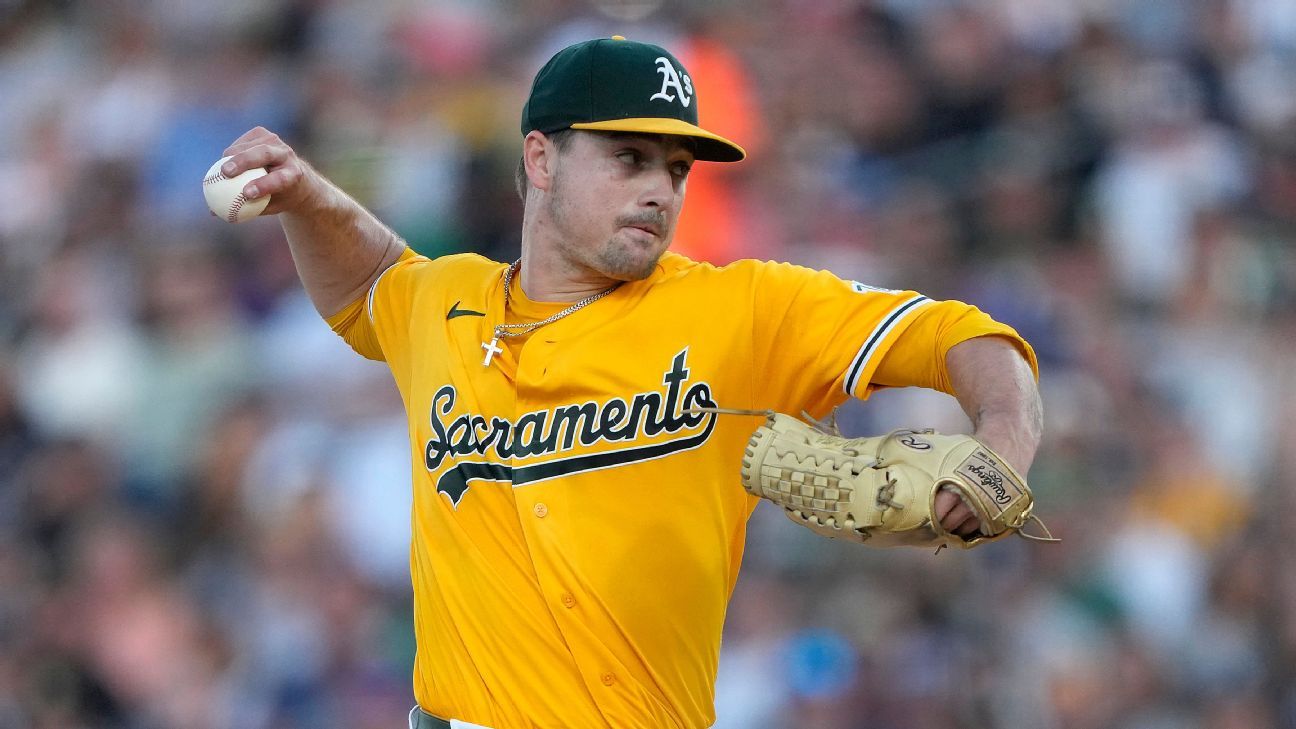
Athletics right-handed starting pitcher J.T. Ginn was placed on the 15-day Injured List on Saturday due to an elbow impingement in his pitching arm, according to reporting by the Associated Press. The transaction removes the starter from the team's active roster as Major League Baseball enters the final month of its 2026 regular season. The decision forces the Athletics to adjust their starting rotation management and active bullpen workload while medical personnel assess the severity of the joint issue in Ginn's throwing arm.
Key facts
What happened
The Athletics officially modified their active roster on Saturday by placing right-handed starting pitcher J.T. Ginn on the 15-day Injured List, citing an elbow impingement in his throwing arm. The move temporarily removes Ginn from the club's 26-man active roster, opening a slot that must be filled by a call-up from the minor league system or an activation from the emergency reserve.
In medical terms, an elbow impingement occurs when soft tissue, inflamed capsule material, or bony growth becomes pinched between the moving structures of the elbow joint during motion. For professional baseball pitchers, the condition frequently develops in either the posterior or anterior aspect of the joint as a consequence of repetitive, extreme mechanical stress. During a standard pitching delivery, the elbow joint experiences severe extension and rotation forces, which can lead to localized swelling, stiffness, pain upon full extension, or reduced terminal velocity.
Placing a player on the 15-day Injured List is the standard administrative mechanism Major League Baseball franchises use to manage physical ailments that require short-term rest or rehabilitation without removing the player from the overall 40-man organizational roster. Once designated on the 15-day Injured List, a pitcher cannot be activated for major league game competition until the full 15-day minimum window has elapsed from the effective start date of the placement.
Why it matters
The placement of a starting pitcher on the Injured List during September carries heightened administrative and operational consequences for a Major League Baseball franchise. Because the MLB regular season concludes in late September or early October, a 15-day minimum absence leaves very little time on the calendar for a pitcher to recover, complete a throwing progression, and return to competitive action before the schedule ends.
For a starting pitcher, returning from an arm injury requires more than simply waiting out the required 15 calendar days. Pitchers typically must undergo physical evaluation, remain symptom-free through flat-ground throwing sessions, progress to bullpen sessions, and often participate in simulated games or minor league rehabilitation appearances before being cleared for major league competition. If an impingement requires a complete shutdown from throwing for even one to two weeks, the calendar constraints of late season mean Ginn may face a tight timeline to pitch again in the 2026 regular season.
Operationally, Ginn's absence places additional strain on the Athletics' remaining pitching staff. Starting rotation slots must be absorbed either by shifting long relievers into spot-starting roles, utilizing bullpen games, or recalling starting pitchers from the team's Triple-A affiliate. Shortened starts or additional bullpen innings can cascade across a pitching staff, increasing the workload for relief pitchers during the final weeks of a long 162-game season.
From a health and career perspective, joint impingements in throwing arms require careful diagnostic monitoring. While an impingement is a joint-space issue rather than a structural ligament tear like the ulnar collateral ligament disruption that necessitates Tommy John surgery, unaddressed joint friction can alter a pitcher's arm slot or mechanics. Compensation for joint pain can lead to secondary strain on surrounding muscles, tendons, or ligaments, making proper conservative treatment or surgical debridement essential for long-term health.
The background
The rules governing roster management and injured list durations in Major League Baseball have undergone significant revision over recent collective bargaining cycles. Prior to 2017, major league teams utilized a standard 15-day Disabled List for all injured players. Under the 2017–2021 Collective Bargaining Agreement, league executives shortened the minimum stay to 10 days in an effort to allow teams to give players brief recovery periods without incurring heavy roster penalties.
However, front offices quickly adapted to the 10-day rule by using it strategically for pitchers. Teams frequently placed starting pitchers on the 10-day list between scheduled starts to rest their arms while cycling fresh relief pitchers onto the active 26-man roster. To curb this practice and protect player workload integrity, Major League Baseball and the Major League Baseball Players Association agreed to reinstate a separate 15-day Injured List specifically for pitchers ahead of the 2020 season. That rule was subsequently codified in the 2022 Collective Bargaining Agreement, maintaining a 10-day minimum for position players and a 15-day minimum for pitchers.
Ginn's injury occurs amid a broader, well-documented arm injury epidemic across professional baseball. Over the past decade, sports science and biomechanical monitoring have documented rising rates of elbow and shoulder injuries among major league and minor league pitchers. Industry analysts and medical professionals attribute this trend primarily to the pursuit of maximum pitch velocity and high spin rates. Modern pitching mechanics generate immense kinetic energy, creating mechanical torque on the elbow joint that approaches the upper limits of human anatomical endurance.
Elbow impingements in pitchers are often tied to repeated high-velocity throwing. Over time, the violent deceleration phase of the pitch can cause the olecranon process—the bony tip of the elbow—to impact the olecranon fossa at the back of the humerus. This repetitive contact can lead to localized bone spurs, cartilage erosion, or soft tissue inflammation. Treatment options range from rest, ice, and anti-inflammatory therapies to corticosteroid injections or minor arthroscopic surgery to clean out bone fragments and smooth joint surfaces during the offseason.
Reaction
The initial summary provided by the Associated Press did not include official comments from Athletics executives, manager, coaching staff, or J.T. Ginn. In accordance with Major League Baseball media protocols, official information regarding player health and roster changes is routinely provided during daily pre-game press conferences conducted by the team's manager, or through formal press bulletins distributed by the club's communications department.
Neither Ginn nor his representatives have issued public comments regarding the medical diagnosis or timeline for recovery. Furthermore, the Major League Baseball Players Association has not released any statement regarding the transaction, as routine injured list placements are standard administrative procedures governed by the collective bargaining agreement. Additional public statements from the club are anticipated following secondary medical evaluations and diagnostic imaging, such as magnetic resonance imaging scans evaluated by team orthopedic physicians.
What we don't know yet
Several key details regarding J.T. Ginn's injury and status remain unconfirmed in the available reporting:
What to watch
This report is based on original news coverage published by the Associated Press.
How this story was produced
This report was written by The Global Wire newsroom from reporting first published by Associated Press. We verify the core facts against the original report, write our own account, and add the background and consequences a short wire item leaves out. Drafting is AI-assisted inside an editor-supervised pipeline, and every story is checked for accuracy of attribution, structure and duplication before it appears — full detail in our AI and funding disclosure.
Spotted an error? Tell us at corrections@horizonglobalnews.com and read our corrections policy or editorial standards.


Reader comments
Loading comments…