

U.S., Chinese and Russian Leaders Convene First Trilateral Talks in Shenzhen
The leaders of the United States, China and Russia have opened unprecedented trilateral talks in Shenzhen, marking a historic summit among the three global powers.
By The Global Wire Newsroom · Reported from Ilaria Federico
Link preview · horizonglobalnews.com
U.S., Chinese and Russian Leaders Convene First Trilateral Talks in Shenzhen
The leaders of the United States, China and Russia have opened unprecedented trilateral talks in Shenzhen, marking a historic summit among the three global powers.
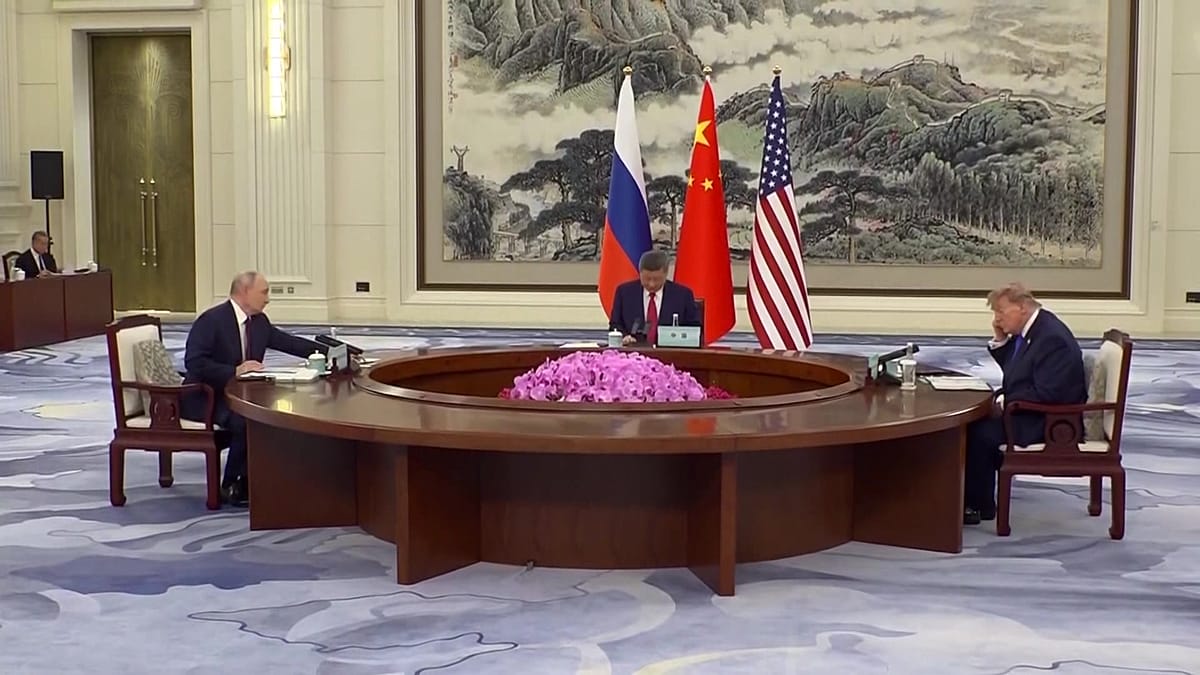
The leaders of the United States, China, and Russia have convened in the southern Chinese metropolis of Shenzhen to commence their first-ever trilateral talks, according to video reporting published by journalist Ilaria Federico. The unprecedented meeting brings together Donald Trump, Xi Jinping, and Vladimir Putin around the same table for direct, three-way negotiations, marking a departure from the traditional format of bilateral summits that has defined relations among the three nuclear-armed powers since the Cold War. Details regarding the formal agenda, the anticipated duration of the sessions, and whether the discussions will yield a joint communiqué or framework agreement were not immediately released as the opening session got underway in Guangdong province on Nov. 19.
Key facts
What happened
According to video reporting by Ilaria Federico, the heads of state of the world's three most powerful nations formally sat down together in Shenzhen to open high-level discussions. The broadcast captured Donald Trump, Vladimir Putin, and Xi Jinping assembling for what represents the first trilateral summit involving the American, Russian, and Chinese presidencies in modern history.
The meeting convened without the prior public release of a minute-by-minute itinerary. Visual documentation confirmed that the three leaders gathered in a formal conference setting in Shenzhen, China's premier southern economic zone adjacent to Hong Kong. The visual evidence shows the leaders seated at a communal negotiating table, signalling the start of substantive discussions among their respective delegations.
The initial reporting did not disclose the composition of the accompanying diplomatic and national security delegations, nor did it outline the planned sequencing of the talks—such as whether plenary discussions among all three leaders would be interspersed with bilateral breakout sessions. Representatives from the White House, the Kremlin, and the Chinese Ministry of Foreign Affairs did not immediately release prepared opening statements or specify the planned duration of the summit proceedings.
Why it matters
The convening of a trilateral summit among Washington, Beijing, and Moscow represents a fundamental structural development in contemporary international relations. For more than half a century, great-power diplomacy has operated through separate bilateral tracks: Washington and Moscow negotiated strategic arms limitations and European security frameworks, while Washington and Beijing focused on cross-Strait stability, regional security in the Asia-Pacific, and an immense bilateral trade relationship. A simultaneous three-way encounter creates a single forum where issues of global trade, strategic nuclear parity, regional territorial disputes, and international sanctions intersect directly.
For international markets, any shift in the dynamics between these three states carries profound consequences. Together, the United States and China account for over 40 percent of global gross domestic product, while Russia remains one of the world's preeminent producers of crude oil, natural gas, and enriched uranium. A reduction in friction or a coordinated understanding on trade restrictions, export controls on advanced semiconductors, and maritime transit could alleviate supply-chain uncertainty across Europe and Asia. Conversely, if the talks stall or produce acrimony, multinational corporations face the risk of accelerated economic fragmentation, intensified tariff regimes, and compounding sanctions.
From a security perspective, global arms control frameworks have deteriorated to near-total collapse. The bilateral New Strategic Arms Reduction Treaty (New START), which capped deployed strategic nuclear warheads at 1,550 for the United States and Russia, expired in early 2026 following years of suspension and non-inspection. Meanwhile, the Pentagon has repeatedly projected that China's operational nuclear arsenal is expanding rapidly toward 1,000 warheads. Washington has long insisted that future strategic stability arrangements must account for Beijing's growing arsenal, while China has historically maintained that its stockpile remains far smaller than those of the two legacy superpowers and should not be subject to tripartite caps. Placing the three leaders in the same room addresses this strategic triangle at its highest level.
The background
The concept of a triangular balance among Washington, Beijing, and Moscow traces its origins to the Cold War. In February 1972, U.S. President Richard Nixon and National Security Advisor Henry Kissinger travelled to Beijing to meet with Chairman Mao Zedong and Premier Zhou Enlai. That historic opening exploited ideological and territorial rifts between the Soviet Union and the People's Republic of China, which had culminated in border clashes along the Ussuri River in 1969. By establishing relations with Beijing, Washington gained diplomatic leverage against Moscow, compelling the Soviets to pursue détente and sign the Strategic Arms Limitation Talks (SALT I) agreement with the United States later that year.
Over the ensuing decades, the geometry of the triangle shifted. Following the dissolution of the Soviet Union in December 1991, Washington enjoyed a period of unmatched global primacy, while Moscow and Beijing gradually resolved their long-standing border demarcations. In 2001, Russia and China signed the Treaty of Good-Neighborliness and Friendly Cooperation, laying the groundwork for closer strategic alignment.
In recent years, the relationship between Beijing and Moscow deepened substantially. In February 2022, just weeks before Russia launched its full-scale invasion of Ukraine, Xi Jinping and Vladimir Putin issued a joint statement in Beijing proclaiming a "no-limits" partnership with "no forbidden areas of cooperation." Despite Western economic sanctions, Sino-Russian bilateral trade reached a record level exceeding $240 billion in 2023, driven by Chinese purchases of discounted Russian energy and Russian imports of Chinese manufactured goods, industrial machinery, and vehicles.
Simultaneously, U.S.-China relations experienced their most turbulent period in decades. Following the imposition of Section 301 tariffs by the first Trump administration in 2018 on more than $350 billion of Chinese imports, tensions expanded to encompass advanced technology restrictions, maritime boundaries in the South China Sea, and the status of Taiwan. While high-level bilateral summits occurred periodically—such as the November 2023 meeting between Joe Biden and Xi Jinping in Woodside, California, and various interactions during Donald Trump's first presidency, including his 2017 state visit to Beijing and the 2018 Helsinki summit with Putin—the three powers have never previously gathered in a trilateral presidential format.
The selection of Shenzhen as the host city holds historical and symbolic significance. Designated as China's first Special Economic Zone in August 1980 under the leadership of Deng Xiaoping, Shenzhen transformed from a modest fishing and agricultural county into a global metropolis of nearly 18 million residents. It serves as the headquarters for leading Chinese telecommunications and hardware firms, symbolising China's technological modernisation and integration into the global economy.
Reaction
Official international reactions to the opening of the Shenzhen summit were developing as news of the gathering emerged. Given the suddenness of the broadcast, allied governments and international organisations had not issued formal communiqués at the time of initial reporting.
European capitals are expected to monitor the talks with extreme scrutiny. Key members of the North Atlantic Treaty Organization (NATO) and the European Union have consistently viewed the strengthening axis between Moscow and Beijing as a direct challenge to the rules-based international order, particularly regarding European territorial integrity and the ongoing conflict in Ukraine. Leaders in Brussels, London, Paris, and Berlin will watch closely for any indication that Washington is pursuing unilateral agreements regarding European security architecture without direct allied consultation.
In the Indo-Pacific region, close American treaty allies, including Japan, South Korea, and the Philippines, are anticipating briefings through established diplomatic channels. The government in Tokyo has repeatedly expressed concern over joint Sino-Russian military patrols in the Sea of Japan and the East China Sea. Similarly, authorities in Taipei will evaluate whether cross-Strait security issues were raised during the trilateral exchanges or deferred to bilateral sidelines.
Multilateral bodies, including the United Nations Secretariat in New York, routinely welcome direct dialogue among permanent members of the UN Security Council. Under Chapter V of the United Nations Charter, the United States, China, and Russia hold three of the five permanent seats equipped with veto power. Diplomatic analysts note that formal statements are likely to emerge in upcoming press briefings at the State Department in Washington, the Russian Foreign Ministry in Moscow, and the Ministry of Foreign Affairs in Beijing.
What we don't know yet
Significant gaps remain in the publicly available reporting surrounding the Shenzhen meeting. The initial video disclosure confirms the physical presence of Trump, Putin, and Xi at a single negotiating table, but it leaves critical procedural and substantive questions unanswered.
First, the official agenda has not been disclosed. It remains unconfirmed whether the talks are designed to address a single pressing crisis—such as negotiated terms regarding the war in Ukraine or stabilizing maritime flashpoints—or whether they represent an open-ended dialogue covering strategic nuclear stability, trade tariffs, space weaponisation, and artificial intelligence safety.
Second, the format and duration of the summit are unknown. It is unclear whether the three leaders will hold one plenary session or conduct multi-day talks involving foreign and defence ministers. Furthermore, the reporting does not clarify whether bilateral meetings between Trump and Xi, Trump and Putin, or Putin and Xi will occur alongside the three-way talks.
Third, there is no public indication of whether the delegations intend to issue a joint statement, separate national summaries, or hold a joint press conference. The absence of confirmed deliverables leaves observers unable to verify whether the gathering was convened to formalise pre-negotiated agreements or merely to establish a diplomatic channel among the three leaders.
What to watch
The trajectory of global diplomacy in the immediate aftermath of the Shenzhen summit will depend on several concrete milestones over the coming days and weeks:
This report incorporates news reporting originally published by Ilaria Federico on Nov. 19, 2026.
How this story was produced
This report was written by The Global Wire newsroom from reporting first published by Ilaria Federico. We verify the core facts against the original report, write our own account, and add the background and consequences a short wire item leaves out. Drafting is AI-assisted inside an editor-supervised pipeline, and every story is checked for accuracy of attribution, structure and duplication before it appears — full detail in our AI and funding disclosure.
Spotted an error? Tell us at corrections@horizonglobalnews.com and read our corrections policy or editorial standards.





Reader comments
Loading comments…