

Trump Calls Putin a 'Friend' in Sideline Bilateral at Shenzhen APEC Summit
The first face-to-face encounter between the leaders in over a year drew swift backlash as Donald Trump offered a warm reception to Vladimir Putin in China.
By The Global Wire Newsroom · Reported from Travis Gettys
Link preview · horizonglobalnews.com
Trump Calls Putin a 'Friend' in Sideline Bilateral at Shenzhen APEC Summit
The first face-to-face encounter between the leaders in over a year drew swift backlash as Donald Trump offered a warm reception to Vladimir Putin in China.
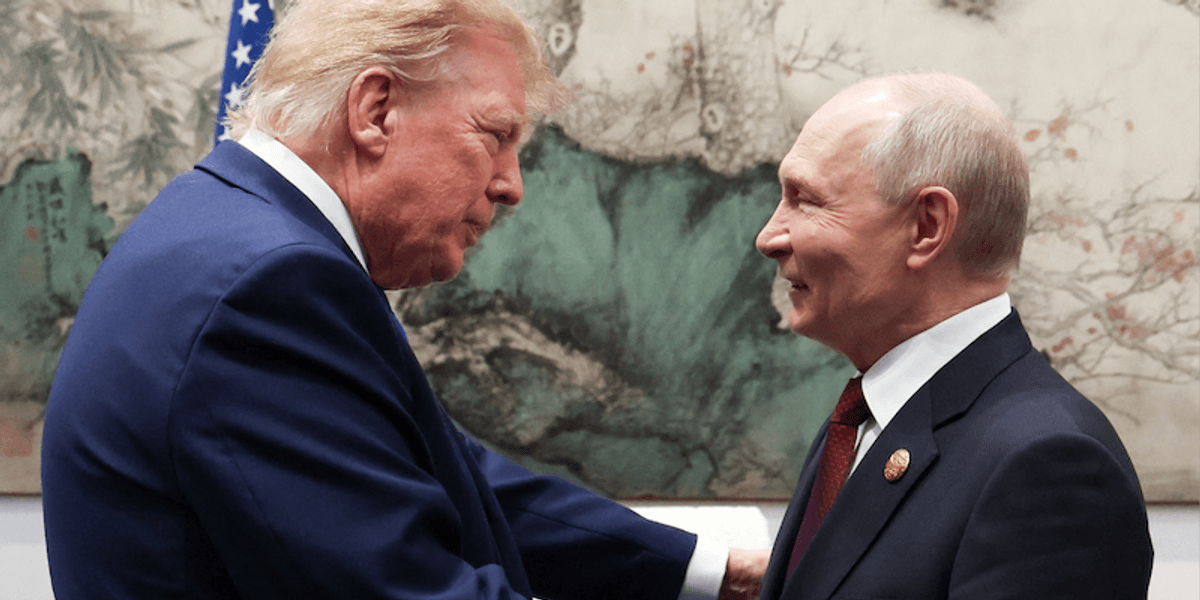
SHENZHEN, China — U.S. President Donald Trump and Russian President Vladimir Putin met face-to-face on Thursday on the sidelines of the Asia-Pacific Economic Cooperation summit in Shenzhen, China, marking the first in-person encounter between the two leaders in more than a year. The interaction immediately sparked controversy when Trump, appearing visibly enthusiastic before assembled media pools, turned toward the Russian leader and introduced him with warm personal praise, asking aloud, "Who is he?" before answering, "He’s my friend." The high-profile bilateral encounter took place amid intense global friction over the continuing war in Ukraine, expanding strategic alignment between Moscow and Beijing, and growing unease among European allies regarding the posture of American foreign policy toward the Kremlin.
Key facts
What happened
According to reporting by Travis Gettys, the encounter unfolded during the scheduled proceedings of the annual APEC leaders' gathering in Shenzhen. As diplomatic pools gathered for photo opportunities ahead of their private talks, Trump approached Putin with open warmth. Instead of maintaining standard diplomatic reserve, the American president offered an upbeat, beaming reception, gesturing toward Putin and delivering his informal, personal introduction directly in front of attending officials and reporters.
Following the public greeting, the two delegations convened for bilateral discussions behind closed doors. While the specific agenda points and negotiated outcomes of the discussion were not immediately detailed in early dispatches, the setting of the encounter was notable. APEC, an organization founded in 1989 that encompasses 21 Pacific Rim member economies, is traditionally structured around multilateral trade liberalization, investment facilitation, and economic integration. However, bilateral side meetings frequently overshadow the formal communique, offering world leaders an arena to address urgent bilateral security dilemmas away from their home capitals.
Photographs and broadcast footage from the Shenzhen conference center captured both leaders exchanging pleasantries before entering the private negotiating room, flanked by their respective diplomatic and national security aides. The public display of camaraderie between Washington and Moscow stood in sharp contrast to the frosty, compartmentalized engagements typical of high-level diplomatic contacts between the United States and the Russian Federation in recent years.
Why it matters
The tone and visual optics of any face-to-face summit between American and Russian heads of state carry immediate, tangible consequences for international security, alliance structures, and financial markets. Trump's open declaration of personal friendship with Putin undermines the diplomatic consensus established among North Atlantic Treaty Organization (NATO) allies, who have spent years isolating Moscow economically, culturally, and diplomatically. For allied governments in Eastern and Northern Europe—particularly the Baltic states of Estonia, Latvia, and Lithuania, alongside Poland and Finland—a normalized, cordial rapport between the American executive and the Kremlin signals potential fissures in the transatlantic security umbrella.
Beyond Europe, the Shenzhen encounter affects the delicate balance of Pacific diplomacy. As Washington navigates tense trade and technology disputes with Beijing, the public display of warmth between Trump and Putin inside China complicates multilateral efforts to counter non-market economic practices and coercive statecraft. For international energy and commodities markets, any hint that Washington might seek a separate accommodation or de-escalation with Moscow can influence benchmark crude pricing, sanctions-compliance compliance frameworks for maritime shipping, and multinational corporate risk assessments. Moreover, by framing a head-of-state relationship through the lens of personal affinity rather than institutional strategic interest, such meetings inject unpredictability into long-standing bilateral deterrence frameworks, including nuclear arms control mechanisms and strategic stability dialogues that have languished since the suspension of the New START treaty.
The background
The complex dynamic between Donald Trump and Vladimir Putin stretches back more than a decade, marked by persistent controversy, congressional inquiries, and dramatic breaks with traditional American diplomatic protocol. During his first presidential administration from 2017 to 2021, Trump consistently spoke of Putin in complimentary terms, frequently expressing a desire to establish normalized commercial and diplomatic ties with Russia. The two leaders first met on the sidelines of the Group of 20 (G20) summit in Hamburg, Germany, in July 2017, followed by a formal bilateral summit in Helsinki, Finland, in July 2018. The Helsinki meeting sparked intense domestic criticism across the American political spectrum after Trump appeared to credit Putin’s personal denials regarding Russian interference in the 2016 U.S. presidential election over the verified assessments of U.S. intelligence agencies.
Subsequent bilateral sessions occurred at the G20 gathering in Osaka, Japan, in June 2019, alongside numerous telephone exchanges. Throughout that tenure, however, professional foreign policy and national security institutions within the U.S. government maintained a stringent policy toward Moscow, imposing sweeping rounds of punitive sanctions, expelling Russian intelligence officers, and arming Ukrainian military units with defensive weapons systems, including FGM-148 Javelin anti-tank missiles.
Relations between Washington and Moscow severed almost entirely following Russia's full-scale invasion of Ukraine in February 2022. The United States and its European allies responded by freezing Russian central bank reserves, imposing unprecedented export controls on microelectronics and industrial machinery, and funding extensive military aid packages for Kyiv. In March 2023, the International Criminal Court in The Hague issued an arrest warrant for Putin concerning alleged war crimes, severely restricting his ability to travel to nations bound by the Rome Statute. However, non-signatory nations such as China have continued to host the Russian president, treating him as a full head of state. The Shenzhen APEC summit provided a legally uninhibited forum for Putin to participate in direct, high-level multilateral diplomacy.
Reaction
The immediate response to the Shenzhen greeting was characterized by sharp alarm among foreign policy analysts and commentators. Reporting by Travis Gettys highlighted that external observers greeted the interaction with visible dismay, describing the spectacle of an American president beaming and warmly introducing the Russian leader as "absolutely horrific" given the backdrop of the war in Ukraine and documented human rights violations.
Formal political reactions are expected to break down along familiar institutional and partisan lines. Members of the foreign affairs and intelligence committees in the U.S. Senate and House of Representatives are anticipated to demand comprehensive readouts from the State Department and the National Security Council regarding the exact commitments, assurances, or private understandings discussed behind closed doors. Democratic lawmakers and traditional national security conservatives typically criticize unscripted, informal praise of authoritarian leaders as a dereliction of democratic leadership that demoralizes allied states fighting Russian aggression. Conversely, Trump's staunchest congressional defenders routinely argue that personal diplomacy and direct rapport with foreign adversaries represent pragmatic statecraft aimed at avoiding direct military conflict between nuclear-armed superpowers.
European capitals, particularly Brussels, London, and Berlin, are expected to closely scrutinize the meeting's aftermath for any indications of weakening American resolve regarding economic sanctions enforcement or military support packages. Ukrainian officials in Kyiv have consistently cautioned that any normalization of bilateral contact between Washington and Moscow that bypasses Ukrainian interests risks rewarding territorial aggression and destabilizing the European continent.
What we don't know yet
Significant gaps remain regarding the substantive policy outcomes of the Shenzhen meeting. The available reporting does not clarify whether the two leaders conducted their talks alone with only designated language interpreters present—a practice Trump utilized during their controversial 2018 Helsinki encounter—or whether institutional national security advisers, such as the Secretary of State and National Security Advisor, participated in the substantive discussions. The presence of institutional note-takers is critical for maintaining permanent government records and ensuring that security agencies can verify what was promised or agreed upon.
Furthermore, the initial reports do not specify whether the leaders addressed concrete points of contention, such as the resumption of nuclear arms control negotiations, the status of detained foreign nationals in Russian penal colonies, or potential frameworks for cease-fire negotiations in Eastern Europe. It remains unverified whether Trump offered any prospective relief from existing executive-branch sanctions or if Putin presented specific preconditions for diplomatic de-escalation. The absence of an immediate joint communique or shared policy statement leaves the precise diplomatic achievements or compromises of the session completely unconfirmed.
What to watch
In the coming days and weeks, several concrete milestones will reveal the practical impact of the Trump-Putin encounter in Shenzhen. Observers should watch closely for official declassified readouts or formal statements issued by both the White House National Security Council and the Russian Foreign Ministry in Moscow. The degree of convergence or divergence between the American and Russian summaries of the meeting will offer crucial insight into whether substantive agreements were reached or if the cordial public greeting masked deep policy impasses.
Domestically, congressional leaders may schedule oversight hearings to question administration officials regarding the summit, focusing particularly on whether any informal agreements were struck concerning bilateral intelligence sharing, technology transfer restrictions, or sanctions enforcement. Abroad, attention will shift to the scheduled meetings of European foreign ministers and NATO defense ministerial consultations, where allied leaders will seek explicit reassurances from Washington that American commitments to collective defense under Article 5 remain absolute.
Finally, observers must monitor any shifts in front-line military activity in Ukraine or changes in Kremlin rhetoric regarding potential diplomatic negotiations. If Moscow interprets Trump's friendly overture as a sign of imminent Western division, it could alter its operational calculations on the battlefield or harden its negotiating posture in international forums.
This report incorporates details originally reported by journalist Travis Gettys, who documented President Donald Trump's public greeting of Russian President Vladimir Putin at the APEC summit in Shenzhen.
How this story was produced
This report was written by The Global Wire newsroom from reporting first published by Travis Gettys. We verify the core facts against the original report, write our own account, and add the background and consequences a short wire item leaves out. Drafting is AI-assisted inside an editor-supervised pipeline, and every story is checked for accuracy of attribution, structure and duplication before it appears — full detail in our AI and funding disclosure.
Spotted an error? Tell us at corrections@horizonglobalnews.com and read our corrections policy or editorial standards.






Reader comments
Loading comments…