

Study Models Health Toll of Compound Heatwaves and Smog in a Warming Climate
Research in npj Clean Air uses 2018 and 2019 extreme weather storylines to demonstrate how higher global temperatures worsen the combined public health toll of toxic air and severe heat.
By The Global Wire Newsroom · Reported from Shen; Fuzhen; Hegglin; Michaela I; Emmerichs; Tamara; Taraborrelli; Domenico; Zhao; Qi
Link preview · horizonglobalnews.com
Study Models Health Toll of Compound Heatwaves and Smog in a Warming Climate
Research in npj Clean Air uses 2018 and 2019 extreme weather storylines to demonstrate how higher global temperatures worsen the combined public health toll of toxic air and severe heat.
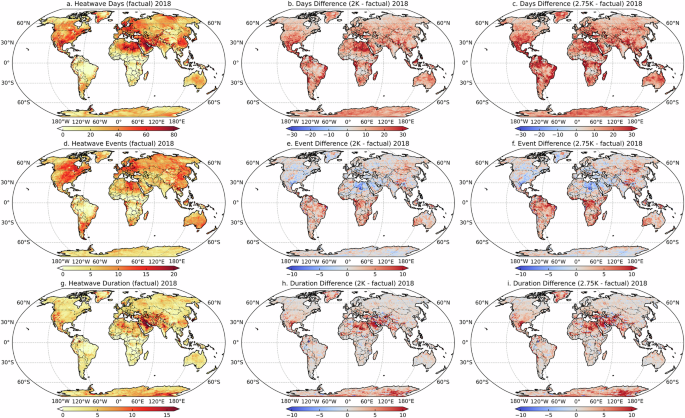
Atmospheric researchers and environmental health scientists have modeled how the co-occurrence of extreme heatwaves and ambient air pollution intensifies global health risks under escalating climate baselines, according to a peer-reviewed study published in the journal npj Clean Air. Authored by Fuzhen Shen, Michaela I. Hegglin, Tamara Emmerichs, Domenico Taraborrelli, and Qi Zhao, the investigation adopts an event-based storyline methodology using the historically severe meteorological events of 2018 and 2019. The findings provide critical insight into how physical interactions between elevated surface temperatures and atmospheric pollutants amplify population vulnerability across diverse geographic regions, addressing persistent analytical gaps in climate epidemiological forecasting.
Key facts
What happened
To capture how compound environmental extremes behave as global average temperatures climb, the research team constructed a physical storyline simulation anchored in real-world observations from 2018 and 2019. Rather than relying on traditional multi-decadal mean projections that frequently smooth out short-lived meteorological spikes, the authors examined how the specific, high-impact weather anomalies of those consecutive years would unfold across a world subjected to additional warming.
During 2018 and 2019, severe heat episodes swept across the Northern and Southern Hemispheres, shattering local temperature records, triggering prolonged atmospheric stagnation, and promoting conditions ripe for hazardous air pollution. Shen, Hegglin, Emmerichs, Taraborrelli, and Zhao analyzed the regional atmospheric dynamics that govern both thermal extremes and the concentration of harmful surface pollutants. By preserving the observed synoptic atmospheric circulation of the 2018–2019 baseline while scaling the underlying thermodynamic conditions, the study evaluated the resulting changes in exposure levels and associated mortality burdens.
The authors demonstrated that regional responses to additional warming are far from uniform. In several heavily populated continental areas, higher baseline temperatures accelerate the photochemical production of secondary air pollutants and lengthen the duration of stagnant air masses. Consequently, the research shows that public health burdens expand disproportionately when heatwaves and air pollution overlap, revealing regional vulnerabilities that conventional, uncoupled climate impact assessments fail to detect.
Why it matters
Public health authorities and civil protection systems have historically managed extreme heatwaves and air quality emergencies through siloed administrative frameworks. Meteorological agencies issue heat advisories based on thermodynamic heat index calculations, while environmental ministries dispatch smog alerts based on air monitoring stations measuring fine particulate matter (PM2.5) or ground-level ozone. In nature, however, these phenomena frequently arise from identical atmospheric conditions, producing a synergistic shock to human physiology that exceeds the sum of their individual hazards.
When populations endure intense heat, cardiovascular and thermoregulatory systems experience severe stress as the body redirects blood flow to the skin and accelerates perspiration to shed thermal load. Breathing air laden with elevated ozone or particulate matter at the same time introduces systemic pulmonary inflammation, oxidative stress, and heightened blood viscosity. For vulnerable demographics—including older adults, children, outdoor workers, and people with pre-existing cardiopulmonary disorders—concurrent exposure exponentially increases hospital admissions and excess mortality.
For municipal managers, urban planners, and hospital systems, the implications of this study are operational and immediate. If regional atmospheric warming systematically boosts localized air pollution during extreme heat, emergency medical systems must prepare for compound surges in respiratory and cardiac distress rather than isolated heatstroke cases. Furthermore, energy grid operators face simultaneous challenges: power generation efficiency declines in extreme heat even as cooling demand spikes, which can increase fossil fuel combustion from peaker power plants and worsen regional air quality precisely when atmospheric dispersion is at its lowest.
The background
The years 2018 and 2019 stand among the most critical benchmarks in modern climate science. In 2018, extensive heatwaves and concurrent droughts struck Scandinavia, Western Europe, East Asia, and North America, contributing to extensive agricultural losses and major wildfire seasons in California and the Arctic Circle. The following year, 2019, confirmed a trajectory of intensifying extremes: Western Europe observed historic heatwaves that saw absolute all-time temperature records eclipsed in France, Belgium, Germany, the Netherlands, and the United Kingdom, while catastrophic bushfires engulfed tens of millions of hectares across eastern Australia.
Atmospheric scientists have long recognized that persistent high-pressure systems, known as anticyclones or atmospheric blocking patterns, create the meteorological conditions necessary for severe summer heatwaves. These blocking patterns generate sustained clear skies, maximum solar radiation, descending warm air, and low surface wind speeds. These identical physical conditions also catalyze the formation of ground-level ozone, an atmospheric oxidant formed when nitrogen oxides and volatile organic compounds react in the presence of intense sunlight and heat. Concurrently, stagnant air traps primary emissions and fine particulates close to the surface, while heat-induced wildfires and desiccated topsoil generate vast volumes of smoke and mineral dust.
Despite widespread awareness of these physical connections, integrating air chemistry and climate epidemiology into localized health forecasts has proven challenging. The Intergovernmental Panel on Climate Change (IPCC) has underscored that compound climate hazards represent an escalating risk under all emissions trajectories. However, conventional global climate models operate at spatial resolutions that struggle to resolve fine-scale photochemical interactions, local topography, and urban heat island effects. The storyline approach deployed by Shen and colleagues circumvents statistical averaging by interrogating how concrete, documented weather disasters would worsen under a higher planetary energy balance.
Reaction
The methodologies and findings presented in npj Clean Air align with an escalating international push among environmental epidemiologists and atmospheric physicists for unified extreme-event forecasting. Research organizations and public health institutions, including the World Health Organization (WHO) and the World Meteorological Organization (WMO), have increasingly urged national member states to decommission separate warning protocols in favor of integrated multi-hazard early warning systems.
Public health specialists focused on environmental exposures have pointed to the study as empirical reinforcement for revising clinical emergency protocols. While traditional heat response guidelines advise opening municipal cooling centers, public health researchers emphasize that cooling infrastructure must incorporate high-efficiency particulate air filtration systems; otherwise, bringing vulnerable individuals into unconditioned or unpurified public shelters during joint heat-and-pollution events fails to mitigate pulmonary threats.
Regulatory agencies, such as the European Environment Agency and the United States Environmental Protection Agency, face continuing calls from the scientific community to coordinate ozone and particulate compliance targets with regional climate adaptation strategies. The publication is expected to inform deliberations within atmospheric chemistry working groups and influence technical planning ahead of upcoming United Nations climate negotiations and clean air forums.
What we don't know yet
Despite the insights generated by the study, several scientific questions remain unaddressed. Chief among them is the exact quantitative interplay between specific industrial emission reductions and regional heat-pollution feedback loops. As economies transition toward renewable energy, changes in local precursor pollutants—such as reductions in vehicular nitrogen oxides—may alter regional atmospheric chemistry regimes in complex ways, occasionally driving localized increases in surface ozone under specific chemical environments.
Additionally, substantial empirical gaps persist regarding human physiological responses in developing nations across the Global South. A significant portion of epidemiological research linking concurrent air pollution and temperature extremes is derived from cohorts in North America, Europe, and East Asia. Regions across South Asia, Central Africa, and South America often experience significantly higher baseline concentrations of particulate matter alongside extreme absolute temperatures, but possess fewer ambient monitoring stations and digitized clinical health records. How compounding hazards manifest across populations characterized by lower baseline access to mechanical cooling, differing housing structures, and unique underlying disease burdens remains an urgent area requiring field validation.
What to watch
In the months and years ahead, observers should track several key developments across environmental policy and climate research. First, monitor whether national weather agencies begin formally piloting joint heat-pollution indices that provide the public with a unified operational metric representing simultaneous thermodynamic and air quality stress.
Second, watch the development of municipal heat action plans across major metropolitan areas in North America, Europe, and Asia. City governments are increasingly pressured to audit whether public emergency shelters possess advanced mechanical filtration capable of scrubbing fine particulate matter during concurrent wildfire and heat episodes.
Third, examine the technical contributions prepared for the IPCC's upcoming Seventh Assessment cycle. The operational use of the storyline approach by Shen and colleagues provides a methodological framework likely to be evaluated and built upon by regional climate working groups seeking to capture physical extremes with greater regional fidelity. Finally, observe statutory revisions to ambient air quality standards internationally, assessing whether regulatory frameworks incorporate the reality that escalating summer heat baselines make traditional clean air benchmarks significantly harder to attain without deeper cuts to precursor emissions.
This article is based on peer-reviewed research conducted by Fuzhen Shen, Michaela I. Hegglin, Tamara Emmerichs, Domenico Taraborrelli, and Qi Zhao, published in the scientific journal npj Clean Air.
How this story was produced
This report was written by The Global Wire newsroom from reporting first published by Shen; Fuzhen; Hegglin; Michaela I; Emmerichs; Tamara; Taraborrelli; Domenico; Zhao; Qi. We verify the core facts against the original report, write our own account, and add the background and consequences a short wire item leaves out. Drafting is AI-assisted inside an editor-supervised pipeline, and every story is checked for accuracy of attribution, structure and duplication before it appears — full detail in our AI and funding disclosure.
Spotted an error? Tell us at corrections@horizonglobalnews.com and read our corrections policy or editorial standards.




Reader comments
Loading comments…