

Russian Forces Tow Damaged Cargo Vessel After Drone Strike Near Finnish Waters
A salvage operation is underway in the Baltic Sea after a military-linked Russian cargo ship was disabled in an apparent drone strike near Finland's maritime perimeter.
By The Global Wire Newsroom · Reported from Nela Heidner
Link preview · horizonglobalnews.com
Russian Forces Tow Damaged Cargo Vessel After Drone Strike Near Finnish Waters
A salvage operation is underway in the Baltic Sea after a military-linked Russian cargo ship was disabled in an apparent drone strike near Finland's maritime perimeter.
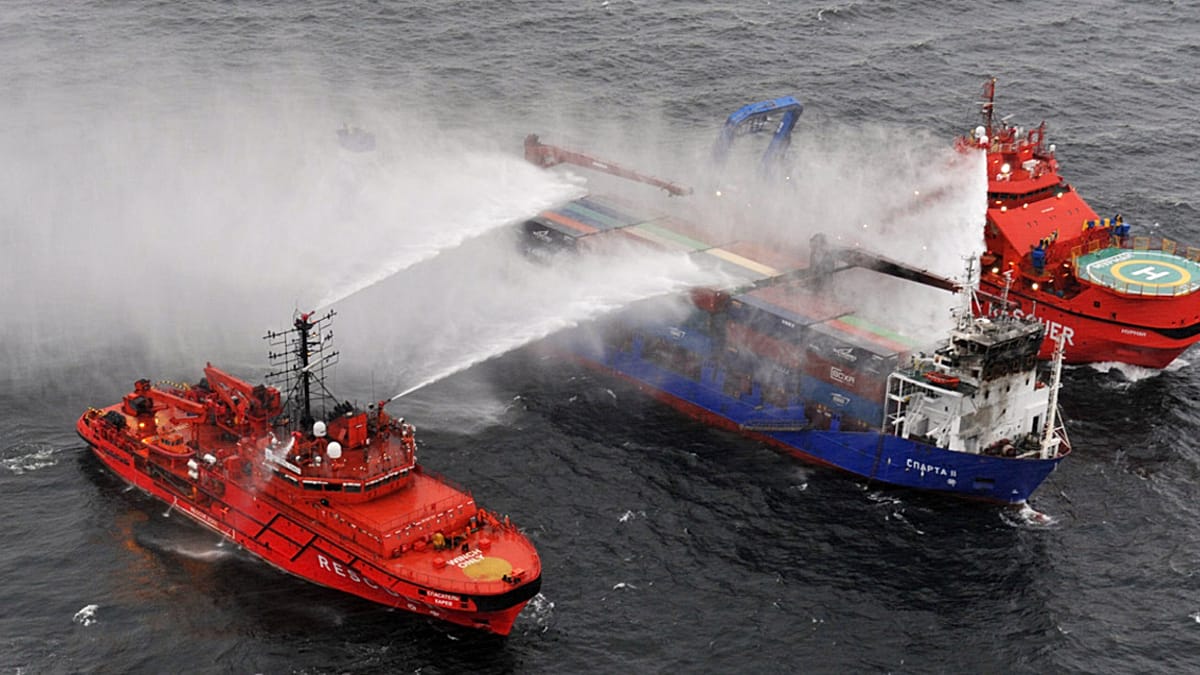
Russian maritime authorities have initiated a salvage operation to tow a damaged cargo vessel linked to military logistics following a suspected Ukrainian drone strike near Finnish territorial waters in the Baltic Sea, according to reporting by Nela Heidner. The incident, which unfolded in one of Northern Europe's most heavily monitored and strategically delicate waterways, marks a critical geographic expansion of maritime combat operations that were previously concentrated primarily within the Black Sea theater. The targeting of a logistics hull operating within proximity to European Union and NATO maritime boundaries has triggered immediate security concerns across the littoral states of the Baltic, where surveillance assets and coast guard patrols have maintained elevated readiness for months.
Key facts
What happened
According to reporting by Nela Heidner, the transport vessel was operating in the international shipping corridors of the Baltic Sea in the vicinity of Finnish waters when it sustained disabling damage attributed to an uncrewed drone strike. Russian salvage tugs were subsequently dispatched to secure the hull, stabilize its buoyancy, and begin towing the platform toward safe anchorage or repair facilities under Russian jurisdiction.
Details released through initial reports indicate that the ship was operating in support of military or state logistics requirements. While the specific class of uncrewed system employed—whether an aerial long-range loitering munition or an uncrewed surface vessel (USV)—has not been formally certified by regional defense ministries, the physical aftermath required immediate assistance from maritime rescue units. Russian state agencies undertook the towing effort to prevent the vessel from drifting into commercial transit lanes or running aground along the shallow, rocky archipelagos that characterize the Gulf of Finland's northern approaches.
Maritime tracking patterns in the northern Baltic typically route deep-draft transport vessels through well-defined traffic separation schemes designed to avoid shoals. Navigational traffic in these zones is continuously logged by both coastal Vessel Traffic Services (VTS) centers in Helsinki and Tallinn and military radar installations positioned throughout the Gulf of Finland. The intervention by Russian recovery vessels occurred under close observation from neighboring maritime enforcement agencies, which routinely monitor any disabled or combat-damaged hulls traversing adjacent exclusive economic zones.
Why it matters
The extension of maritime strikes into the Baltic basin carries profound operational and commercial ramifications for regional security, international trade, and international maritime law. The Baltic Sea is among the most congested maritime routes in the world, with more than 2,000 commercial ships navigating its waters on any given day, carrying crude oil, refined fuels, containerized goods, and bulk minerals. A direct strike on a transport vessel in this semi-enclosed body of water significantly increases the war-risk insurance premiums for all commercial maritime operators servicing regional ports, regardless of flag state.
From a strategic perspective, the incident demonstrates that the reach of asymmetric uncrewed strike capabilities is no longer bounded by the Black Sea perimeter. If confirmed as an operation executed or directed by Ukrainian forces, the strike establishes that Russian maritime logistics chains operating from primary Baltic ports—including Ust-Luga, Primorsk, Kronstadt, and Saint Petersburg—are subject to interception hundreds of nautical miles away from Ukraine's territory. This alters the risk calculus for the Russian Ministry of Defence, which relies on Baltic sea lanes to sustain and supply its isolated Baltic Fleet garrison and the heavily militarized Kaliningrad exclave, situated between Poland and Lithuania.
Furthermore, the close proximity of the strike to Finnish territorial waters directly tests NATO's maritime posture. Following Finland's formal accession to NATO in April 2023 and Sweden's accession in March 2024, the Baltic Sea has been widely categorized by Western defense analysts as a strategic interior sea for the alliance. An kinetic action occurring on the threshold of allied territorial waters creates immediate navigational hazards, environmental dangers from potential fuel leakage or cargo combustion, and the distinct possibility of accidental collateral damage against neutral merchant traffic.
The background
Since the launch of Russia's full-scale invasion of Ukraine in February 2022, maritime warfare has undergone a profound technological transformation driven primarily by Ukraine's development and deployment of indigenous uncrewed platforms. In the Black Sea, Ukrainian forces employed Magura V5 and Sea Baby surface drones, alongside aerial strike systems, to systematically target the Russian Black Sea Fleet. Those operations succeeded in damaging or sinking capital warships, including amphibious landing platforms and missile corvettes, forcing the Russian navy to withdraw major surface combatants from Sevastopol to Novorossiysk.
While the Black Sea witnessed repeated kinetic maritime engagements, the Baltic Sea remained largely characterized by asymmetric shadow competition, surveillance friction, and infrastructure vulnerability. Over the past three years, the Baltic littoral has experienced several severe incidents involving critical subsea infrastructure. In September 2022, underwater detonations crippled the Nord Stream 1 and 2 natural gas pipelines in international waters near Bornholm Island. In October 2023, the Balticconnector natural gas pipeline and an adjacent telecommunications cable connecting Finland and Estonia were severed by a dragged anchor from a commercial container carrier, prompting NATO to establish specialized maritime critical infrastructure monitoring cells.
Russian military logistics in the Baltic rely heavily on a fleet of civilian-flagged and state-owned commercial vessels operating under government contracts. These roll-on/roll-off (Ro-Ro) vessels and general cargo ships routinely transport armaments, dual-use supplies, construction materials, and mechanized equipment between continental Russia, the Kaliningrad Special Region, and overseas operational points such as naval logistics centers in the Mediterranean. These movements are legally regulated by the 1982 United Nations Convention on the Law of the Sea (UNCLOS), which guarantees the freedom of navigation in international waters and the right of innocent passage through territorial seas, even as coastal states maintain strict radar and aerial surveillance over Russian-flagged traffic.
Finland shares an extensive maritime border with Russia in the Gulf of Finland, where transit corridors run remarkably close to sovereign territory. The Gulf narrows considerably east of Hogland Island, creating bottleneck corridors where naval assets, commercial oil tankers of Russia's so-called dark fleet, and standard cargo carriers navigate in close proximity. Regional coast guards, led by the Finnish Border Guard (Rajavartiolaitos) and the Estonian Police and Border Guard Board, have maintained round-the-clock surface monitoring to prevent navigational crises, oil spills, and hybrid incursions along these maritime borders.
Reaction
Official public statements following the reporting by Nela Heidner remained tightly circumscribed as regional governments assessed the forensic details of the strike. Finnish defense and maritime safety authorities are expected to review coastal radar telemetry and automated identification system (AIS) logs to reconstruct the vessel's route and determine the exact coordinates of the impact relative to Finland's maritime boundaries.
In Helsinki, parliamentary defense committees and maritime enforcement officials have historically responded to incidents near sovereign waters by emphasizing strict adherence to territorial integrity, maritime safety protocols, and coordination with NATO's Allied Maritime Command (MARCOM), headquartered in Northwood, United Kingdom. Under standard operating procedures, Finnish naval craft and aerial reconnaissance units document unusual salvage operations to ensure that disabled foreign ships do not drift into domestic waters or discharge hazardous substances into the fragile marine ecosystem of the Gulf of Finland.
Moscow has generally condemned asymmetric attacks against its maritime logistics network, categorizing such operations as unlawful acts of state-sponsored terrorism, while rarely releasing comprehensive damage assessments of auxiliary and transport vessels. Ukrainian military intelligence (HUR) and the Security Service of Ukraine (SBU), which typically claim responsibility for maritime strikes after their operational security windows close, had not issued a formal operational bulletin detailing the exact weapon system used in the Baltic action at the time of reporting.
What we don't know yet
Several substantive operational and technical elements of the event remain unverified in the open reporting. Crucially, the exact identity, hull registry, international classification number, and flag state of the cargo vessel have not been released. The precise nature of the cargo aboard the platform—whether munitions, dual-use industrial hardware, or standard freight intended for military garrisons—remains undisclosed, as does the extent of human casualties among the crew.
Additionally, the launch vector and platform mechanics of the drone remain an open question. It is not yet established whether the strike was delivered by an aerial long-range uncrewed aerial vehicle launched from allied territory, international airspace, or Ukrainian soil, or if it was carried out by a sea-skimming surface drone launched from a clandestine mother ship operating within the Baltic transit lanes. Gaps also remain regarding the exact geographical coordinates of the incident: specifically, whether the impact occurred inside Finland's contiguous zone, within its exclusive economic zone, or strictly along the central median line of the Gulf of Finland's international corridor.
What to watch
The immediate development to monitor is the destination of the salvage operation. Ship-tracking data and satellite imagery will clarify whether the disabled vessel is being towed east toward Kronstadt or Saint Petersburg, or southwest toward Baltiysk in Kaliningrad. The extent of environmental containment measures deployed around the hull will provide visible indicators regarding whether fuel bunkers or hazardous cargo holds were breached.
In the policy arena, attention will focus on official statements from the Finnish Ministry of Defence, the Government of Estonia, and NATO headquarters in Brussels. Any determination that an uncrewed combat system operated inside or over national airspace or territorial waters would trigger formal diplomatic protests and potential operational adjustments to NATO's Baltic Air Policing and maritime patrol missions. Furthermore, commercial marine insurers in London and Northern Europe are likely to review risk classifications for commercial transport operating along eastern Baltic sea routes, which could result in altered routing schedules or enhanced security surcharges for vessels entering the Gulf of Finland in the coming weeks.
This report is based on original news reporting published by Nela Heidner.
How this story was produced
This report was written by The Global Wire newsroom from reporting first published by Nela Heidner. We verify the core facts against the original report, write our own account, and add the background and consequences a short wire item leaves out. Drafting is AI-assisted inside an editor-supervised pipeline, and every story is checked for accuracy of attribution, structure and duplication before it appears — full detail in our AI and funding disclosure.
Spotted an error? Tell us at corrections@horizonglobalnews.com and read our corrections policy or editorial standards.





Reader comments
Loading comments…