

Rubio Calls Iran History's Largest State Terror Sponsor at Federalist Society Event
Addressing the National Lawyers Convention, the US secretary of state reaffirmed Washington's hardline posture against Tehran's regional network and ideological doctrine.
By The Global Wire Newsroom · Reported from ET Online
Link preview · horizonglobalnews.com
Rubio Calls Iran History's Largest State Terror Sponsor at Federalist Society Event
Addressing the National Lawyers Convention, the US secretary of state reaffirmed Washington's hardline posture against Tehran's regional network and ideological doctrine.
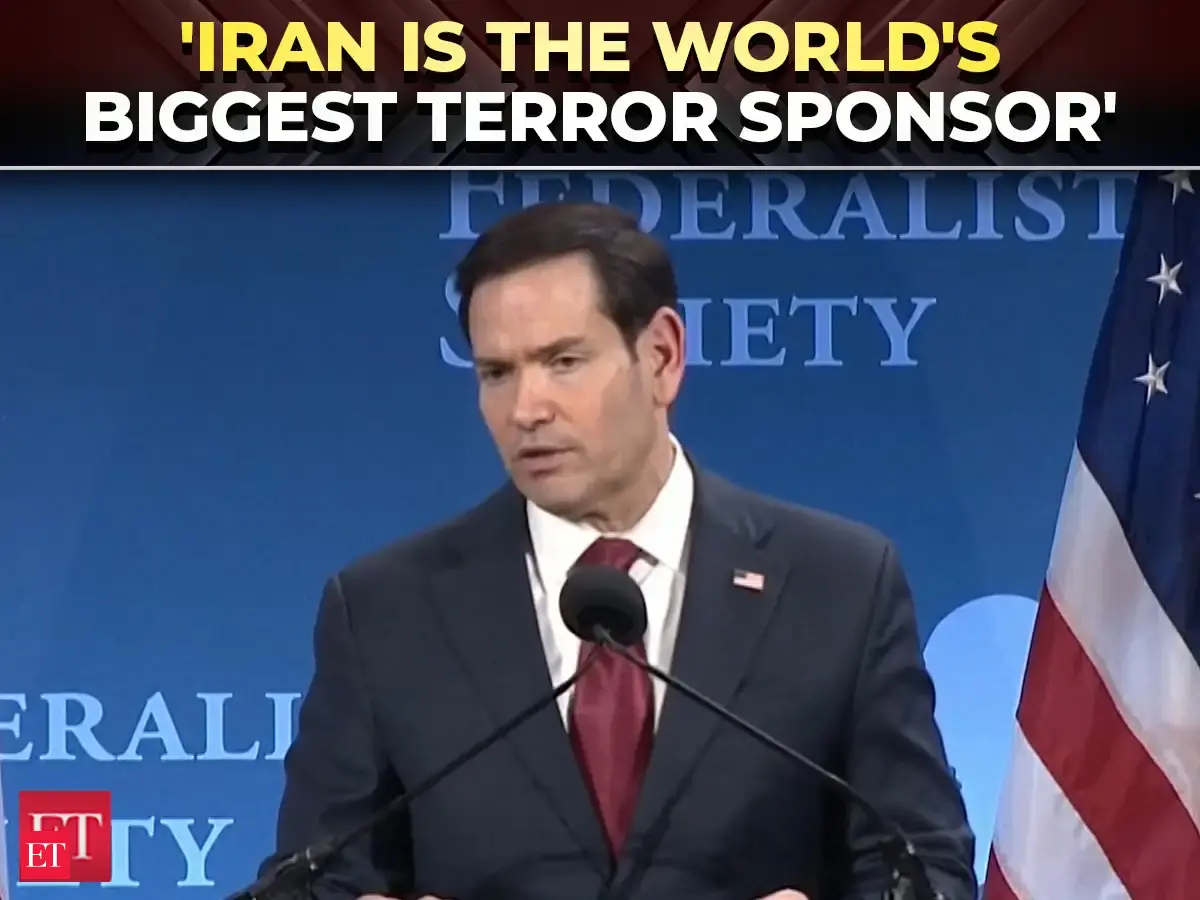
WASHINGTON — United States Secretary of State Marco Rubio characterized the government of the Islamic Republic of Iran as the preeminent state sponsor of terrorism in human history during an address at the 2026 National Lawyers Convention, reinforcing the administration's uncompromising diplomatic and economic posture toward Tehran. Speaking before the annual gathering hosted by the conservative Federalist Society, Rubio framed the Iranian regime's constitutional doctrine of exporting its clerical revolution across the Middle East as the foundational engine of decades of regional instability, citing its persistent reliance on non-state militant proxies and specialized funding networks.
Key facts
What happened
Appearing as a featured speaker at the National Lawyers Convention, Secretary Rubio delivered a detailed critique of Iranian foreign and military policy, according to reporting by ET Online. In his remarks, Rubio focused on the governing philosophy of the Islamic Republic, arguing that the nation's supreme leadership views the cross-border proliferation of revolutionary ideology not as an incidental foreign policy initiative, but as an existential constitutional mandate.
Rubio argued that this structural commitment to exporting revolution has made Tehran the single most consequential state sponsor of terrorism globally. He emphasized that the financial, logistical, and technical assistance funneled from Tehran to regional proxy organizations has fundamentally altered the security architecture of the Middle East. By underwriting asymmetric warfare networks, Rubio stated, the Iranian leadership has prolonged regional conflicts and undermined sovereign governance from the Levant to the Arabian Peninsula.
While the speech addressed broader national security priorities and legal frameworks governing international diplomacy, the secretary of state devoted significant attention to the historical continuity of American sanctions against Iran. He noted that Washington's classification of Iran as a state sponsor of terrorism, first instituted in 1984, remains an indispensable instrument in coordinating multilateral pressure against the regime's illicit financial conduits.
Why it matters
Rubio's forceful rhetoric before an audience of influential legal scholars, judges, and policymakers serves as a clear policy signal that the State Department intends to pursue an aggressive containment strategy against Iran. In diplomatic and trade terms, reaffirming Iran's primary role in international terrorism indicates that the US administration will resist calls for sanctions relief or diplomatic rapprochement without comprehensive, verifiable concessions on regional proxy warfare and ballistic missile proliferation.
For international energy markets and commercial shipping lanes, the administration's vocal confrontation with Tehran carries tangible operational stakes. Iran sits along the Strait of Hormuz, a maritime chokepoint through which approximately one-fifth of the world's total petroleum consumption passes daily. Tensions between Washington and Tehran routinely translate into fluctuating war-risk insurance premiums for commercial vessels operating in the Persian Gulf and Red Sea corridors.
Furthermore, Rubio's invocation of Iran's ideological doctrine reflects an administrative judgment that the challenge posed by Tehran cannot be resolved solely through narrow nuclear negotiations. By prioritizing the export of revolution and conventional proxy support, the State Department is communicating to European and Middle Eastern allies that American deterrence policy will link economic engagement directly to Iran's conduct across Syria, Lebanon, Iraq, and Yemen.
For financial institutions worldwide, the secretary's position underscores the elevated compliance risks associated with any transactions that touch Iranian-linked entities. Under current US statutory frameworks, designations under state sponsorship authorities subject foreign banks to sweeping secondary sanctions, effectively excluding institutions that facilitate Iranian commerce from the dollar-denominated global clearing system.
The background
The legal and diplomatic estrangement between Washington and Tehran dates to the 1979 Islamic Revolution, which toppled the US-aligned monarchy of Shah Mohammad Reza Pahlavi and established a theocracy headed by Ayatollah Ruhollah Khomeini. The subsequent 444-day seizure of the American Embassy in Tehran by revolutionary students shattered bilateral diplomatic ties, leading to the severance of official relations in April 1980.
In January 1984, under President Ronald Reagan, the United States formally designated Iran as a State Sponsor of Terrorism pursuant to Section 6(j) of the Export Administration Act, Section 40 of the Arms Export Control Act, and Section 620A of the Foreign Assistance Act. The initial designation was spurred primarily by Tehran's logistical and operational ties to militant groups in Lebanon, including the nascent Hezbollah organization implicated in the October 1983 bombing of the US Marine Corps barracks in Beirut, which killed 241 American service members.
The State Sponsor of Terrorism list carries severe statutory penalties, including a total ban on defense exports and sales, strict controls over dual-use exports, prohibitions on foreign financial assistance, and the mandatory rescission of sovereign immunity in US courts for victims of state-sponsored terrorist acts. Over subsequent decades, successive American administrations expanded these measures by imposing secondary sanctions targeting third-country entities engaged in transactions with Iran's energy sector, central bank, and Islamic Revolutionary Guard Corps (IRGC).
Efforts to resolve the broader geopolitical standoff produced the 2015 Joint Comprehensive Plan of Action (JCPOA), negotiated under President Barack Obama alongside Britain, France, Germany, Russia, and China. That agreement provided targeted economic relief in exchange for verifiable caps on Iran's uranium enrichment program. However, the accord deliberately excluded non-nuclear issues, such as ballistic missile development and regional proxy funding, leaving the 1984 terrorism designation and related counterterrorism sanctions intact.
In 2018, the US withdrew from the JCPOA and reinstated comprehensive sanctions under a "maximum pressure" campaign. In April 2019, Washington designated the IRGC in its entirety as a Foreign Terrorist Organization (FTO), marking the first time the United States had applied the designation to a branch of a foreign sovereign military. Since then, the region has experienced recurrent cycles of escalation, encompassing maritime interdictions, drone and missile strikes against infrastructure, and indirect hostilities involving Iranian-backed militias.
Reaction
While Iranian officials did not immediately issue a direct rebuttal to Rubio's convention address, representatives of Iran's Ministry of Foreign Affairs have historically rejected US terrorism designations as politically motivated pretexts designed to justify unilateral economic sanctions. Tehran routinely maintains that its foreign relationships represent legitimate alliances with regional sovereign movements and portrays American military deployments across the Persian Gulf as the primary source of instability.
Within Washington's policy community, Rubio's remarks were broadly received by convention attendees as a confirmation that the administration's foreign policy will be guided by traditional neoconservative and hawkish national security principles. Analysts at Washington-based think tanks noted that Rubio's explicit focus on the 1979 ideological foundation of the regime implies skepticism regarding the prospects of moderating Iranian behavior through transactional diplomacy.
Among regional allies, particularly Israel and the member states of the Gulf Cooperation Council, the secretary's firm language is expected to be welcomed as a sign of continued American strategic alignment. Governments in the region have long urged Washington to treat Tehran's conventional missile transfers and militia support with the same urgency as its nuclear fuel cycle.
What we don't know yet
Significant gaps remain regarding the specific tactical initiatives that will accompany the secretary of state's public posture. Rubio's address did not outline whether the State Department plans to unveil new tranches of unilateral sanctions, intensify enforcement against third-party maritime tankers transporting illicit Iranian crude to East Asian refineries, or seek additional multilateral censure resolutions at the United Nations.
It is also unclear how this uncompromising public posture will affect indirect backchannel communications that have periodically been utilized to manage crises, de-escalate maritime encounters, or secure the release of detained foreign nationals. The speech left unaddressed whether the administration envisions any feasible diplomatic off-ramp or whether its overarching strategy assumes that meaningful behavioral change from Tehran is impossible under its current constitutional structure.
Finally, the reporting does not indicate how Washington plans to reconcile its assertive counter-Iran strategy with the foreign policy priorities of European allies, several of which maintain diplomatic relations with Tehran and have historically sought to preserve avenues for civil dialogue.
What to watch
The trajectory of US-Iran relations over the coming months will hinge on several observable decision points. Observers should track upcoming enforcement actions by the US Department of the Treasury's Office of Foreign Assets Control (OFAC), particularly designations targeting international maritime logistics networks and front companies in the United Arab Emirates, Turkey, and Southeast Asia that facilitate Iranian oil sales.
Another critical indicator will be the diplomatic posture adopted by the United States and its partners during upcoming meetings of the International Atomic Energy Agency (IAEA) Board of Governors in Vienna. Any joint push by Washington and European capitals to formally refer Iranian compliance disputes to the United Nations Security Council would signal a coordinated transition from rhetorical pressure to institutional censure.
Additionally, defense posture changes in the Middle East warrant close attention, specifically rotational deployments directed by US Central Command (CENTCOM), combined naval patrols in the Red Sea and Persian Gulf, and bilateral defense agreements between Washington and regional partners aimed at countering unmanned aerial systems and ballistic missile threats.
This account is based on reporting published by ET Online.
How this story was produced
This report was written by The Global Wire newsroom from reporting first published by ET Online. We verify the core facts against the original report, write our own account, and add the background and consequences a short wire item leaves out. Drafting is AI-assisted inside an editor-supervised pipeline, and every story is checked for accuracy of attribution, structure and duplication before it appears — full detail in our AI and funding disclosure.
Spotted an error? Tell us at corrections@horizonglobalnews.com and read our corrections policy or editorial standards.






Reader comments
Loading comments…