

Physicists Demonstrate Quantum Location Verification Using Single-Photon Signals
A breakthrough experiment using single photons and precision timing offers a cryptographic method to verify physical presence against digital spoofing.
By The Global Wire Newsroom · Reported from Peter Hall
Link preview · horizonglobalnews.com
Physicists Demonstrate Quantum Location Verification Using Single-Photon Signals
A breakthrough experiment using single photons and precision timing offers a cryptographic method to verify physical presence against digital spoofing.
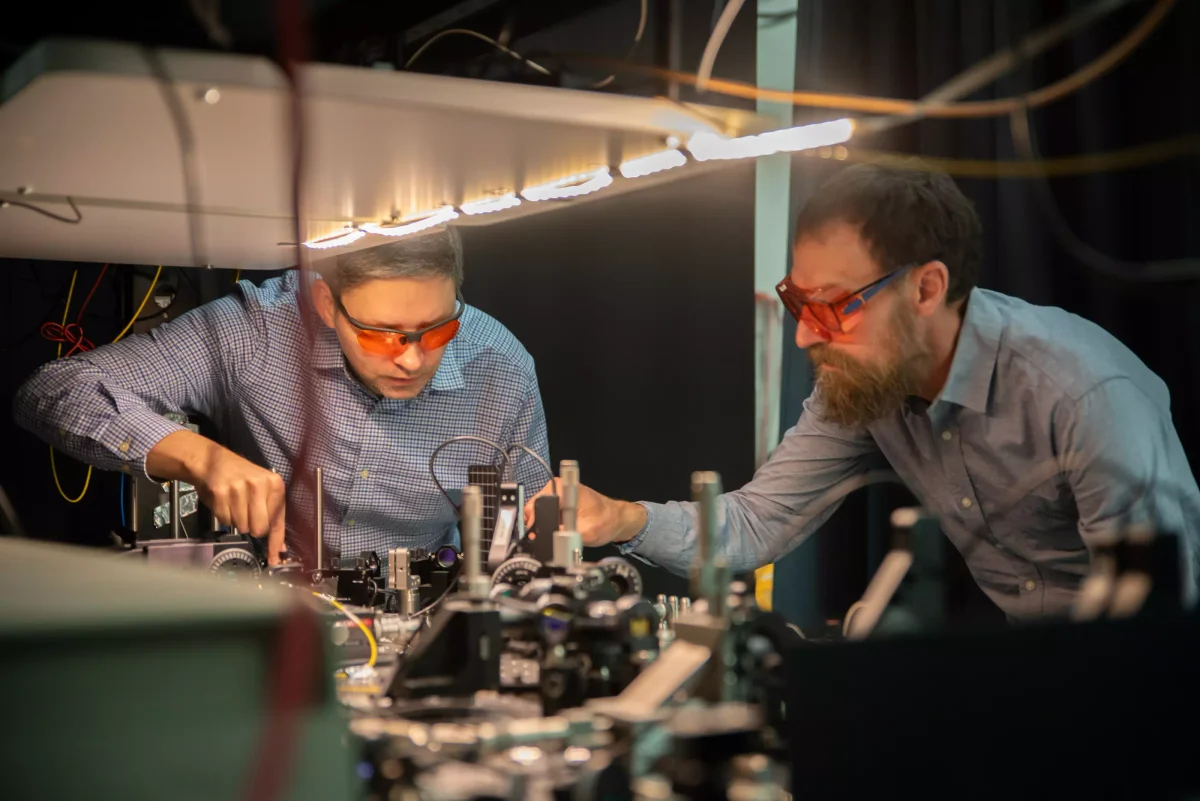
Researchers have demonstrated a practical method for verifying physical locations using individual particles of light and high-precision timing, establishing an experimental defense against digital imposters, according to reporting by Peter Hall. The trial represents the first real-world physical implementation to confirm geographic positioning through the fundamental properties of quantum mechanics, addressing longstanding vulnerabilities in satellite-based navigation and networked location services.
Key facts
What happened
In a landmark laboratory demonstration, experimental physicists validated a location-verification protocol by transmitting an individual photon and measuring its arrival within a strictly calibrated time window, according to reporting by Peter Hall. By pairing single-photon transmission with high-precision timing constraints, the researchers confirmed that the receiving entity occupied an exact coordinate in space during the transaction.
Under the experimental framework, the system leverages physical limits to confirm position. A verifying node sends a quantum state—embodied here by a single light particle—toward the target location while initiating an ultra-precise timing measurement. Because the speed of light serves as an absolute speed limit in the universe, approximately 299,792 kilometers per second in a vacuum, the response from a target claiming a specific position must arrive within an exacting, calculable duration. Any adversary positioned elsewhere, attempting to intercept, measure, and relay the signal, introduces a temporal delay dictated by the additional physical distance the signal must travel.
Simultaneously, the physical properties of the photon prevent conventional interception strategies. In classical electronics, a hostile actor can clone an incoming radio or optical signal and forward it without distortion. A quantum state, however, cannot be cloned without measurement altering its delicate configuration. By checking both the intact quantum state and the exact moment of return, the researchers demonstrated that an entity situated at any other physical location could not successfully impersonate the genuine target.
Why it matters
Modern economies, civilian infrastructure, and international security rely extensively on location verification, yet existing methods are structurally vulnerable. Civil satellite navigation networks—such as the United States Global Positioning System, Europe's Galileo, China's BeiDou, and Russia's GLONASS—broadcast signals across vast distances at extremely low power levels, typically around minus 160 decibel-watts when arriving at Earth's surface. Consequently, terrestrial radio transmitters broadcasting counterfeit signals can easily overpower authentic satellite transmissions, tricking receivers into calculating incorrect coordinates or artificial timestamps.
This vulnerability, known as GPS spoofing, has evolved from a theoretical threat into an everyday disruption. Commercial maritime tracking data frequently reveals vessels appearing to sail inland or circle airport runways because nearby electronic warfare systems broadcast false positioning coordinates. Civil aviation authorities have repeatedly issued warnings to pilots navigating eastern Europe, the eastern Mediterranean, and the Persian Gulf regarding false navigation data and automated system failures caused by deceptive terrestrial signals.
In digital enterprise security, physical location is increasingly used as a crucial factor in zero-trust architecture and automated financial processing. High-value transactions, remote access to national defense mainframes, and supervisory control and data acquisition systems governing electrical grids often restrict access based on verified geographic boundaries, known as geofencing. Today, malicious actors bypass these barriers using virtual private networks, proxy servers, and radio-frequency spoofing kits that cost only a few hundred dollars. If single-photon location verification can be deployed across production networks, it introduces an immutable defense. Organizations could definitively verify that an authorization signal originated within a hardened server room, an operations center, or a designated command post, entirely neutralizing remote digital imposters.
The background
The theoretical foundation for using quantum physics to confirm geography, known in academic literature as quantum position verification (QPV), was first formalized in the early 2000s. Early theoretical proposals, notably advanced by physicists Adrian Kent in 2002 and later expanded by computer scientists Harry Buhrman and colleagues in 2011, explored whether the relativistic constraint of the speed of light combined with quantum mechanics could achieve unconditional security.
Traditional cryptographic techniques depend on mathematical complexity. For example, public-key algorithms such as RSA rely on the difficulty of factoring large composite integers. However, classical cryptographic schemes cannot guarantee geographic presence; an authorized user who shares their private key or whose device is compromised can be impersonated from any location worldwide.
Early theoretical formulations of quantum position verification faced an apparent barrier: the threat of quantum teleportation. Theoretical papers demonstrated that if multiple coordinated attackers surround a target location and share large quantities of pre-distributed entangled quantum states, they can theoretically perform instantaneous collaborative operations to simulate a legitimate prover's presence without residing at the declared location. This became known as the entanglement attack problem.
To circumvent this theoretical vulnerability in practice, experimentalists focused on specialized protocols requiring massive amounts of entanglement that remain physically and computationally unfeasible for current adversaries. Concurrently, advancements in hardware over the past two decades made physical implementations viable. Single-photon detectors, specifically superconducting nanowire single-photon detectors (SNSPDs), achieved timing resolutions measured in tens of picoseconds alongside system detection efficiencies exceeding 90 percent. Parallel developments in ultra-stable atomic clocks, particularly optical lattice and rubidium frequency standards, made it possible to coordinate remote nodes with sub-nanosecond synchronization. The experiment reported by Peter Hall marks the critical transition of these concepts from abstract blackboard theorems into a functioning physical implementation.
Reaction
While formal public statements from defense agencies and commercial telecommunications bodies have not yet been released regarding this specific trial, the scientific and cryptographic sectors have long awaited an experimental confirmation of quantum position verification. Applied physicists and network security architects are expected to evaluate the protocol in peer-reviewed forums, focusing particularly on detection efficiency and loss tolerances.
Standardization bodies, including the International Telecommunication Union (ITU) and the European Telecommunications Standards Institute (ETSI)—both of which maintain dedicated committees on quantum communication and quantum key distribution (QKD)—are anticipated to review the operational constraints of single-photon verification. In telecommunications and defense circles, experts will scrutinize whether the demonstrated timing tolerances can withstand the signal attenuation and atmospheric turbulence that characterize outdoor freespace and terrestrial fiber networks.
What we don't know yet
The initial reporting leaves several critical parameters and technical specifications unstated. It has not yet been specified what precise physical distance separated the verifier and the target during the experiment, nor whether the optical path was established across open-air free space or through dedicated low-loss telecommunications fiber optic cables.
Furthermore, the exact institutional affiliations of the researchers, the specific wavelength of the photon utilized, and the hardware platform employed for the single-photon generation remain undisclosed. In practical applications, the wavelength dictates compatibility with existing fiber infrastructure; for instance, telecommunication wavelengths near 1,550 nanometers benefit from established infrastructure, whereas visible or near-infrared wavelengths often require custom or satellite-based transmission links.
Finally, the tolerance of the system against optical loss remains undefined. In practical environments, single photons are routinely absorbed or scattered by dust, moisture, or standard glass fiber attenuation, which averages roughly 0.2 decibels per kilometer in modern fiber. It remains unknown how the protocol distinguishes between a hostile interceptor and ordinary environmental signal loss, and whether a high-loss scenario permits an adversary to mount a denial-of-service attack.
What to watch
The immediate milestone to watch will be the publication of the complete peer-reviewed study, which will detail the physical architecture, photon detection rates, error margins, and the specific timing thresholds achieved. Following publication, independent quantum research laboratories in Europe, North America, and East Asia are expected to attempt replication under varied atmospheric and environmental conditions.
Observers should also monitor whether standard-setting organizations begin integrating position-verification metrics into emergent quantum network frameworks. The development of integrated photonics will serve as another key indicator; moving single-photon sources and superconducting detectors from laboratory benches onto silicon photonic chips is essential before the technology can be installed in mobile military platforms, commercial aircraft, or financial data centers.
Additionally, trial demonstrations over increasing physical distances—moving from laboratory optical benches to outdoor links between buildings, and eventually to ground-to-satellite transmissions—will determine whether quantum position verification can scale into an operational defensive network against global spoofing.
This account is based on original reporting by Peter Hall.
How this story was produced
This report was written by The Global Wire newsroom from reporting first published by Peter Hall. We verify the core facts against the original report, write our own account, and add the background and consequences a short wire item leaves out. Drafting is AI-assisted inside an editor-supervised pipeline, and every story is checked for accuracy of attribution, structure and duplication before it appears — full detail in our AI and funding disclosure.
Spotted an error? Tell us at corrections@horizonglobalnews.com and read our corrections policy or editorial standards.





Reader comments
Loading comments…