

North Korea Spurns Repeated Outreach From Trump as Direct Diplomacy Stalls
Efforts by Donald Trump to revive leader-to-leader communications with Pyongyang have been rebuffed, including an unopened letter discarded by a North Korean envoy.
By The Global Wire Newsroom · Reported from Tom Boggioni
Link preview · horizonglobalnews.com
North Korea Spurns Repeated Outreach From Trump as Direct Diplomacy Stalls
Efforts by Donald Trump to revive leader-to-leader communications with Pyongyang have been rebuffed, including an unopened letter discarded by a North Korean envoy.
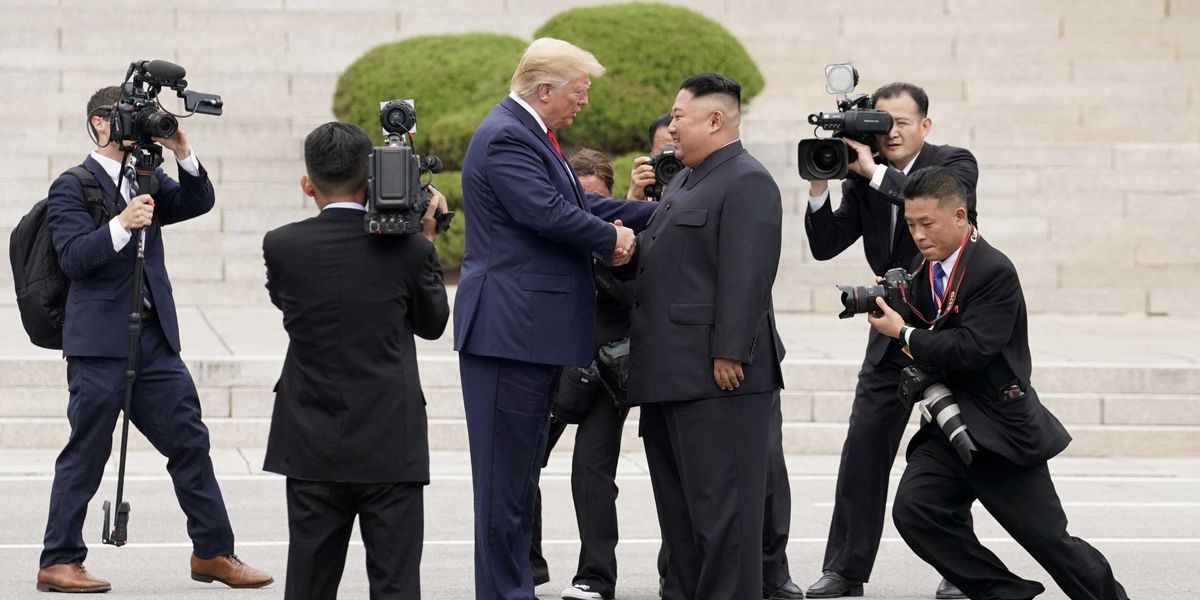
WASHINGTON — Repeated attempts by Donald Trump to re-establish personal communications with North Korean leader Kim Jong Un have been flatly rejected by Pyongyang, according to reporting by The Wall Street Journal. Since regaining the presidency, Trump has sought to rekindle the direct personal relationship that defined his administration's high-stakes diplomacy with the isolated, nuclear-armed nation between 2018 and 2019. However, overtures transmitted through both personal missives and established diplomatic backchannels have encountered total silence from the North Korean leadership, culminating in an episode where a North Korean representative discarded a communication from the American president without opening it.
Key facts
What happened
Following his return to the White House, Trump initiated several attempts to contact Kim Jong Un in an effort to reopen lines of communication that had remained frozen under the prior administration. The overtures were handled through multiple tracks, incorporating direct personal notes addressed to Kim as well as quiet diplomatic inquiries through established intermediate contacts, according to reporting by The Wall Street Journal.
Rather than engaging or negotiating terms for dialogue, North Korean authorities maintained an unyielding wall of silence. The rejection escalated beyond passive indifference during a recent interaction in which an official American communication intended for Kim was summarily rejected. A North Korean diplomatic envoy reportedly cast aside the correspondence without examining its contents, delivering a stark symbolic snub to the administration's attempts to rekindle summit-level diplomacy.
The dynamic stands in severe contrast to the first administration, when Trump and Kim engaged in an unprecedented exchange of more than two dozen personal letters—missives Trump famously characterized as warm and affectionate. During that initial period, direct correspondence bypassed traditional bureaucratic reviews at the State Department and the North Korean Foreign Ministry, creating a top-down negotiating format that temporarily suspended severe military tensions. The recent rejection of basic communications confirms that Pyongyang has discarded that transactional framework entirely, refusing even baseline courtesies extended through bilateral channels.
Why it matters
The outright refusal by Pyongyang to accept communications from the White House illustrates how profoundly the geopolitical terrain has shifted in Northeast Asia, stripping the United States of its principal diplomatic channel with a rapidly advancing nuclear power. For decades, American policy toward North Korea has oscillated between stringent economic containment and conditional engagement aimed at denuclearization. Trump's first-term approach fundamentally upended that playbook by banking on personal rapport to bypass decades of institutional distrust. The decisive rejection of that dynamic closes off what was once considered the only functioning bridge between the two executive leaderships, eliminating an avenue for direct crisis management at a time when the risk of miscalculation remains acute.
Furthermore, this development directly impacts regional security calculations for treaty allies South Korea and Japan. Both Seoul and Tokyo endured significant anxiety during the initial summit era, fearing that unilateral leader-level negotiations might yield an American concession—such as a reduction in joint military exercises or the drawdown of forward-deployed forces—without fully dismantling the North Korean nuclear threat. The failure of personal diplomacy removes immediate risks of an uncoordinated bilateral compromise, but it simultaneously increases structural instability. Without open channels, Washington, Seoul, and Tokyo must rely entirely on deterrence architectures, ballistic missile defense, and joint military maneuvers, raising the operational temperature along the Korean Peninsula. For international financial markets and shipping lanes traversing the Yellow Sea and Sea of Japan, heightened alert postures and sustained missile testing introduce recurring volatility and supply chain vulnerabilities.
The background
Direct contact between Trump and Kim began in the aftermath of 2017, a year defined by sharp verbal escalations and rapid North Korean technological breakthroughs. During that period, Pyongyang conducted its sixth underground nuclear test—widely assessed to have been a thermonuclear device with an estimated yield exceeding 100 kilotons—and launched intercontinental ballistic missiles capable of reaching the continental United States. The escalation prompted United Nations Security Council resolutions, including Resolutions 2375 and 2397, which imposed near-total embargos on North Korean refined petroleum imports, coal exports, and overseas labor contracts.
Diplomatic conditions shifted dramatically in 2018 when South Korea, under then-President Moon Jae-in, brokered an opening that led to the historic Singapore Summit on June 12, 2018. That event marked the first-ever meeting between a sitting United States president and a North Korean leader. The two men signed a brief joint declaration pledging to establish new bilateral relations, build a lasting peace regime, and work toward the complete denuclearization of the Korean Peninsula. However, the document lacked enforcement mechanisms, defined timelines, or a mutually agreed-upon definition of denuclearization.
The process collapsed during their second formal summit in Hanoi, Vietnam, held on February 27 and 28, 2019. The negotiations broke down when Kim offered to dismantle the Yongbyon nuclear scientific research center in exchange for the lifting of five key United Nations economic sanctions adopted in 2016 and 2017. The American delegation insisted that Yongbyon represented only a fraction of North Korea's covert enrichment and weapon production architecture, demanding a comprehensive declaration and total elimination of all nuclear infrastructure before major sanctions relief could occur. The summit ended abruptly without a joint statement.
A subsequent, impromptu meeting at the Demilitarized Zone in Panmunjom on June 30, 2019, saw Trump briefly cross the Military Demarcation Line into North Korean territory, but technical working-level talks held later that year in Stockholm, Sweden, broke down within hours. Since that time, Pyongyang has dramatically expanded its tactical nuclear doctrine, codified the permanent status of its nuclear arsenal into its national constitution, and systematically upgraded its road-mobile and solid-fueled missile systems.
Critically, the international environment supporting North Korean isolation has dismantled over recent years. Following the 2022 invasion of Ukraine, Pyongyang established an extensive military alliance with Moscow, supplying substantial quantities of conventional munitions and ballistic systems in return for Russian technological assistance, fuel supplies, and diplomatic shielding at the United Nations Security Council. Having secured an alternate economic and strategic lifeline, Pyongyang no longer views sanctions relief from Washington as an existential necessity, drastically reducing the leverage any American administration holds.
Reaction
Neither the White House nor the North Korean Permanent Mission to the United Nations has issued formal, on-the-record statements regarding the reported rejection of the president's correspondence. When questions regarding North Korean contacts have arisen in previous settings, administration spokespersons have consistently maintained that the United States remains committed to regional deterrence while preserving an openness to dialogue without preconditions. In congressional circles, foreign policy leaders and national security committees are expected to scrutinize the administration's outreach, with opposition lawmakers historically criticizing top-down diplomacy as conferring unearned legitimacy on an authoritarian regime, while proponents defend personal overtures as a necessary tool to prevent accidental war.
In Seoul, South Korean defense officials and diplomatic planners are closely observing the impasse. South Korea's military establishment has consistently prioritized intelligence-sharing arrangements with the Pentagon and trilateral defense coordination alongside Japan. South Korean analysts anticipate that Kim Jong Un will address the state of foreign relations during upcoming plenary meetings of the Workers' Party of Korea Central Committee or in major state-directed pronouncements through the official Korean Central News Agency, forums Pyongyang traditionally employs to communicate strategic shifts to foreign audiences.
What we don't know yet
Significant operational and substantive details regarding the outreach remain undisclosed in the initial reporting. It is not currently known precisely what terms, concessions, or proposals were outlined inside the rejected correspondence, or whether the message offered unconditional dialogue or proposed specific agenda items such as sanctions modifications or security guarantees. The exact timeline, geographic location, and level of the North Korean diplomat who reportedly tossed the correspondence aside also remain unspecified in the published account.
Furthermore, the degree of coordination between the White House and regional allies prior to dispatching these overtures has not been clarified. It remains uncertain whether South Korea, Japan, or regional intermediaries such as China were notified of the outreach before it occurred. The strategic intent behind Pyongyang's refusal is similarly unresolved: it is unclear whether the rejection represents a permanent strategic realignment indicating North Korea has permanently abandoned bilateral talks with Washington, or whether it serves as a tactical posturing designed to extract maximal concessions before considering re-engagement.
What to watch
The trajectory of U.S.-North Korea relations over the coming months will be shaped by several critical indicators and scheduled milestones:
This account is based on original reporting published by The Wall Street Journal and summarized by Tom Boggioni.
How this story was produced
This report was written by The Global Wire newsroom from reporting first published by Tom Boggioni. We verify the core facts against the original report, write our own account, and add the background and consequences a short wire item leaves out. Drafting is AI-assisted inside an editor-supervised pipeline, and every story is checked for accuracy of attribution, structure and duplication before it appears — full detail in our AI and funding disclosure.
Spotted an error? Tell us at corrections@horizonglobalnews.com and read our corrections policy or editorial standards.






Reader comments
Loading comments…