

Naval Group Unveils SCX 26 Surface Combatant Concept for 2040s High-Intensity Warfare
French shipbuilder Naval Group has unveiled the SCX 26, an advanced warship concept featuring a dual superstructure, directed-energy weapons, railguns, and comprehensive drone systems.
By The Global Wire Newsroom · Reported from David Szondy
Link preview · horizonglobalnews.com
Naval Group Unveils SCX 26 Surface Combatant Concept for 2040s High-Intensity Warfare
French shipbuilder Naval Group has unveiled the SCX 26, an advanced warship concept featuring a dual superstructure, directed-energy weapons, railguns, and comprehensive drone systems.
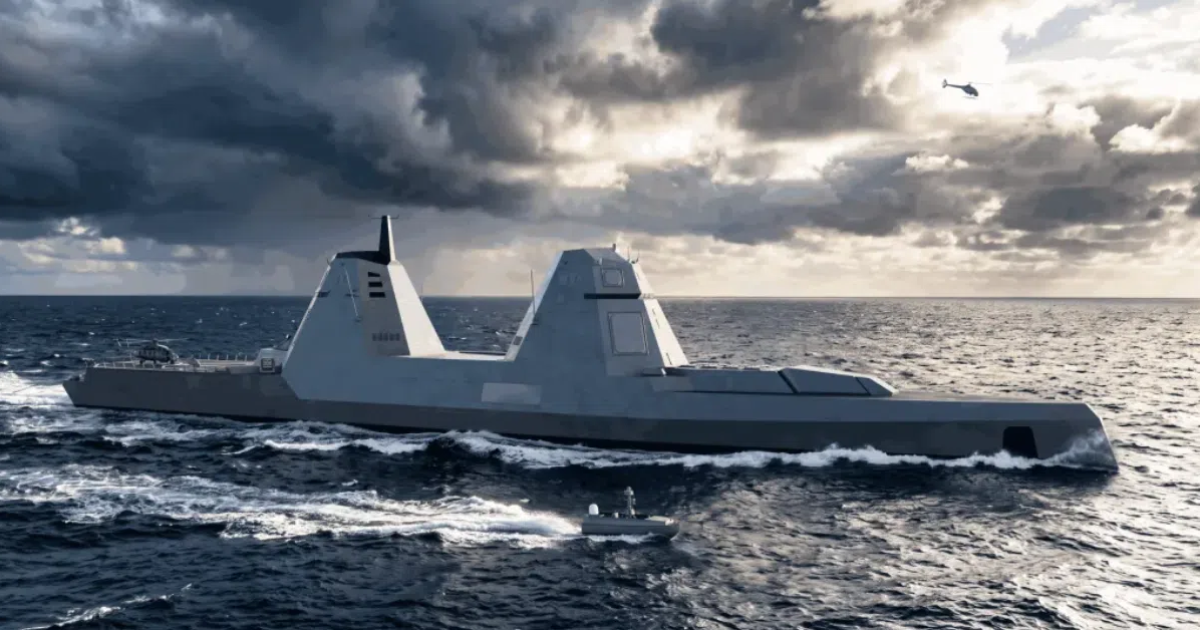
French naval defense contractor Naval Group has unveiled the SCX 26, an advanced conceptual surface warship engineered to anticipate the tactical and technological demands of maritime combat in the 2040s, according to reporting by David Szondy. Designed around an unconventional double-superstructure silhouette, the vessel integrates electromagnetic railguns, directed-energy laser weapons, and an expansive suite of autonomous uncrewed vehicles. The design reflects an industrial push toward resilient, heavily automated naval platforms capable of operating across contested maritime theaters where missile saturation, hypersonic threats, and autonomous drone swarms are projected to dominate future fleet engagements.
Key facts
What happened
Naval Group presented the SCX 26 as its strategic blueprint for the mid-21st-century surface combatant, outlining a design that fundamentally breaks with conventional single-island frigate and destroyer profiles. According to reporting by David Szondy, the concept focuses on providing the structural volume, electrical power generation, and computational bandwidth required to support emerging military technologies that remain in development across European defense laboratories.
The most immediately visible feature of the SCX 26 is its twin superstructure. Rather than consolidating the ship's bridge, radar arrays, and exhaust uptakes into a single central superstructure, the vessel splits its topside architecture across two distinct forward and aft deckhouses. In naval architecture, this layout offers distinct tactical advantages, including physical separation of primary bridge navigation from combat operations centers, reduced electromagnetic interference between high-powered planar radar arrays, and clean aerodynamic airflow across the mid-hull and aft flight zones. The layout also provides critical survivability through internal system redundancy, ensuring that a direct hit to one island does not instantly sever all optical, sensor, and command links across the ship.
Beyond its external geometry, the SCX 26 places heavy emphasis on advanced armament. The platform is designed to house directed-energy laser weapons and electromagnetic railgun mounts alongside conventional vertical launch system cells. By incorporating solid-state lasers and railguns, the design seeks to solve the acute magazine-depth limitations that challenge current surface combatants, offering rapid-firing capabilities limited primarily by onboard electrical generation rather than physical munitions storage. The design also incorporates comprehensive facilities for launching, recovering, and coordinating uncrewed aerial vehicles, uncrewed surface vessels, and autonomous underwater vehicles, turning the ship into an offshore command node for collaborative drone warfare.
Why it matters
The introduction of the SCX 26 highlights a decisive evolution in global naval doctrine, driven by rapid advancements in anti-access/area-denial (A2/AD) capabilities. Over the past decade, naval engagements—from the Black Sea to the Red Sea and Bab el-Mandeb—have demonstrated that modern surface combatants face asymmetric threats where hostile forces can launch swarms of cheap commercial-derivative drones and low-cost anti-ship missiles against multibillion-dollar warships. The economic equation of using interceptor missiles costing upwards of $2 million each to neutralize loitering munitions costing under $50,000 has placed unsustainable fiscal and logistical strains on Western naval fleets.
Directed-energy weapons and electromagnetic railguns directly alter this cost-exchange calculation. A high-energy laser system costs only a few dollars per shot in electrical generation costs, providing a virtually bottomless magazine for counter-drone, counter-sensor, and anti-missile point defense as long as the ship's propulsion and power management systems remain functional. Similarly, electromagnetic railguns bypass the hazards of storing volatile chemical propellant charges inside the hull while providing hypervelocity projectiles capable of engaging air, surface, and land targets at extended ranges.
However, fielding these systems requires a revolution in marine engineering. Railguns and laser weapons demand massive pulses of instantaneous electrical energy, alongside continuous megawatt-scale cooling capacities to dissipate extreme heat loads. Conceptual platforms like the SCX 26 serve as the testing ground for integrated electrical propulsion architectures, sophisticated energy storage capacitors, and dynamic distribution grids that can route tens of megawatts of power between drive shafts, radar arrays, and energy weapons in fractions of a second.
The background
Headquartered in Paris, Naval Group is Europe's leading naval defense contractor, owned jointly by the French state (which holds an approximate 62.5 percent controlling interest) and defense electronics firm Thales (which holds approximately 35 percent). With primary shipyards located along the French coast in Lorient, Cherbourg, Brest, and Toulon, the company builds the backbone of the French Navy (Marine Nationale), including the Horizon-class air defense destroyers, the Aquitaine-class FREMM multi-mission frigates, and the newer FDI (Frégate de Défense et d’Intervention) platforms, as well as nuclear-powered attack and ballistic missile submarines.
Every two years, typically coinciding with major maritime expositions such as the Euronaval trade exhibition in Paris, Naval Group unveils speculative forward-looking concept ships. Past concept studies have included the SMX-25 submarine-surface hybrid, the biomimetic SMX-31 Electric submarine concept, and the Blue Shark surface combatant unveiled in 2022. While these designs are rarely constructed in their exact concept configurations, they serve as public-facing technology incubators. Features demonstrated in earlier concept ships have regularly migrated into operational platforms; for example, the integrated panoramic sensor masts, reverse-bow hydrodynamic hulls, and modular multi-mission drone bays originally debuted on concept models before appearing on production-line FDI frigates now entering service with France and the Hellenic Navy of Greece.
The weapons envisioned for the SCX 26 also build upon established European defense research initiatives. France has actively pursued high-energy laser weapons through domestic projects such as the HELMA-P (High Energy Laser for Multiple Applications - Power) system, developed by CILAS and ArianeGroup, which underwent sea trials aboard the French Navy's Horizon-class destroyer *Forbin*. At the multilateral level, the European Defence Agency has sponsored the PILUM (Projectiles for Increased Long-range Utility and Mobility) initiative, an effort led by the French-German Research Institute of Saint-Louis (ISL) aimed at demonstrating the viability of electromagnetic railgun launchers for land and naval applications.
Reaction
While official military responses remain tied to broader defense reviews, naval analysts and defense observers have framed the SCX 26 reveal as an indicator of where European shipbuilders see the future export market and domestic naval requirements heading over the next twenty years. Independent defense specialists have noted that the ship's double-superstructure configuration mirrors the design philosophy adopted on larger naval platforms, such as the Royal Navy's Queen Elizabeth-class aircraft carriers and Italy's amphibious assault ship *Trieste*, adapted down to a surface combatant displacement.
In France, formal programmatic interest will fall under the scrutiny of the Ministry of Armed Forces (Ministère des Armées) and the National Assembly's Standing Committee on National Defense and Armed Forces. Lawmakers and military planners are currently executing the 2024–2030 Military Programming Law (Loi de Programmation Militaire), which allocates €413 billion to defense modernization. While the current cycle prioritizes the completion of the FDI frigate program, the new replenishment tankers (BRF), and preliminary design work on the next-generation nuclear-powered aircraft carrier (PANG), research-and-development funding line items under the Direction générale de l'armement (DGA) will be tasked with assessing whether the advanced energy and hull concepts highlighted in the SCX 26 should be transitioned into formal procurement requirements for the late 2030s.
What we don't know yet
Naval Group's public presentation leaves several critical technical and programmatic metrics unspecified. The builder has not published definitive specifications regarding the ship's displacement, waterline length, beam, or propulsion machinery, leaving it unclear whether the SCX 26 is envisioned as a heavy frigate in the 6,000-to-8,000-ton class or a full-sized cruiser-displacement destroyer exceeding 10,000 tons. The type of primary power plant—whether advanced gas-turbine combined cycle, diesel-electric hybrid, or an alternative fuel system—remains undisclosed, though accommodating railguns and multi-hundred-kilowatt laser weapons will necessitate an unprecedented total electrical output for a European surface warship.
Crucially, it is not yet known whether the French Navy intends to formalize the SCX 26 into a concrete requirement to replace its aging fleet of air defense destroyers or early-generation multi-mission frigates by 2040. There are no published cost estimates or procurement timelines associated with the concept, and the degree to which allied navies within NATO or the European Union might be invited to collaborate on structural elements of the design remains entirely unaddressed.
What to watch
Moving forward, key developments will center on technical milestones emerging from European directed-energy and railgun testing programs. Observers should watch for next-phase firing results from the French-German Research Institute of Saint-Louis under the PILUM and follow-on THEMA railgun projects, which will determine whether electromagnetic launch rails can overcome extreme bore erosion and maintain barrel longevity under sustained operational cycles.
Additionally, defense watchers should track upcoming procurement milestones from the French defense procurement agency, the DGA, particularly regarding sea-based trials of high-energy lasers aboard active French surface combatants. The legislative drafting of France's subsequent Military Programming Law—scheduled to cover the post-2030 budgetary window—will provide the first concrete fiscal indicator of whether the innovative architectural choices, twin-island configuration, and deep drone-integration frameworks showcased in the SCX 26 are formally adopted as official acquisition requirements for the Marine Nationale's next generation of principal combatants.
This report is based on original reporting by David Szondy.
How this story was produced
This report was written by The Global Wire newsroom from reporting first published by David Szondy. We verify the core facts against the original report, write our own account, and add the background and consequences a short wire item leaves out. Drafting is AI-assisted inside an editor-supervised pipeline, and every story is checked for accuracy of attribution, structure and duplication before it appears — full detail in our AI and funding disclosure.
Spotted an error? Tell us at corrections@horizonglobalnews.com and read our corrections policy or editorial standards.





Reader comments
Loading comments…