

Mystery Surrounds Omission of Ukraine Provision from Trilateral Summit Communique
Finland's president reveals Washington sought the removal of a Ukraine clause from a high-stakes joint text involving Donald Trump, Vladimir Putin, and Xi Jinping.
By The Global Wire Newsroom · Reported from Travis Gettys
Link preview · horizonglobalnews.com
Mystery Surrounds Omission of Ukraine Provision from Trilateral Summit Communique
Finland's president reveals Washington sought the removal of a Ukraine clause from a high-stakes joint text involving Donald Trump, Vladimir Putin, and Xi Jinping.
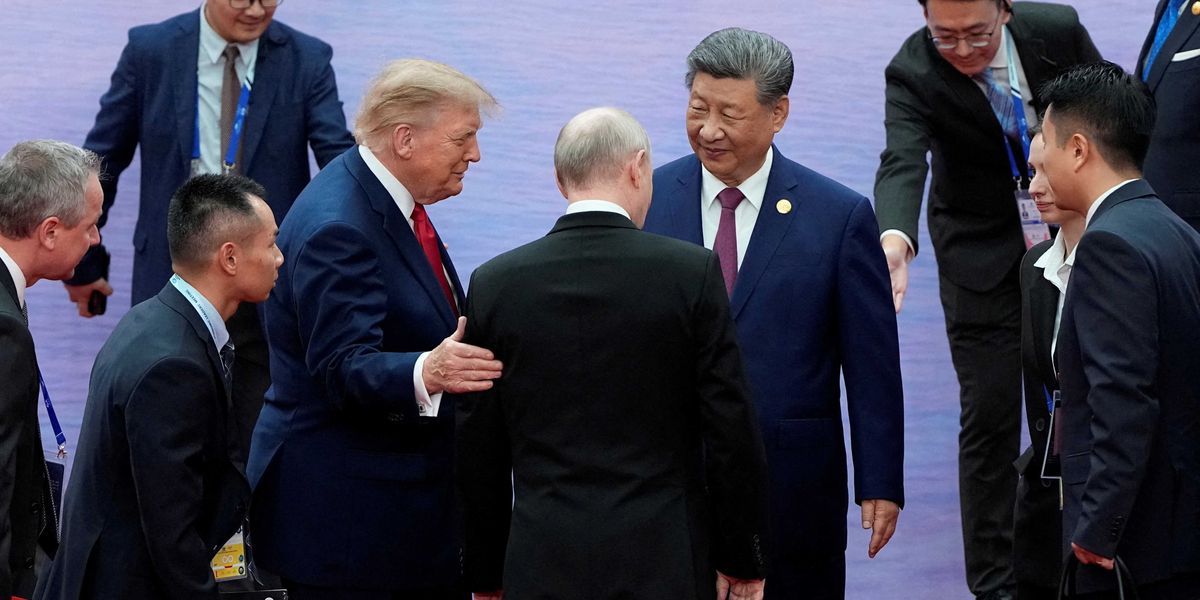
Diplomatic uncertainty deepened across European capitals following revelations that United States negotiators requested the removal of language regarding Ukraine from a major joint declaration between U.S. President Donald Trump, Russian President Vladimir Putin, and Chinese leader Xi Jinping. Finnish President Alexander Stubb disclosed the diplomatic maneuver to reporters in Berlin following talks among allied European leaders, characterizing the exclusion as a troubling signal for the security architecture of Eastern Europe. The disclosure highlights widening fissures among Western allies regarding the management of negotiations over Russia's war in Ukraine and the degree to which Washington may be willing to compromise on language governing sovereignty and territorial integrity to secure broad trilateral agreements with Moscow and Beijing.
Key facts
What happened
According to an account by journalist Travis Gettys, the diplomatic development surfaced during high-level European discussions in Berlin. Finnish President Alexander Stubb, addressing journalists following a regional coalition gathering in the German capital, revealed that United States officials had explicitly intervened during draft negotiations to excise a section directly referencing Ukraine. The text in question was tied to a joint declaration involving Donald Trump, Vladimir Putin, and Xi Jinping, an extraordinary diplomatic instrument bringing together the leaders of the world's primary nuclear superpowers.
Stubb described the decision to eliminate the language as an unwelcome turn of events, telling reporters that the removal represented a negative indicator for European security coordination. While draft declarations in multilateral summits routinely undergo intensive, line-by-line revisions by sherpas and senior diplomats, the deliberate strike of language addressing the continent's most intense armed conflict since the Second World War raised immediate alarms. Stubb indicated that European partners had been monitoring the tripartite discussions closely, but the unilateral American intervention to remove the Ukraine clause caught key regional allies off guard.
European leaders had gathered in Berlin to coordinate continental defense priorities, funding mechanisms for Kyiv, and collective deterrence postures along NATO's eastern frontier. During those proceedings, the realization that Washington had actively accommodated or proposed the exclusion of explicit protections or conditions regarding Ukraine from a major superpower text cast a shadow over allied deliberations. The Finnish president did not recite the verbatim language that was struck from the draft, but confirmed that its presence had been deemed unacceptable to the drafting posture adopted by Washington.
Why it matters
For international policymakers, security analysts, and citizens throughout Eastern and Central Europe, the excision of Ukraine from a trilateral superpower communique carries profound strategic ramifications. Joint communiques issued by heads of state are not merely ceremonial documents; they serve as structural benchmarks that establish international consensus, direct diplomatic bureaucracies, and signal the red lines of sovereign powers. When language concerning an ongoing war is removed from such a text at the behest of the United States, it creates an interpretive vacuum that adversaries and allies alike must parse.
For Ukraine, any indication that its territorial integrity or sovereign rights are being treated as secondary bargaining chips in broader geopolitical negotiations between Washington, Moscow, and Beijing is acutely destabilizing. Throughout the conflict initiated by Russia's full-scale invasion, Kyiv has maintained the foundational principle of "nothing about Ukraine without Ukraine." An arrangement in which American envoys negotiate the scope of Ukraine's mention alongside Russian and Chinese counterparts—ultimately choosing silence—threatens to bypass the Ukrainian government on matters fundamental to its national survival.
For European members of NATO, particularly front-line Nordic and Baltic states such as Finland, Estonia, Latvia, and Lithuania, the move exacerbates anxieties over the durability of the trans-Atlantic alliance. These nations have invested heavily in defense modernization, integrated command structures, and direct economic and military assistance to Ukraine, operating under the assumption that U.S. leadership would remain steadfast in opposing unilateral territorial revisionism. If Washington demonstrates a willingness to soft-pedal or sidestep Ukrainian sovereignty to secure broader, transactional deals with Moscow and Beijing, European governments face the daunting prospect of having to shoulder the diplomatic and conventional military burdens of deterring Russia with diminished American coordination.
Furthermore, global financial and energy markets closely monitor these trilateral maneuvers. Continued instability in Ukraine directly affects European natural gas transit, global grain supply corridors through the Black Sea, and international sanctions enforcement against Russian hydrocarbons and financial institutions. An opaque diplomatic shift increases systemic uncertainty across commodity sectors.
The background
To contextualize the development, it is necessary to examine the evolving diplomatic landscape that has emerged around the conflict in Ukraine and the long-standing mechanics of major-power summits. Following Russia's illegal annexation of Crimea in 2014 and its full-scale invasion launched in February 2022, Western policy toward Moscow was anchored by stringent economic sanctions, comprehensive diplomatic isolation in multilateral bodies like the United Nations General Assembly and the G7, and expansive military aid packages coordinated through forums such as the Ukraine Defense Contact Group at Ramstein Air Base in Germany.
Finland, which shares an 830-mile border with the Russian Federation, underwent a historic shift in its foreign policy doctrine in direct response to the war. Abandoning decades of formal military non-alignment, Helsinki applied for NATO membership in 2022 and formally acceded to the North Atlantic Treaty in April 2023, followed shortly thereafter by Sweden. Alexander Stubb, who assumed the Finnish presidency after winning the country's presidential election in early 2024, has consistently functioned as one of Europe's most vocal proponents of strong institutional deterrence against Russian revanchism and has stressed the existential importance of Ukrainian victory for European stability.
Simultaneously, the geopolitical posture of the United States has been subject to sharp domestic debates. Donald Trump has long advocated a revisionist foreign policy rooted in an "America First" doctrine, frequently questioning the utility of traditional multilateral security pacts, criticizing the scale of financial and military assistance authorized by Congress for Kyiv, and asserting that a negotiated settlement to the war could be reached swiftly through direct bilateral and trilateral engagements with Vladimir Putin and Xi Jinping.
Beijing, meanwhile, has positioned itself as an ostensible neutral mediator while sustaining an economic lifeline for Moscow under the rubric of a "no limits" partnership announced just weeks before the 2022 invasion. China issued a 12-point peace proposal in 2023, but Western capitals criticized it for failing to require Russian troop withdrawals. Superpower trilateral texts that encompass Washington, Moscow, and Beijing represent an exceptionally rare diplomatic configuration, traditionally reserved for high-stakes strategic stability, nuclear non-proliferation, or crisis de-escalation frameworks. Removing a central conflict from such a text fundamentally alters the document's baseline meaning.
Reaction
Official reaction to Stubb's statements highlighted the acute nervousness prevailing among Western partner states. While Stubb voiced his critique openly to reporters in Berlin, other European leaders attending the sessions were reported to be privately conferring to assess the operational implications of the altered declaration.
Diplomats from across the European Union and NATO member states have historically relied on consistent public messaging from the White House to maintain unified sanctions regimes against Russian entities and individuals. When asked about Stubb's disclosures, allied defense and diplomatic representatives in Berlin reiterated their formal commitment to supporting Ukraine militarily and financially, but they largely avoided direct, on-the-record rebukes of the American president, reflecting a cautious desire to preserve working relations with the Trump administration.
Neither the White House National Security Council nor the U.S. Department of State issued an immediate detailed refutation of Stubb's characterization, leaving the rationale behind the request unclarified in the public record. In Moscow, Kremlin officials have routinely welcomed signs of Western division regarding Ukraine, consistently arguing that external military aid merely prolongs hostilities while insisting that any diplomatic resolution must account for what the Russian government describes as "realities on the ground." Officials in Beijing similarly maintained their public doctrine that all constructive efforts toward peace are welcome, without detailing their specific posture during the communique drafting process.
What we don't know yet
Significant gaps remain in the public record regarding the exact circumstances of the negotiation. Most critically, the precise language of the excised Ukraine clause has not been disclosed by any of the participating governments or by European observers. It remains unknown whether the original text contained strong condemnatory language regarding territorial aggression, an endorsement of international borders, a specific framework for a ceasefire, or broad aspirations for peaceful settlement.
Additionally, it is unclear at what bureaucratic level the decision to excise the clause was initiated—whether it originated as an executive instruction from President Trump himself, a tactical concession offered by American negotiators to break an impasse on other clauses, or a reciprocal compromise requested by Moscow or Beijing in exchange for unrelated commitments. The reporting does not clarify what other subject areas were covered in the trilateral document, whether the final communique retained any binding obligations, or how Ukrainian officials in Kyiv were notified of the omission, if at all.
What to watch
In the coming weeks, several key indicators will reveal the strategic fallout from the Berlin disclosure. Observers will watch closely for formal responses from Ukrainian President Volodymyr Zelenskyy and his administration, who have systematically pushed back against backchannel discussions that risk compromising Ukrainian sovereignty.
Subsequent communiques and press statements from upcoming gatherings—including NATO ministerial meetings in Brussels, scheduled European Union summits, and United Nations Security Council briefings—will be scrutinized to determine whether Washington continues to diverge from the language adopted by its European allies. Furthermore, attention will focus on Capitol Hill, where congressional committees overseeing foreign relations and armed services may seek testimony from State Department and national security officials to clarify the United States' negotiating posture during the trilateral talks.
This account is based on reporting by Travis Gettys.
How this story was produced
This report was written by The Global Wire newsroom from reporting first published by Travis Gettys. We verify the core facts against the original report, write our own account, and add the background and consequences a short wire item leaves out. Drafting is AI-assisted inside an editor-supervised pipeline, and every story is checked for accuracy of attribution, structure and duplication before it appears — full detail in our AI and funding disclosure.
Spotted an error? Tell us at corrections@horizonglobalnews.com and read our corrections policy or editorial standards.






Reader comments
Loading comments…