

Martian Meteorite Study Identifies First Garnet and Unseen Crustal Rock
Analysis of meteorite NWA 8171 at the Royal Ontario Museum reveals a novel rock type and the first direct physical evidence of garnet from Mars.
By The Global Wire Newsroom · Reported from TOI Science Desk
Link preview · horizonglobalnews.com
Martian Meteorite Study Identifies First Garnet and Unseen Crustal Rock
Analysis of meteorite NWA 8171 at the Royal Ontario Museum reveals a novel rock type and the first direct physical evidence of garnet from Mars.
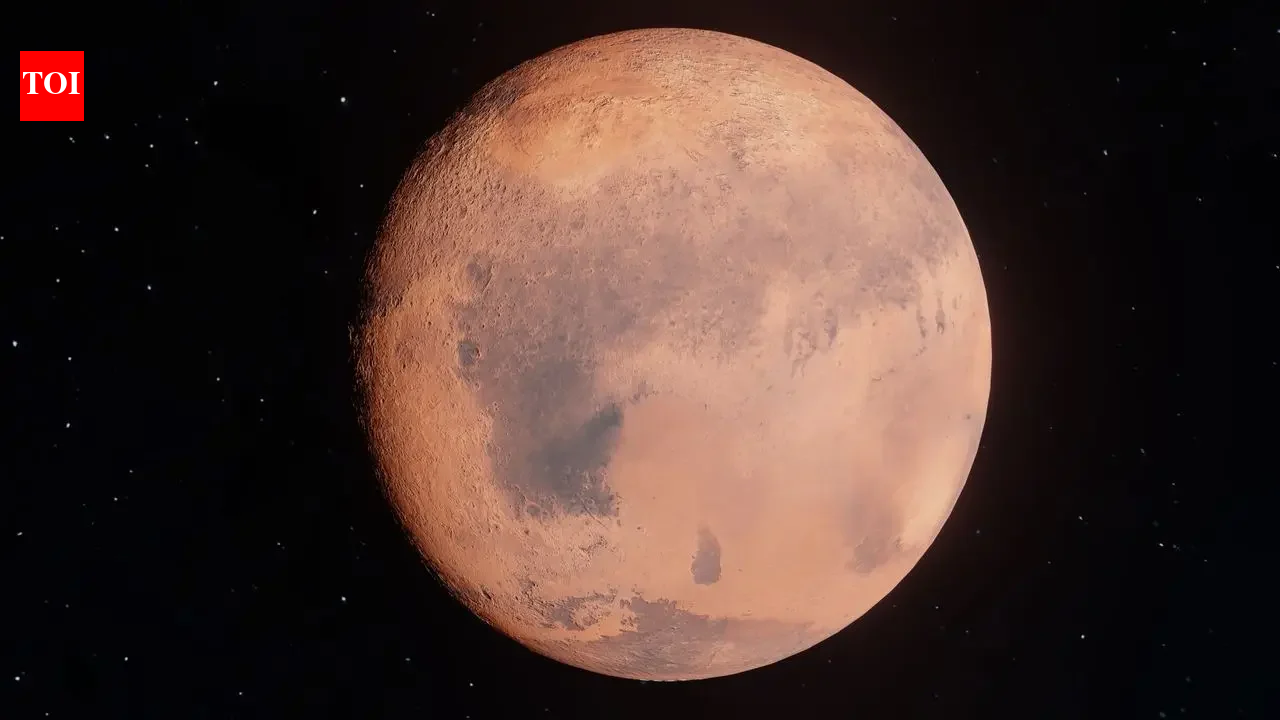
An international research team studying a fragment of the Martian meteorite Northwest Africa 8171 has discovered a previously unidentified rock type from Mars, along with the first recorded presence of the mineral garnet within a Martian geological sample. The investigation, based at the Royal Ontario Museum in Toronto and led by researcher Tanya Kizovski, provides researchers with physical evidence of complex geological processes operating in Mars' interior or during catastrophic impact events, offering fresh clues about the evolution of the Red Planet's early crust.
Key facts
What happened
Researchers examining the internal petrology of Northwest Africa 8171 isolated an anomalous lithic clast embedded within the meteorite's dark matrix. Meteorites classified under the Northwest Africa 8171 designation are polymict regolith breccias—composite rocks formed by the physical consolidation of broken rock fragments, mineral grains, and impact glass on the Martian surface. Because breccias aggregate disparate materials tossed together by volcanic eruptions and meteor strikes, individual specimens can preserve microscopic fragments from geological formations that no robotic rover or satellite has visited directly.
Using high-resolution spectroscopic techniques and micro-beam analytical tools, the team led by Tanya Kizovski mapped the mineralogical composition of the meteorite slice held by the Royal Ontario Museum. The investigation revealed an assemblage of silicate minerals unlike any previously documented among Martian meteorites or surface rocks analyzed by robotic missions. Interspersed within this lithology were discrete grains of garnet, an orthosilicate mineral group long hypothesized to exist within deep planetary interiors but never before observed directly in physical material originating from Mars.
Subsequent mineralogical characterization focused on verifying the chemistry of the garnet grains to rule out terrestrial contamination, a pervasive risk for meteorites recovered from desert environments where windborne dust and weathering can alter mineral surfaces. The geochemical signatures, elemental ratios, and crystal boundaries demonstrated that the garnet formed as an integral component of the parent rock prior to its ejection from Mars, confirming the mineral as genuinely indigenous to the Martian environment.
Why it matters
For planetary scientists, finding garnet in a Martian sample alters existing models of the planet's internal pressure, temperature regimes, and thermal evolution. On Earth, garnets are common rock-forming minerals found primarily in metamorphic terrains subjected to elevated temperatures and extreme pressures—such as subduction zones and mountain roots—as well as within deep mantle rocks like peridotite and eclogite. Because Mars lacks terrestrial-style plate tectonics, geologists have long debated whether conditions sufficient to crystallize garnet were ever achieved in accessible portions of the Martian crust.
If the newly identified rock formed through deep magmatic or metamorphic processes, its existence demonstrates that the early Martian crust was thick enough and dynamically active enough to produce localized high-pressure environments before cooling into the stagnant lid state seen today. Alternatively, if the garnet crystallized as a result of shock metamorphism triggered by an immense asteroid strike, it provides crucial calibration data for how violent surface collisions reshape silicate minerals on planetary bodies with lower surface gravity than Earth. In either case, the discovery provides an empirical benchmark that improves the accuracy of orbital remote-sensing instruments, which rely on laboratory spectral libraries to interpret data collected from Martian orbit.
The background
Until the recovery of the Northwest Africa 7034 clan in the early 2010s, virtually all cataloged Martian meteorites belonged to the SNC group: shergottites, nakhlites, and chassignites. These SNC meteorites consist almost exclusively of relatively young igneous rocks, predominantly basalts and ultramafic cumulates ranging in age from roughly 180 million to 1.3 billion years old. While valuable, SNC meteorites offer a skewed perspective, representing young volcanic flows rather than the vast expanses of ancient cratered terrain that characterize the majority of the Martian southern highlands.
Northwest Africa 7034 and its paired stones, including NWA 8171, transformed Martian geology upon their scientific description in 2013. Sourced from the deserts of northwest Africa, these paired stones represent ancient sedimentary or regolith breccias containing components dated to approximately 4.4 billion years ago, during the Noachian or pre-Noachian epochs. They preserve physical relics from the earliest era of Mars, a time when the planet possessed an active magnetic dynamo, widespread surface water, and frequent impact bombardment.
Curated museum collections play an indispensable role in extracting new science from these stones over extended periods. Because meteorites are scarce—only a few hundred kilograms of verified Martian material exist on Earth across all collections—institutions like the Royal Ontario Museum conserve specimens in controlled environments, making slivers available as analytical technologies advance. Instruments capable of non-destructive nano-scale imaging, electron backscatter diffraction, and high-precision isotopic mass spectrometry have made it possible to isolate millimeter-sized clasts inside meteorites and identify minerals that went unnoticed during initial classifications a decade ago.
Reaction
The planetary science community has greeted the detection of Martian garnet with considerable interest, though specialists emphasize the necessity of corroborating the geological context through peer-reviewed validation. Researchers who study terrestrial metamorphic geology and impact physics have expressed particular interest in examining the specific chemical composition of the garnet—specifically the proportions of pyrope, almandine, spessartine, and grossular endmembers—which serve as precise geological thermometers and barometers.
Curators and planetary geologists at international conferences and specialized symposia are expected to scrutinize the structural relationship between the garnet grains and adjacent mineral phases. Discussions among specialists will focus on whether the mineral displays signs of solid-state shock transformation, which would indicate an impact origin, or equilibrium crystallization textures consistent with slow cooling deep within a magma chamber or a thick volcanic sequence.
What we don't know yet
Significant uncertainties remain regarding the provenance and formation history of the newly identified rock clast. Foremost among these open questions is the exact setting in which the garnet crystallized. While researchers have verified the mineral's existence in the sample, planetary scientists cannot yet definitively state the depth at which the host rock originated or the geological mechanism that produced it. Without definitive pressure-temperature boundary calculations, the sample could represent an excerpt from the deep Martian mantle, an uncharacterized layer of the lower crust, or an impact-melt sheet formed near the planetary surface during a cataclysmic collision.
Furthermore, the precise age of the garnet-bearing lithology remains unmeasured. Although the broader NWA 8171 breccia matrix incorporates materials that crystallized approximately 4.4 billion years ago, regolith breccias regularly incorporate younger debris created by later impacts. Radiometric dating targeting the isotopic ratios of the garnet or its adjacent mineral phases will be necessary to establish whether the rock formed during Mars' primordial crustal building phase or during a subsequent volcanic or impact event.
What to watch
Moving forward, several key milestones will clarify the implications of the Royal Ontario Museum discovery. Scientists will watch for the publication of comprehensive crystallographic and isotopic data in peer-reviewed planetary science journals, which will document the exact compositional profile of the garnet grains and establish their chemical boundaries.
Parallel attention will center on data arriving from robotic missions operating on the Martian surface and in orbit. NASA's Perseverance rover, currently collecting core samples in Jezero Crater, carries spectrometers specifically designed to detect varied mineral groups across exposed rock outcrops. Planetary scientists will compare orbital spectral scans from the Mars Reconnaissance Orbiter's Compact Reconnaissance Imaging Spectrometer for Mars (CRISM) against the newly recorded laboratory signatures from NWA 8171 to determine whether similar garnet-bearing lithologies can be mapped across broad regions of the Martian surface. Ultimately, future sample return initiatives, which aim to transport sealed Martian core samples to Earth-based laboratories in the 2030s, will determine whether garnet is a localized anomaly or a widespread component of the planet's hidden stratigraphy.
This report is based on original reporting published by TOI Science Desk.
How this story was produced
This report was written by The Global Wire newsroom from reporting first published by TOI Science Desk. We verify the core facts against the original report, write our own account, and add the background and consequences a short wire item leaves out. Drafting is AI-assisted inside an editor-supervised pipeline, and every story is checked for accuracy of attribution, structure and duplication before it appears — full detail in our AI and funding disclosure.
Spotted an error? Tell us at corrections@horizonglobalnews.com and read our corrections policy or editorial standards.





Reader comments
Loading comments…