

Jensen Huang Steps Down from Nvidia, Opening New Chapter for AI Chip Market
The departure of Nvidia's co-founder and longtime chief executive raises questions over whether rivals can break the company's grip on artificial intelligence hardware.
By The Global Wire Newsroom · Reported from bloomberg.com
Link preview · horizonglobalnews.com
Jensen Huang Steps Down from Nvidia, Opening New Chapter for AI Chip Market
The departure of Nvidia's co-founder and longtime chief executive raises questions over whether rivals can break the company's grip on artificial intelligence hardware.
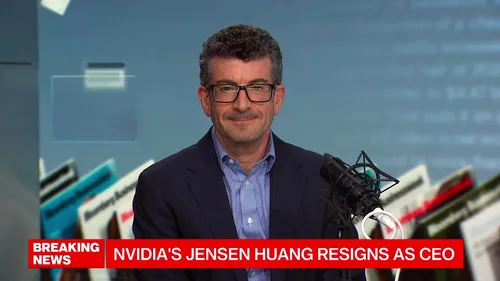
SANTA CLARA, Calif. — Jensen Huang's departure from Nvidia Corp. has sent shockwaves through the global semiconductor industry, raising immediate questions over whether competitors can begin to erode the Silicon Valley company's commanding lead in artificial intelligence hardware. While enterprise demand for accelerated computing and high-performance graphics processing units remains resilient, the exit of Nvidia's visionary co-founder and long-serving chief executive removes the central architect of the modern AI computing boom at a critical juncture for the company, according to analysis published by Bloomberg.
Key facts
What happened
Jensen Huang, who has guided Nvidia since its founding in 1993, is leaving the helm of the semiconductor powerhouse, according to reporting by Bloomberg. The move marks the end of one of the longest and most consequential chief executive tenures in the history of the technology industry. Under Huang's direction, Nvidia evolved from a niche manufacturer of computer gaming graphics cards into the hardware foundation of the global artificial intelligence economy, reaching a multi-trillion-dollar market capitalization.
Following the announcement, financial markets and technology analysts quickly turned their focus toward the competitive ramifications of Huang's exit. In assessments published by Bloomberg Intelligence, senior analysts Robert Schiffman and Mandeep Singh observed that broader appetite for artificial intelligence infrastructure remains fundamentally sound. Major technology corporations continue to allocate unprecedented capital expenditure budgets toward specialized computing clusters, data centers, and advanced networking systems.
However, Schiffman and Singh noted that Huang's departure introduces an element of executive uncertainty that could provide an opening for competing hardware designers. For years, Nvidia's aggressive annual product cadence and tight hardware-software integration have kept rival semiconductor manufacturers at a distinct disadvantage. With Huang vacating the top post, industry observers are re-evaluating whether competing chipmakers can leverage this transition period to secure supply contracts and chip design wins with major technology customers.
Why it matters
Nvidia's market power across the artificial intelligence ecosystem is virtually without precedent in modern computing. The company's high-bandwidth processors, such as its Hopper and Blackwell system architectures, have served as the core computational engine for nearly every breakthrough in large language models and frontier generative systems. When a single firm commands an estimated market share exceeding 80 percent in such a strategic sector, any disruption in senior leadership carries macro-level consequences for global supply chains, equity markets, and technology governance.
For enterprise customers, including cloud computing giants such as Microsoft Corp., Alphabet Inc., Amazon.com Inc., and Meta Platforms Inc., the immediate concern centers on roadmap continuity. Cloud hyperscalers have collectively directed tens of billions of dollars each quarter toward Nvidia-powered clusters. If leadership changes disrupt Nvidia's release schedules, supply-chain execution, or strategic partnerships, enterprise buyers will face difficult choices regarding future infrastructure allocation.
Concurrently, Huang's exit matters profoundly for rival semiconductor manufacturers. Companies like Advanced Micro Devices (AMD) and Intel have spent years investing in competing silicon architectures, such as AMD's Instinct accelerator lineup. However, competing against Huang's entrenched market position and singular leadership authority has proved extraordinarily difficult. A leadership transition at Nvidia could prompt enterprise chief information officers and procurement executives to diversify their vendor relationships, reducing their dependence on a single supplier and opening the door to multi-vendor hardware environments.
The background
Jensen Huang co-founded Nvidia in April 1993 alongside Chris Malachowsky and Curtis Priem at a roadside diner in San Jose, California. The company initially focused on specialized 3D graphics chips for personal computer gaming, inventing what it formally defined as the graphics processing unit (GPU) with the release of the GeForce 256 in 1999. In that era, graphics hardware relied on fixed-function pipelines optimized strictly for rendering geometric polygons on computer monitors.
A foundational shift occurred in 2006 when Huang directed Nvidia to invest hundreds of millions of dollars into developing CUDA (Compute Unified Device Architecture). CUDA transformed Nvidia's GPUs into programmable, general-purpose parallel computing engines. The investment compressed company profit margins for several years and was initially met with skepticism by Wall Street. However, the decision established a robust software moat: developers, researchers, and computer scientists globally standardized their mathematical computing and scientific simulations on Nvidia's proprietary platform.
When deep learning gained mainstream academic prominence in 2012—exemplified by the AlexNet neural network's breakthrough performance using Nvidia desktop gaming cards—Nvidia was uniquely positioned to capitalize on the nascent field. Under Huang's leadership, the company pivoted entirely toward enterprise artificial intelligence, designing purpose-built tensor processing cores, high-throughput interconnects such as NVLink, and comprehensive software libraries spanning entire vertical industries.
In recent years, the explosion of generative artificial intelligence following late-2022 product rollouts pushed demand for Nvidia's enterprise accelerators to historic heights. Hardware models including the A100 and H100 became among the most sought-after technological assets on Earth, generating waitlists stretching over several quarters and catapulting Nvidia into the ranks of the world's most valuable public corporations alongside Apple and Microsoft. Throughout this trajectory, Huang remained the public face, chief strategist, and product evangelist for the enterprise, maintaining an unusually hands-on management structure that direct reports characterized as central to the company's speed.
Reaction
The announcement of Huang's departure immediately shifted market discourse toward the future balance of power in enterprise silicon. According to reporting by Bloomberg, analysts Robert Schiffman and Mandeep Singh emphasized that the underlying drivers of artificial intelligence hardware investment are not dissipating. Technology companies, sovereign wealth funds, and national governments continue to finance artificial intelligence sovereign clouds and commercial infrastructure at a breakneck pace.
Nonetheless, equity analysts and institutional investors are expected to closely scrutinize the upcoming executive appointments and governance statements from Nvidia's board of directors. Key industry counterparties—including Taiwan Semiconductor Manufacturing Co. (TSMC), which manufactures Nvidia's most advanced silicon designs on leading-edge lithography nodes—and packaging partners will be evaluating whether long-term production agreements experience any operational friction. Representatives across the semiconductor supply chain, as well as enterprise software customers who have built foundational platforms on CUDA, are preparing for regulatory filings and public commentary during upcoming quarterly earnings presentations.
What we don't know yet
Significant operational and corporate governance details remain undisclosed in the immediate aftermath of the announcement. The available reporting does not specify the precise timing of Huang's departure, whether he will immediately vacate his board seat, or whether he plans to transition into an advisory capacity or executive chairmanship. Crucially, Nvidia has not yet announced a formal successor, leaving open the question of whether the board will promote an internal veteran steeped in the company's engineering-first culture or recruit an external executive from the broader technology landscape.
Furthermore, the long-term impact on Nvidia's engineering culture and customer relationships is unmeasured. Huang maintained an unconventional organizational structure with dozens of direct reports and an intense, flat hierarchy designed to eliminate corporate inertia. Whether an incoming chief executive can maintain that operating velocity while preserving critical relationships with foundry suppliers, system integrators, and sovereign clients remains entirely unproven.
What to watch
In the coming weeks, market observers must track several critical indicators to assess how the executive transition unfolds:
This article includes reporting originally published by Bloomberg.
How this story was produced
This report was written by The Global Wire newsroom from reporting first published by bloomberg.com. We verify the core facts against the original report, write our own account, and add the background and consequences a short wire item leaves out. Drafting is AI-assisted inside an editor-supervised pipeline, and every story is checked for accuracy of attribution, structure and duplication before it appears — full detail in our AI and funding disclosure.
Spotted an error? Tell us at corrections@horizonglobalnews.com and read our corrections policy or editorial standards.




Reader comments
Loading comments…