

Jensen Huang’s Nvidia Return Triggers Wave of Synthetic Media Parodies
The reinstatement of Nvidia's chief executive after an espionage-linked scandal has prompted an explosion of hyper-realistic deepfakes, exposing new challenges for corporate governance and synthetic media.
By The Global Wire Newsroom · Reported from AFP Staff
Link preview · horizonglobalnews.com
Jensen Huang’s Nvidia Return Triggers Wave of Synthetic Media Parodies
The reinstatement of Nvidia's chief executive after an espionage-linked scandal has prompted an explosion of hyper-realistic deepfakes, exposing new challenges for corporate governance and synthetic media.
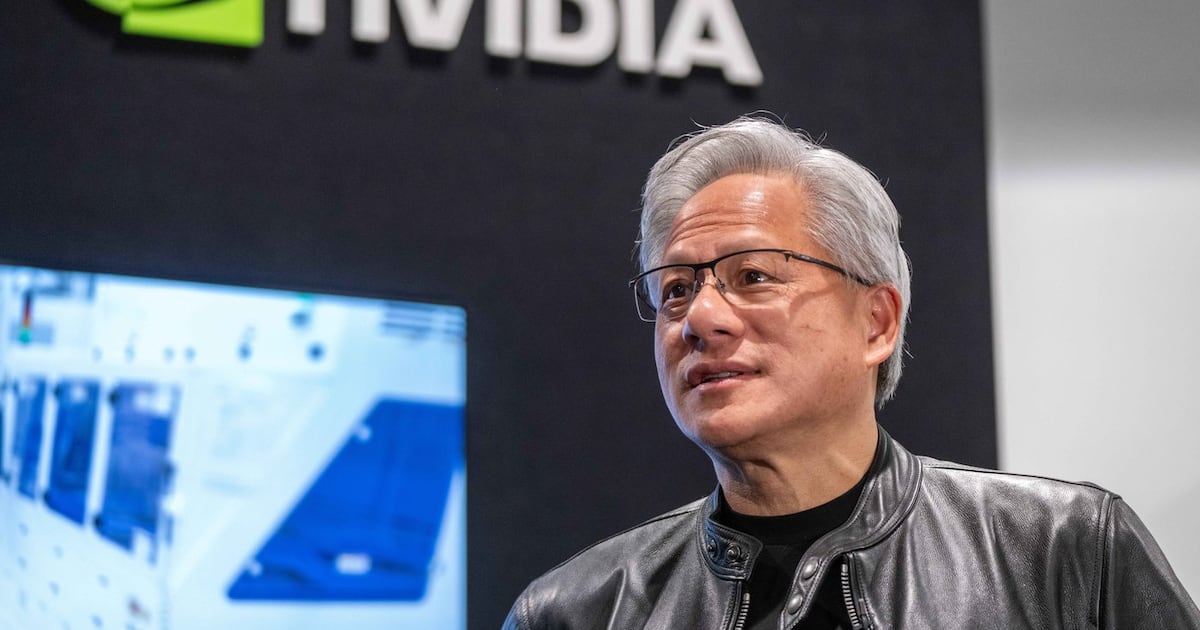
The reinstatement of Jensen Huang as chief executive officer of American semiconductor titan Nvidia Corp. has set off a widespread proliferation of artificial intelligence-generated parody videos across digital networks, according to reporting by Agence France-Presse. The return of the high-profile technology executive, following a period dominated by allegations involving personal misconduct and corporate espionage, immediately catalyzed internet creators and satire accounts who deployed sophisticated generative video tools to caricature Huang's public image. The resulting flood of synthetic media has brought renewed attention to the rapid maturation of generative tools—ironically running on the very graphics processing architecture that Nvidia manufactures—and the acute vulnerabilities public companies face when executive controversies enter the digital public sphere.
Key facts
What happened
Jensen Huang’s formal resumption of the chief executive office at Nvidia served as the catalyst for an immediate, coordinated wave of synthetic video production across multiple digital platforms, according to AFP. Internet creators, satirists, and digital communities deployed state-of-the-art synthetic media software to generate video clips portraying Huang in a variety of staged, fictional, and hyperbolic scenarios.
According to the AFP account, the satirical media drew heavily upon the sensational elements of the controversy that had previously enveloped Huang and Nvidia, which centered on a complex narrative combining allegations of sexual impropriety and industrial or geopolitical espionage. In numerous clips disseminated online, digital facsimiles of Huang were rendered using high-fidelity face-swapping algorithms, text-to-video generators, and neural voice models that accurately mimic his vocal cadence and tone. Many of the synthetic productions embraced bombastic slogans such as "the king is back," juxtaposing his trademark public persona—frequently recognizable by his signature black leather jacket—with dramatic narrative tropes borrowed from cinema and espionage thrillers.
Rather than relying on basic, easily identifiable video manipulations, the media deluge featured advanced lip-synchronization and contextual generative backgrounds. These videos portrayed Huang delivering fabricated speeches to investors, confronting corporate rivals, and addressing the allegations that had precipitated his temporary absence from the helm of the world’s leading artificial intelligence chip designer. While many of the clips were clearly marked as parodies or published in overtly humorous contexts, the high visual fidelity and rapid distribution of the files underscored how readily modern generative AI pipelines can produce convincing representations of prominent international figures within hours of breaking news events.
Why it matters
The episode carries significant implications for corporate crisis communications, investor confidence, and the broader information ecosystem surrounding publicly traded technology companies. For Nvidia, an enterprise whose market capitalization climbed into the trillions of dollars on the back of the worldwide generative artificial intelligence expansion, the situation represents a peculiar corporate irony: the company’s own computational infrastructure provides the foundation for the technologies now used to lampoon its corporate leadership.
In contemporary equity markets, executive credibility is intimately linked to share valuation. When chief executives face controversies involving personal conduct or national security risks such as espionage, corporate communication teams typically rely on highly controlled, measured messaging to calm institutional investors and supply-chain partners. The spontaneous emergence of hyper-realistic deepfakes undermines this control. Synthetic clips can be clipped, altered, or stripped of their parody disclaimers, entering trading algorithms, retail investment forums, and international news feeds as genuine statements. In fast-moving market environments, even temporary confusion regarding an executive's actual statements or legal posture can trigger sudden market volatility.
Furthermore, the incident demonstrates that the threshold for producing broadcast-quality synthetic video has effectively collapsed. What once required Hollywood-level visual effects studios and weeks of post-production rendering can now be assembled by decentralized online creators within minutes of a news alert. This shift introduces profound reputational risks not only for Nvidia but for any multinational corporation whose leadership faces high-stakes public scrutiny, complicating the ability of regulators, journalists, and the public to separate verified corporate disclosures from synthetic fabrications.
The background
Jensen Huang co-founded Nvidia in 1993 alongside Chris Malachowsky and Curtis Priem, steering the Santa Clara, California-based firm from a specialized designer of 3D graphics processors for personal computer gaming into the dominant computational force of the modern technology sector. Over three decades of leadership, Huang maintained an unusually enduring presence at the top of an American technology giant, establishing a charismatic public profile that made him synonymous with the company’s identity.
Nvidia’s fortunes transformed dramatically with the rise of deep learning in the early 2010s, when researchers discovered that the parallel processing capabilities of graphics processing units (GPUs) were ideally suited for training complex neural networks. By the time OpenAI released ChatGPT in late 2022, Nvidia had established a near-monopoly on high-end data-center accelerators, with its A100, H100, and subsequent Blackwell architecture architectures commanding market shares estimated above 80 percent in AI model training. This dominance turned Nvidia into a pivotal geopolitical asset, subjecting the company to intense scrutiny under United States export control regimes administered by the Department of Commerce, which sought to restrict advanced semiconductor shipments to strategic competitors, most notably China.
Against this backdrop of intense geopolitical friction, allegations touching on both corporate or sovereign espionage and personal executive impropriety represent an acute crisis for a hardware manufacturer tied to national security supply chains. Simultaneously, the underlying software models that generate synthetic media—ranging from diffusion models to generative adversarial networks and transformer-based voice models—have experienced rapid advancements in fidelity, multimodal reasoning, and accessibility. The confluence of these technological capabilities with Huang’s distinctive personal brand created the conditions for a viral cultural phenomenon once his leadership status shifted.
Reaction
Neither Nvidia’s corporate communications office nor Jensen Huang released formal statements directly addressing the parody deepfake deluge in the immediate aftermath of the initial wave, according to the available reporting. Corporate governance professionals, cybersecurity analysts, and digital ethics watchdogs, however, have observed the phenomenon with acute interest.
Legal experts who monitor digital likeness rights and synthetic deception point out that while parody has historically enjoyed broad protection under the First Amendment of the U.S. Constitution and equivalent international jurisprudence, the deployment of hyper-realistic biometric replicas tests existing legal boundaries. Corporate boards and general counsel are increasingly expected to evaluate whether synthetic parodies infringe on intellectual property, constitute commercial defamation, or violate nascent digital replica statutes. In regulatory forums, digital consumer advocacy groups have cited instances of executive deepfakes to argue before bodies like the U.S. Federal Trade Commission (FTC) and the European Commission that digital watermarking and provenance standards—such as those promoted by the Coalition for Content Provenance and Authenticity (C2PA)—must be made mandatory for consumer-facing AI generation applications.
What we don't know yet
Several critical elements of the situation remain unclarified by the available disclosures. The AFP report does not specify the precise terms, duration, or governance mechanisms that accompanied Huang’s initial step back from executive duties, nor does it detail the formal findings of any internal or external investigations into the allegations of personal misconduct and espionage. It is unclear whether law enforcement agencies, such as the U.S. Department of Justice or federal counterintelligence bodies, ever launched formal proceedings related to the espionage claims, or whether the matter was resolved purely through corporate governance procedures.
Additionally, the reporting does not identify specific digital platforms where the deepfakes achieved the highest concentration, nor whether platform safety teams have taken steps to label, downrank, or remove the synthetic videos under existing synthetic media policies. The degree to which major institutional shareholders have raised concerns regarding the executive's return, or the potential impact of the controversy on Nvidia’s upcoming regulatory clearances and commercial partnerships, remains similarly undocumented.
What to watch
In the coming weeks, attention will focus squarely on Nvidia’s institutional schedule, particularly its upcoming quarterly earnings report and conference call with financial analysts. Market observers will watch to see whether Huang addresses the controversy directly or focuses exclusively on product roadmaps, data-center demand, and semiconductor production milestones. Any deviation from standard corporate communication could prompt immediate market reactions.
Close monitoring is also warranted regarding the regulatory response to the synthetic media wave. With governments in the United States, the European Union, and East Asia implementing frameworks such as the EU AI Act and state-level deepfake disclosure statutes in jurisdictions like California, regulatory agencies may treat the rapid weaponization of executive likenesses as a test case for enforcement. Observers will also track whether major social media and distribution platforms enforce labeling requirements or content moderation interventions on parody videos depicting corporate executives, and whether Nvidia takes legal steps against creators who produce synthetic material crossing from satire into defamation or financial disinformation.
This report incorporates information originally reported by Agence France-Presse.
How this story was produced
This report was written by The Global Wire newsroom from reporting first published by AFP Staff. We verify the core facts against the original report, write our own account, and add the background and consequences a short wire item leaves out. Drafting is AI-assisted inside an editor-supervised pipeline, and every story is checked for accuracy of attribution, structure and duplication before it appears — full detail in our AI and funding disclosure.
Spotted an error? Tell us at corrections@horizonglobalnews.com and read our corrections policy or editorial standards.




Reader comments
Loading comments…