

Heimplanet Redesigns Inflatable Basecamp Tent Engineered for 100-Mph Winds
An overhaul of the Mavericks geodesic air tent aims to shelter 10 people against extreme weather with a 10-minute setup, expanding pneumatic structural design in harsh environments.
By The Global Wire Newsroom · Reported from C C Weiss
Link preview · horizonglobalnews.com
Heimplanet Redesigns Inflatable Basecamp Tent Engineered for 100-Mph Winds
An overhaul of the Mavericks geodesic air tent aims to shelter 10 people against extreme weather with a 10-minute setup, expanding pneumatic structural design in harsh environments.
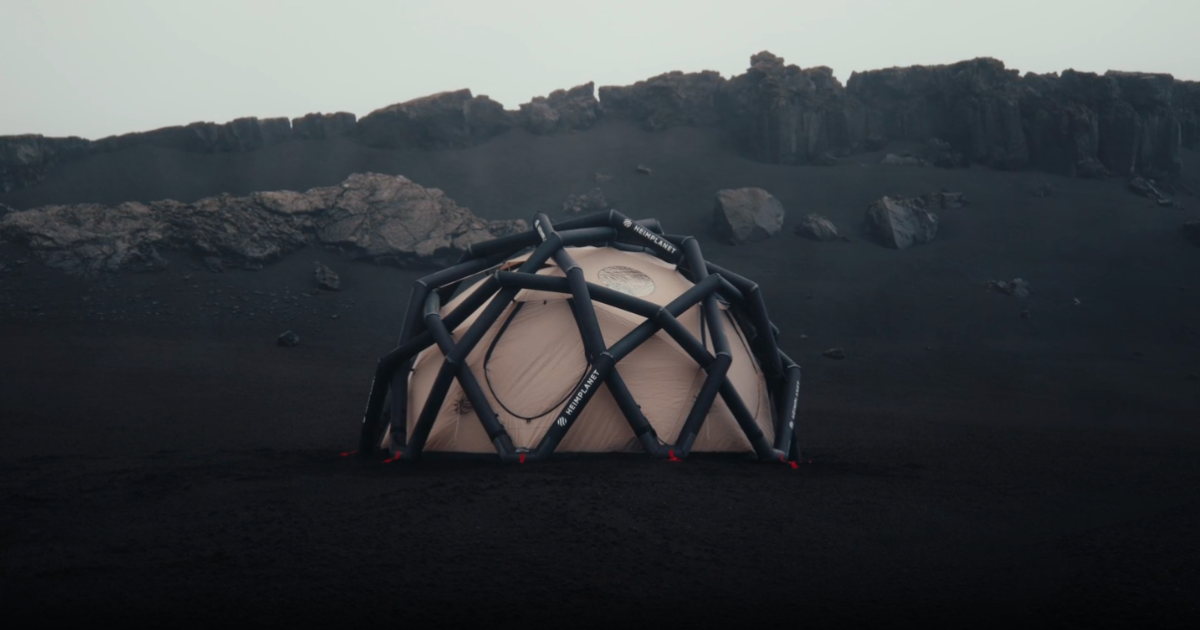
German outdoor equipment manufacturer Heimplanet has unveiled a comprehensive redesign of its flagship Mavericks basecamp tent for 2026, updating a high-capacity inflatable geodesic shelter designed to withstand severe gale conditions. The updated system is engineered to house up to 10 occupants and erect within approximately 10 minutes using pneumatic inflation, according to reporting by journalist C C Weiss. Originally developed to provide tactical shelter in punishing marine and alpine environments, the updated shelter integrates structural reinforcements and refined fabric geometry to increase resistance against wind speeds exceeding 100 miles per hour (161 kilometers per hour), positioning pneumatic architecture as an increasingly viable alternative to traditional rigid-pole basecamp structures used by scientific teams, extreme expeditions, and humanitarian responders.
Key facts
What happened
According to reporting by C C Weiss, Heimplanet has released the 2026 iteration of the Mavericks tent, marking the most substantial overhaul of the company's largest inflatable shelter since its commercial introduction. The Mavericks model stands at the apex of the manufacturer's geodesic tent portfolio, which replaces traditional rigid pole frameworks with an interconnected lattice of pressurized air beams known as an Inflatable Diamond Grid.
The redesign focuses primarily on durability, environmental shedding, and structural stability under extreme meteorological duress. While the previous generation of the Mavericks was already rated to withstand storm-force winds of over 100 mph (161 km/h)—equivalent to a Category 2 hurricane on the Saffir-Simpson wind scale—the 2026 variant integrates re-engineered outer textiles, revised beam integration, and enhanced anchoring points to withstand persistent buffeting, heavy snow precipitation, and torrential rainfall.
Despite an internal footprint and volume designed to sleep up to 10 individuals or function as an operational workspace for expedition crews, the structure retains a single-point or multi-valve inflation protocol that enables full setup in roughly 10 minutes. By pumping air into the multi-chamber skeleton, users can elevate the entire geodesic dome without assembling, threading, or bending rigid poles—a mechanical process that historically requires several team members and presents severe failure risks during sub-zero or high-wind deployment.
Why it matters
The modernization of high-capacity pneumatic shelters carries practical consequences for professional outdoor expeditions, remote research operations, and emergency logistical response. For decades, extreme-weather group shelters have relied almost exclusively on heavy, complex geodesic pole systems, such as large-scale expedition domes produced by alpine manufacturers. While structurally robust once fully erected and guyed out, conventional rigid-pole structures possess a critical operational vulnerability: the assembly window. Pitching a large rigid dome in sustained winds above 40 mph often requires three to five individuals fighting against sail-like fabric panels, where a single dropped, bent, or fractured pole can compromise the entire shelter or injure crew members.
Pneumatic airframe systems fundamentally change that operational profile. Because inflatable beams can be anchored flat to the terrain before pressure is applied, personnel can secure the perimeter and introduce air via manual pumps, battery-powered inflators, or compressed gas canisters without exposing loose, fragile poles to bending moments. If an extreme wind gust depresses a pressurized air beam past its structural yield point, the beam flexes, absorbs the kinetic energy, and immediately rebounds once the gust subsides. A rigid aluminum pole exposed to identical momentary forces bends permanently or snaps, frequently tearing the outer rainfly and leaving occupants exposed to the elements.
Furthermore, expedition logistics are governed by transport volume and weight. Large geodesic pole bags often measure over a meter in length, posing transport hurdles on bush aircraft, cargo sledges, and pack animals. Inflatable airframes compress into unified, flexible bags that pack more efficiently into standard cargo containers. By verifying that an airframe structure can consistently survive Category 2 hurricane winds while maintaining a 10-minute setup cycle, the updated design offers research institutions, polar stations, and tactical emergency agencies an alternative that mitigates setup risks in environments where exposure can turn fatal within minutes.
The background
Heimplanet, established in Hamburg, Germany, in 2011 by founders Stefan Clauss and Stefan Schulze-Dieckhoff, pioneered the commercial outdoor application of geodesic pneumatic shelters with the release of "The Cave," a three-person tent supported by an external inflatable cage. The foundational concept was derived from architectural principles established by American visionary R. Buckminster Fuller in the mid-20th century, who demonstrated that geodesic domes distribute mechanical loads across triangular or diamond grids more efficiently than rectilinear or hoop-style frames.
To translate Fuller's geometry into pneumatic materials, Heimplanet developed its Inflatable Diamond Grid (IDG). Rather than relying on a single continuous air tube, the architecture divides the frame into multiple discrete, valve-isolated chambers. During initial setup, the chambers can be inflated simultaneously through linked ports. Once pressurized, the user closes separating valves, isolating each structural tube. Consequently, if one chamber suffers an abrasion puncture, the surrounding chambers remain fully pressurized, preventing structural collapse and allowing field repairs.
The original Mavericks tent was designed as an extreme expedition shelter, notably deployed during high-profile athletic and exploratory initiatives such as the Red Bull Storm Chase, where windsurfers and support crews tracked and operated directly inside storm systems producing hurricane-strength coastal winds. Outside of consumer outdoor recreation, structural air beams have historically seen widespread adoption in military field hospitals, chemical-biological decontamination units, and aviation hangars manufactured by defense contractors. However, translating those industrial capabilities into a transportable, human-packable expedition shelter required advances in thermoplastic polyurethane (TPU) bladders, high-tenacity ripstop polyester covers, and high-frequency welded seams capable of holding pressures between 4 and 8 pounds per square inch across extreme temperature swings.
Reaction
The outdoor recreation and expedition equipment sector typically views high-capacity pneumatic shelters through a lens of technical skepticism balanced by growing operational curiosity. Traditional mountaineering and polar expeditions have historically adhered to rigid aluminum pole systems, citing field-proven reliability spanning decades and expressing concerns over potential valve degradation, puncture vulnerability on jagged terrain, and the physical effect of sub-zero temperatures on air pressure. Boyle's law dictates that structural air volume decreases as ambient temperature plummets, requiring teams operating in polar or high-altitude environments to monitor beam pressure actively and introduce supplemental air as night temperatures drop.
Conversely, logistics directors for remote film crews, polar tourism operators, and search-and-rescue teams have increasingly welcomed rapid-inflation shelters. Industry observers anticipate evaluations from third-party alpine testing groups and extreme-environment specialists following the 2026 rollout, particularly regarding how the updated fabric treatments and seam welds perform in sustained UV exposure and sub-freezing conditions. Professional testing bodies, such as the German Technical Inspection Association (TÜV) or outdoor gear testing laboratories, are expected to scrutinize the shelter's deflection angles under artificial wind tunnel conditions to substantiate the manufacturer's operational claims.
What we don't know yet
Several key technical and operational specifications remain unconfirmed in the initial reporting. While the shelter is documented to erect in approximately 10 minutes and shelter 10 people against 100-mph winds, the complete breakdown of packed weight, compressed volume, and retail pricing for the 2026 iteration has not been detailed. The original generation of the Mavericks commanded an expensive price point running into thousands of dollars and carried a significant overall weight, making it a specialized logistical investment rather than a standard consumer purchase.
Additionally, the reporting does not delineate the exact material composition of the updated outer canopy or whether the internal living quarters feature modular thermal linings for polar deployment. It also remains unclear whether the stated 10-minute inflation metric relies on manual double-action floor pumps, high-volume electric compressors, or pressurized gas cartridges, and how that assembly time fluctuates when operating in negative double-digit temperatures where materials stiffen. Finally, detailed documentation outlining specific puncture repair protocols in sub-zero whiteout conditions has not been publicly released.
What to watch
In the coming months, industry observers and prospective institutional buyers should watch for the publication of comprehensive field-test data and independent wind-tunnel validation reports. Commercial availability dates and distribution channels across North America, Europe, and Asia will clarify whether the 2026 Mavericks will be marketed strictly through specialized commercial and institutional channels or offered through mainstream outdoor retail networks.
Long-term deployment results by early institutional adopters—such as scientific teams in Patagonia, Greenland, or maritime disaster relief sectors—will provide the first real-world benchmarks regarding material fatigue, seam longevity, and cold-temperature pressure retention. Furthermore, watchers should track whether competitors in the expedition shelter market respond by integrating hybrid air-and-pole frameworks or launching competing high-pressure inflatable basecamp structures, signaling a broader industrial pivot away from century-old rigid pole paradigms.
This article incorporates reporting originally published by journalist C C Weiss, detailing the release and specifications of Heimplanet's updated 2026 Mavericks inflatable geodesic tent.
How this story was produced
This report was written by The Global Wire newsroom from reporting first published by C C Weiss. We verify the core facts against the original report, write our own account, and add the background and consequences a short wire item leaves out. Drafting is AI-assisted inside an editor-supervised pipeline, and every story is checked for accuracy of attribution, structure and duplication before it appears — full detail in our AI and funding disclosure.
Spotted an error? Tell us at corrections@horizonglobalnews.com and read our corrections policy or editorial standards.





Reader comments
Loading comments…