

F-35C Completes First Arrested Landing on Ford-Class Aircraft Carrier
Lockheed Martin's carrier-variant stealth fighter concluded 11 days of shipboard evaluations aboard the U.S. Navy's newest 100,000-ton aircraft carrier class.
By The Global Wire Newsroom · Reported from Aamir Khollam
Link preview · horizonglobalnews.com
F-35C Completes First Arrested Landing on Ford-Class Aircraft Carrier
Lockheed Martin's carrier-variant stealth fighter concluded 11 days of shipboard evaluations aboard the U.S. Navy's newest 100,000-ton aircraft carrier class.
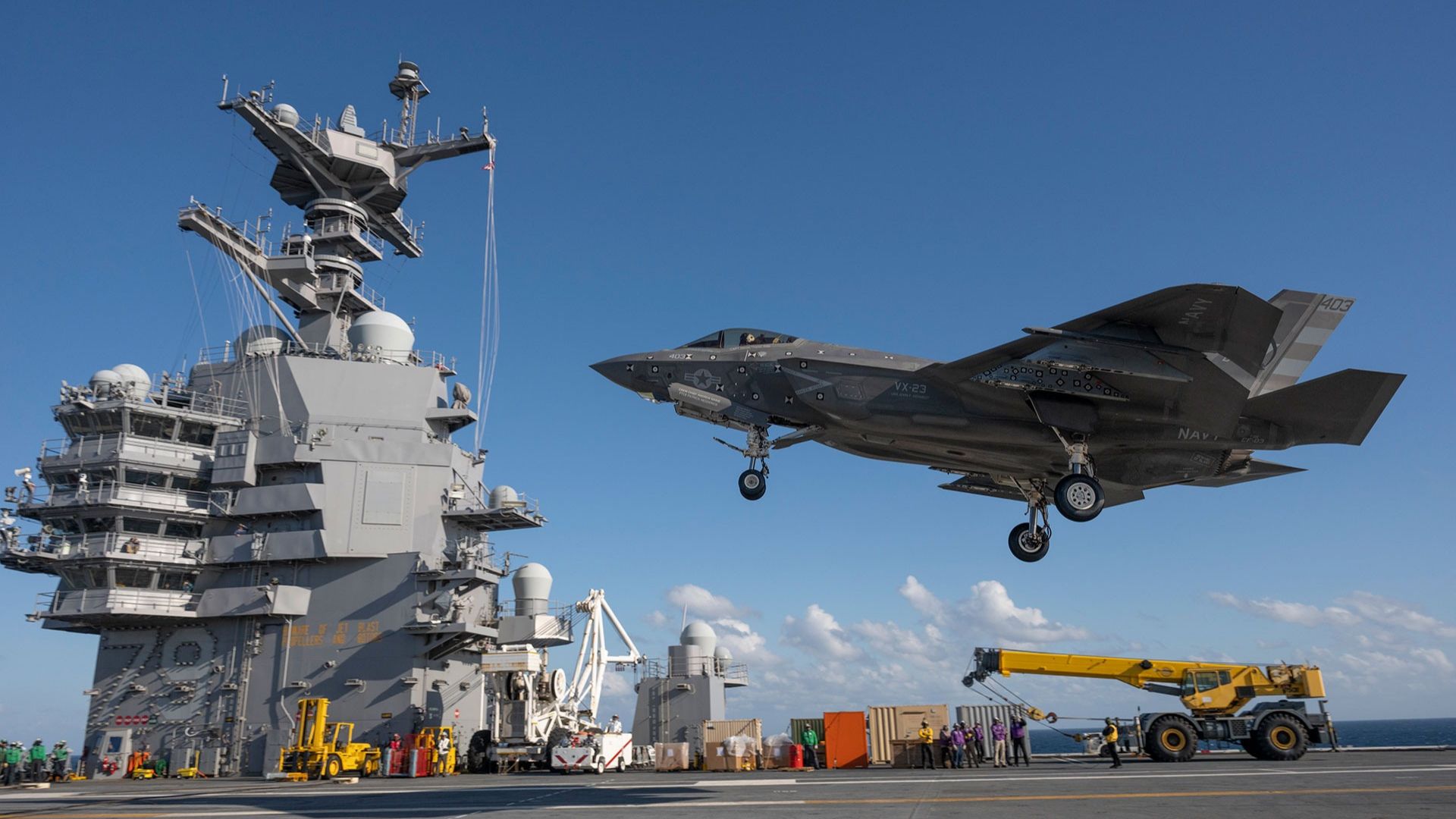
The carrier-capable variant of the Joint Strike Fighter, Lockheed Martin's F-35C Lightning II, has completed an 11-day sequence of sea trials that included its first arrested landing aboard the United States Navy's newest 100,000-ton Gerald R. Ford-class aircraft carrier, according to reporting by Aamir Khollam. The shipboard testing marks an operational milestone in integrating the military's premier fifth-generation naval strike fighter with the next-generation flattop design intended to anchor American maritime power for the next half-century.
Key facts
What happened
During an 11-day developmental underway testing window, naval aviators and technical personnel evaluated the interaction between the F-35C and the flight deck systems of the Navy's newest carrier design, according to reporting by Aamir Khollam. The trials centered on executing arrested recoveries, wherein the aircraft engages an arresting cable stretched across the landing area with its deployable tailhook, bringing a high-speed jet to a complete halt within several hundred feet.
The test sequence encompassed cyclical flight operations designed to validate aircraft-to-ship interfaces across a spectrum of maritime operating conditions. Test teams monitored how the fighter handled launch approaches, cross-deck wind turbulence, and deck rolling motions. Flight deck crews examined ground taxi procedures, tight-space deck spot maneuvering, aircraft re-fueling interfaces, and weapons-handling pathways across the reconfigured deck layout that distinguishes the Ford class from its Cold War-era predecessors.
Technicians also assessed how shipboard systems handled the F-35C's sophisticated avionics and radar-absorbent materials under true open-ocean conditions, testing how salt-air exposure and shipboard diagnostic connections perform during sustained at-sea tempos. While initial carrier qualification and operational deployments of the F-35C have taken place aboard older Nimitz-class ships over recent years, these 11 days represented the dedicated ship-air integration campaign focused specifically on the technological architecture of the Ford class.
Why it matters
The successful recovery and launch of the F-35C aboard a Ford-class carrier is a critical gating item for the modernization of the U.S. Navy's Carrier Air Wing. The Ford class represents the first clean-sheet American aircraft carrier design in more than four decades, developed specifically to increase sortie generation rates by roughly 30 percent relative to the preceding Nimitz class. Fulfilling that operational requirement depends entirely on seamlessly operating modern fifth-generation strike aircraft that feature heavier weights, distinct aerodynamic wake signatures, and unprecedented electronic requirements.
Unlike fourth-generation legacy platforms such as the Boeing F/A-18E/F Super Hornet, the F-35C incorporates low-observable stealth shaping, internal weapons bays, active electronically scanned array radar, and distributed sensor fusion. Integrating these features into carrier strike group maneuvers provides forward combatant commanders with survivable strike and intelligence capabilities inside modern anti-access/area-denial networks, particularly in potential high-intensity contested environments such as the Western Pacific.
Furthermore, the transition to the Ford class entails operating with the General Atomics-built Electromagnetic Aircraft Launch System (EMALS) and Advanced Arresting Gear (AAG). Unlike traditional hydraulic arresting engines that rely on mechanical valves and heavy fluid systems, AAG uses electric motors and digital energy-absorption software. Demonstrating that the 1,200-mph-class F-35C can safely execute arrested landings with the AAG validates years of engineering adjustments directed at reducing mechanical stress on airframes while expanding the operational envelope for diverse naval aircraft.
The background
The Joint Strike Fighter program began in the late 1990s to replace a wide variety of aging tactical aircraft across the U.S. armed services and allied militaries. The baseline program was structured around three variants: the conventional-takeoff F-35A for the U.S. Air Force, the short-takeoff/vertical-landing F-35B for the Marine Corps and international partners, and the F-35C for the U.S. Navy's Catapult Assisted Take-Off But Arrested Recovery (CATOBAR) carriers.
To withstand the extreme physical shocks of carrier flight deck operations, the F-35C differs considerably from its sibling variants. It possesses broader wings and a larger tailplane to improve low-speed handling during steep carrier approaches, extending its wingspan to 43 feet compared to 35 feet on the F-35A and F-35B. Its wingtips fold upward to conserve space on crowded hangar decks. Most significantly, the F-35C features heavily reinforced dual-wheel nose gear designed to engage catapult towbars, ruggedized main landing gear struts, and a heavy-duty tailhook assembly designed to catch arresting wires under decelerations exceeding 3G.
The carrier platform itself represents a major generational shift. Commissioned in 2017, lead ship USS Gerald R. Ford (CVN-78) introduced a rearranged flight deck layout, moved the ship's island further aft, and replaced steam-driven machinery with an all-electric power distribution plant driven by two newly designed A1B nuclear reactors. However, early operational testing of both EMALS and AAG faced years of technical scrutiny, reliability shortfalls, and critical oversight reports from the Pentagon's Director, Operational Test and Evaluation (DOT&E) and the Government Accountability Office. Initial Ford-class design baselines did not fully incorporate the specialized classified handling spaces, high-bandwidth communication suites, and lithium-ion battery storage depots required to support full squadrons of F-35Cs, requiring scheduled dry-dock modification periods to make the hulls fully F-35-compatible.
Initial operational carrier deployments of Navy and Marine Corps F-35C squadrons, beginning with Strike Fighter Squadron 147 (VFA-147) aboard the USS Carl Vinson (CVN-70) in 2021, took place exclusively on Nimitz-class hulls that had undergone dedicated shipyard modifications. Conducting dedicated arrested landings and developmental trials aboard a Ford-class ship brings the Navy's flagship aviation platform into alignment with its flagship warship design.
Reaction
Neither naval leadership nor defense contractor representatives had released public statements at the time of the initial reporting. Detailed operational assessments are typically routed through the Naval Air Systems Command (NAVAIR), based at Naval Air Station Patuxent River in Maryland, alongside the carrier program office under the Program Executive Office for Aircraft Carriers.
Formal documentation of the 11-day trials is expected to be delivered to Navy technical authorities to evaluate whether arresting gear deceleration parameters matched predictive computer modeling. Lawmakers on the House and Senate Armed Services Committees regularly review the results of these ship-integration trials during annual defense authorization hearings to assess fleet readiness, procurement numbers, and the timeline for deploying mixed air wings containing both F-35Cs and upgraded Super Hornets.
What we don't know yet
Several substantive operational details were not specified in the initial wire reporting. It remains unconfirmed precisely which Ford-class vessel hosted the 11 days of testing—whether the trials occurred aboard the operational lead ship USS Gerald R. Ford (CVN-78) following recent modifications, or aboard the second-in-class USS John F. Kennedy (CVN-79), which was constructed from the outset with dedicated F-35C capability modifications incorporated into its shipyard build plan.
The exact tally of arrested traps, touch-and-go maneuvers, and catapult launches completed across the 11-day evolution was also not disclosed. Crucially, the Navy has not yet published telemetry metrics on the reliability rate of the Advanced Arresting Gear during this specific test phase, nor has it detailed whether any software anomalies or deck-handling restrictions were identified while moving the wide-wing stealth jet through the Ford's redesigned munitions elevators and maintenance bays.
What to watch
In the coming months, defense monitors will look for the official release of flight-clearance bulletins from NAVAIR certifying standard squadron operating envelopes for the F-35C aboard the Ford class. These administrative certifications dictate the maximum allowable gross weights, crosswind thresholds, and sea-state limitations governing day and night recoveries.
Observers will also track upcoming dry-dock maintenance and modernization schedules for the fleet. The progress of the USS John F. Kennedy toward formal delivery and commissioning, alongside the ongoing construction of the future USS Enterprise (CVN-80) and USS Doris Miller (CVN-81) at Newport News Shipbuilding in Virginia, will reveal how lessons from these trials are incorporated into the shipbuilder's production line. Finally, the Navy's upcoming budget requests will indicate whether the timeline for deploying fully integrated fifth-generation air wings aboard Ford-class carriers remains on schedule for the late 2020s.
This account is based on original reporting published by Aamir Khollam.
How this story was produced
This report was written by The Global Wire newsroom from reporting first published by Aamir Khollam. We verify the core facts against the original report, write our own account, and add the background and consequences a short wire item leaves out. Drafting is AI-assisted inside an editor-supervised pipeline, and every story is checked for accuracy of attribution, structure and duplication before it appears — full detail in our AI and funding disclosure.
Spotted an error? Tell us at corrections@horizonglobalnews.com and read our corrections policy or editorial standards.





Reader comments
Loading comments…