

Desktop 5-Axis CNC Mill Launches Crowdfunding Push to Simplify 3D Carving
A new compact 5-axis CNC mill designed for users with no prior machining experience has debuted on Kickstarter to bring advanced carving capabilities to desktop workshops.
By The Global Wire Newsroom · Reported from Tushar Mehta
Link preview · horizonglobalnews.com
Desktop 5-Axis CNC Mill Launches Crowdfunding Push to Simplify 3D Carving
A new compact 5-axis CNC mill designed for users with no prior machining experience has debuted on Kickstarter to bring advanced carving capabilities to desktop workshops.
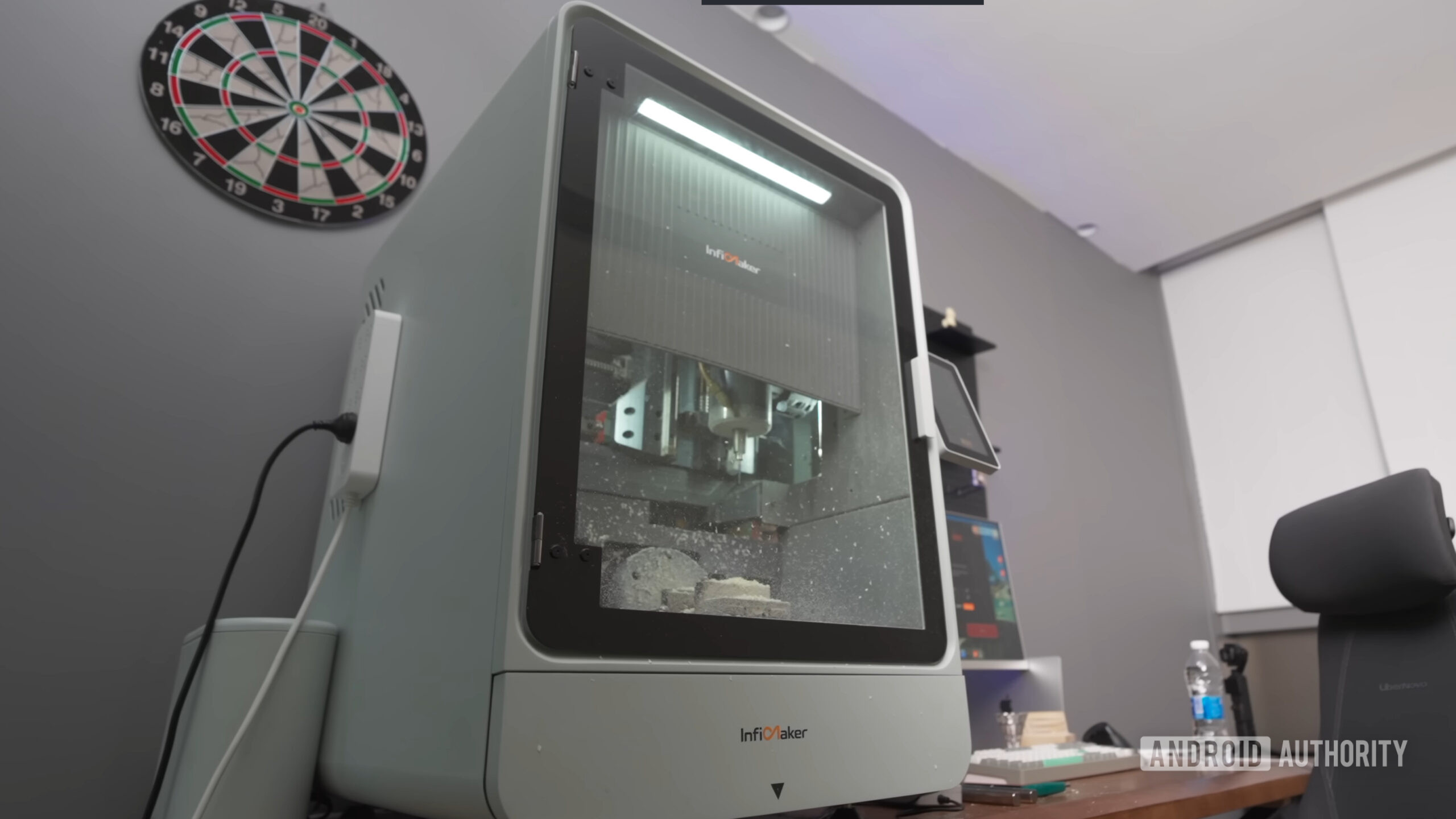
A new compact manufacturing system designed to bring advanced multi-axis machining to non-professional users has officially launched its crowdfunding campaign. According to reporting by Tushar Mehta, a 5-axis desktop Computer Numerical Control (CNC) mill aimed at beginners seeking to carve three-dimensional figurines and complex geometries has gone live on the Kickstarter platform. The device is positioned as an entry point into subtractive digital fabrication for individuals with no prior experience in traditional metalworking, woodworking, or computer-aided manufacturing.
Desktop digital fabrication and user accessibility
The newly introduced hardware seeks to address a longstanding hurdle in personal digital fabrication: the steep learning curve associated with automated carving tools. While consumer-grade 3D printers have achieved widespread adoption in homes, classrooms, and small workshops over the past decade, desktop CNC machinery has remained comparatively niche due to technical friction in software setup, material fixation, and toolpath generation.
As detailed in the report by Tushar Mehta, the new desktop mill features 5-axis motion capability, allowing the cutting tool or workpiece to maneuver across multiple angles simultaneously. This architecture enables users to create detailed three-dimensional figurines—objects that traditionally present severe structural challenges for simpler entry-level machines—without requiring prior background knowledge in manual machining or complex toolpath programming. By launching via a Kickstarter campaign, the developers of the machine are attempting to validate consumer demand for multi-axis desktop carving equipment among hobbyists, tabletop gamers, custom modelers, and educators.
Technical dynamics of 5-axis machining
To understand the mechanical milestone targeted by a desktop 5-axis device, it is useful to contrast it with standard entry-level CNC routers and mills. Conventional hobbyist CNC equipment operates primarily on three linear axes, commonly identified as X (side-to-side), Y (front-to-back), and Z (up-and-down). Under a 3-axis configuration, the cutting bit approaches the stock material strictly from an overhead orientation. Carving complex three-dimensional objects with deep undercuts—such as human figures, statues, or intricate geometric art—typically requires stopping the machine, manually flipping or repositioning the material, and precisely recalibrating zero-point coordinates for each subsequent face.
In contrast, a 5-axis CNC system incorporates two additional rotational axes, typically rotating around the linear axes. This multidirectional capability allows the cutting head or the worktable to tilt and swivel during operation. As a result, the tool bit can approach the stock material from virtually any angle, maintaining optimal contact with complex curves and reaching recessed pockets without manual intervention. Industrial 5-axis machines are widely utilized in aerospace, automotive, and medical device manufacturing due to their ability to produce highly complex, organic geometries. Bringing this level of mechanical freedom to a desktop form factor represents an attempt to miniaturize industrial capabilities for personal workshop environments.
Subtractive versus additive consumer manufacturing
The launch of the desktop 5-axis mill comes at a time when the maker community is increasingly exploring the complementary strengths of additive and subtractive manufacturing. For several years, consumer 3D printing—an additive process that builds objects layer by layer from melted plastic filament or liquid photopolymer resin—has dominated personal fabrication. 3D printing excels at creating hollow structures, rapid prototypes, and complex lattice designs with minimal material waste.
However, subtractive manufacturing via CNC milling offers distinct advantages that additive methods struggle to replicate. In subtractive fabrication, a spinning rotary cutting tool removes material from a solid block of stock, such as hardwood, soft metals, dense foam, or engineering plastics. This method produces structural parts with uniform material density, high physical durability, and superior surface finishes directly from raw stock.
Historically, the primary barrier preventing subtractive machinery from matching 3D printing's consumer popularity has been operational complexity. Setting up a CNC mill traditionally requires detailed knowledge of Computer-Aided Design (CAD), Computer-Aided Manufacturing (CAM) software, spindle rotation speeds, feed rates, and G-code execution. By designing a system that allows users to carve 3D figurines without prior milling experience, the project aims to bypass these software and operational hurdles.
The role of crowdfunding in hardware development
Crowdfunding platforms like Kickstarter have long served as a vital incubator for emerging desktop fabrication hardware. Many now-established brands in 3D printing, desktop laser cutting, and compact CNC routing initially funded their first production runs through public crowdfunding campaigns. These platforms provide hardware creators with essential early capital to order tooling, source components, and streamline supply chains, while also establishing an active user base of early adopters who can offer feedback during early software and hardware iterations.
However, industry analysts note that hardware crowdfunding projects carry distinct operational risks compared to software or digital media campaigns. Delivering precision mechanical devices requires rigorous quality control, calibration testing, supply chain management, and regulatory compliance. The long-term adoption of consumer hardware projects often hinges not only on the core mechanical design of the machine, but also on software stability, comprehensive user documentation, customer support, and the long-term availability of replacement components.
Potential applications and market context
If successful, accessible 5-axis desktop milling could expand the creative possibilities for small-scale creators and specialized industries. Tabletop gaming enthusiasts, mini-model makers, jewelry designers, and craftspeople stand to benefit from the ability to carve custom figurines and detailed physical models from diverse materials. Furthermore, educational institutions looking to teach advanced manufacturing concepts could find compact 5-axis equipment to be a practical alternative to full-scale industrial machinery.
As consumer interest in personalized fabrication continues to expand, tools that simplify complex mechanical processes are likely to play a central role in shaping the next generation of workshop technology.
This news report is based on original reporting by Tushar Mehta covering the Kickstarter campaign launch of the 5-axis desktop CNC mill.
How this story was produced
This report was written by The Global Wire newsroom from reporting first published by Tushar Mehta. We verify the core facts against the original report, write our own account, and add the background and consequences a short wire item leaves out. Drafting is AI-assisted inside an editor-supervised pipeline, and every story is checked for accuracy of attribution, structure and duplication before it appears — full detail in our AI and funding disclosure.
Spotted an error? Tell us at corrections@horizonglobalnews.com and read our corrections policy or editorial standards.





Reader comments
Loading comments…