

Democrat Scott Colom Ousts Cindy Hyde-Smith in Historic Mississippi Senate Race
Democratic challenger Scott Colom unseated Republican incumbent Cindy Hyde-Smith to become Mississippi's first Black United States senator since the Reconstruction era.
By The Global Wire Newsroom · Reported from thestar.com.my
Link preview · horizonglobalnews.com
Democrat Scott Colom Ousts Cindy Hyde-Smith in Historic Mississippi Senate Race
Democratic challenger Scott Colom unseated Republican incumbent Cindy Hyde-Smith to become Mississippi's first Black United States senator since the Reconstruction era.
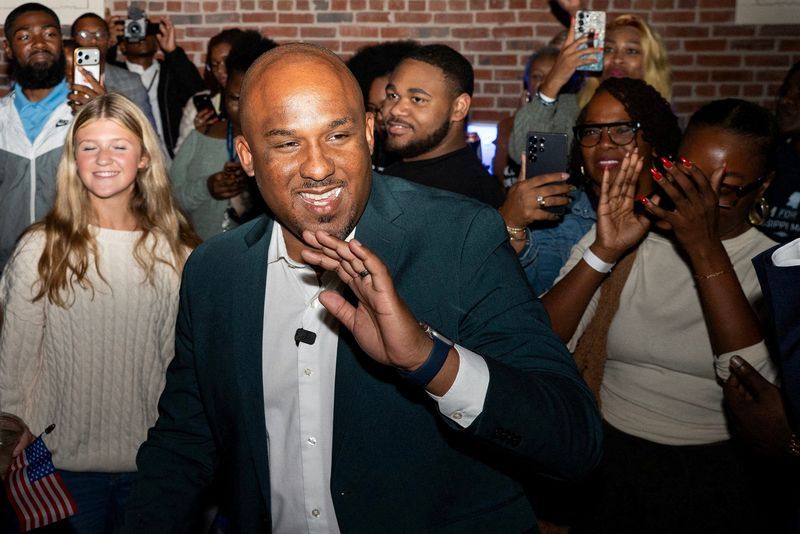
Democratic challenger Scott Colom has won election to the United States Senate from Mississippi, defeating incumbent Republican Senator Cindy Hyde-Smith in a historic upset, according to race projections reported by Reuters. Colom's victory makes him Mississippi's first African American senator in more than 150 years, marking the first time a Black lawmaker will represent the Deep South state in the upper chamber of Congress since the post-Civil War Reconstruction era concluded in the late 19th century.
Key facts
What happened
Media networks and news organizations projected on Wednesday that Scott Colom secured a victory over Republican incumbent Cindy Hyde-Smith following the tabulation of ballots in Mississippi's Senate contest. The projection marked the culmination of an intensely watched general election campaign in which Colom sought to assemble a diverse electoral coalition across the state.
Colom, an attorney who previously served as a local district attorney in eastern Mississippi, challenged Hyde-Smith by mounting a statewide campaign that focused on economic development, public healthcare infrastructure, criminal justice administration, and rural hospital retention. Hyde-Smith, who was originally appointed to the Senate seat in April 2018 before winning a special election later that year and securing her first full six-year term in November 2020, campaigned on a traditional conservative platform emphasizing agricultural interests, judicial conservatism, border security, and deregulation.
As precinct tallies were reported across Mississippi's 82 counties, Colom built substantial leads in urban and suburban population centers—including Jackson and surrounding Hinds County, the Mississippi Delta, and areas of the Gulf Coast—while also narrowing typical Republican margins in several rural and college-town jurisdictions. Although the complete certified tally remains subject to official canvassing, vote patterns across key congressional districts were sufficient for major national outlets to call the race in Colom's favor.
Why it matters
The political ramifications of Colom's victory extend across both federal governance and state-level partisan dynamics. In the Senate, where partisan control frequently turns on a tiny margin, an unexpected Democratic seat in the Deep South shifts the institutional balance of power in Washington. The victory disrupts decades of uninterrupted Republican dominance in Mississippi statewide federal elections, demonstrating that shifting demographics, voter mobilization, and focused local issues can alter long-standing electoral maps.
From a policy perspective, Colom's elevation brings an entirely different legislative focus to Mississippi's Senate delegation. In a state that faces persistent public health challenges, elevated poverty levels, and the highest rate of rural hospital closures per capita, a Democratic senator is positioned to advocate directly for Medicaid expansion, increased federal matching rates for healthcare delivery, and heightened appropriations for municipal water systems and infrastructure, such as the troubled public works network in the capital city of Jackson.
Culturally and historically, the outcome carries profound symbolic weight for Mississippi and the nation. For generations, civil rights leaders and grassroots voting rights organizers have worked to translate the state's substantial African American population into proportionate statewide political representation. Achieving statewide executive or legislative office has eluded Black candidates in Mississippi since the end of Reconstruction, despite the state having the highest proportion of Black residents in the United States. Colom's ascension invalidates the long-held assumption that a Black Democrat faces an insurmountable ceiling in Mississippi statewide politics.
The background
To understand the magnitude of Colom's victory, it is necessary to examine the complex political history of Mississippi following the American Civil War. During Reconstruction, under federal military supervision and following the ratification of the Thirteenth, Fourteenth, and Fifteenth Amendments, Mississippi became an early pioneer in Black political leadership. In 1870, Hiram Rhodes Revels of Natchez was selected by the Mississippi legislature to fill a vacant U.S. Senate seat, becoming the first African American ever to serve in the United States Congress. Five years later, in 1875, Blanche Kelso Bruce was elected to the Senate by the state legislature, serving a full six-year term until 1881 as the first Black senator to complete a full term.
However, the withdrawal of federal troops after the Compromise of 1877 ushered in the Jim Crow era and the systematic disenfranchisement of Black citizens across the American South. In 1890, Mississippi drafted a new state constitution that instituted poll taxes, subjective literacy tests, and restrictive understanding clauses deliberately engineered to strip Black citizens of the ballot. By the turn of the century, Black political participation was virtually extinguished statewide, and Mississippi did not send another Black representative or senator to Washington for nearly a century.
The passage of the Voting Rights Act of 1965 dismantled the legal apparatus of disenfranchisement, gradually restoring voter registration rights to hundreds of thousands of Mississippians. Over subsequent decades, Black candidates won municipal offices, county supervisor positions, legislative seats, and a U.S. House seat representing the Second Congressional District. Yet, at the statewide level, Republican candidates consistently held a solid grip on power, consolidating white conservative voter turnout to offset the roughly 38 percent Democratic baseline provided by the state's Black community.
Cindy Hyde-Smith had occupied this political landscape since her appointment to the Senate by then-Governor Phil Bryant in April 2018, following the resignation of long-serving Republican Senator Thad Cochran due to declining health. Hyde-Smith, a former state senator and state agriculture commissioner who had switched from the Democratic Party to the Republican Party in 2010, won a competitive special election runoff in November 2018 against former U.S. Secretary of Agriculture Mike Espy. She subsequently secured a full term in 2020 by defeating Espy in a rematch. Throughout her tenure, Hyde-Smith aligned herself closely with the national Republican platform and conservative judicial nominations.
Colom rose to prominence in state legal circles in 2015 when he was elected as the district attorney for Mississippi's 16th Circuit Court District, covering Lowndes, Oktibbeha, Clay, and Noxubee counties. In that election, he unseated a long-time white incumbent prosecutor, drawing national attention for his pragmatic approach to criminal justice administration, alternatives to incarceration for nonviolent offenders, and rigorous prosecution of violent crime. That background provided him with a profile that bridged progressive reform and institutional prosecutorial credibility.
Reaction
Formal statements from political leadership and institutional bodies are expected to follow the media projections. Traditionally, losing candidates in U.S. Senate races deliver concession addresses and initiate congratulatory calls once vote margins cross the threshold of statistical recovery, while winners deliver victory speeches addressing their future legislative agendas.
Leaders of the Democratic National Committee and the Democratic Senatorial Campaign Committee are anticipated to highlight the Mississippi outcome as proof of an expanding national map and an affirmation of prolonged investment in Southern organizing efforts. Within the Congressional Black Caucus, Colom's arrival is expected to be met with intense acclaim, adding a historic voice from the Deep South to the Senate membership.
On the Republican side, party leaders and national campaign strategists will face rigorous internal scrutiny regarding how an incumbent lost a statewide contest in an ostensibly secure red state. Conservative groups and legislative caucuses are expected to examine whether turnout dynamics, campaign resource allocation, or local candidate vulnerabilities drove the unseating of Hyde-Smith.
What we don't know yet
While media projections have determined the winner of the contest, several critical pieces of data remain unavailable until state election authorities finalize their work. Official vote counts, absentee ballots, provisional tallies, and military ballots must be officially tabulated and certified by the Mississippi State Board of Election Commissioners, a process that typically takes several days to complete.
Consequently, the final certified margin of victory is not yet known. Analysts will need to review granular precinct-level certified data to determine the exact mechanics of Colom's victory: specifically, what percentage of the white vote Colom captured, whether Black voter turnout in the Mississippi Delta and Jackson reached historic mid-term or presidential peaks, and whether higher-than-anticipated suburban defection in counties such as Madison and Rankin weakened Hyde-Smith's traditional base.
Furthermore, it remains unconfirmed whether Hyde-Smith will seek a formal recount, challenge any specific precinct procedures, or immediately concede the contest. Under Mississippi election law, narrow margins permit candidates to request examinations of ballot boxes, although the threshold and funding requirements depend on the final official margin.
What to watch
The immediate calendar will dictate several key milestones following Wednesday's projection. Under Mississippi statutory deadlines, county election commissions must finish canvassing votes and transmit certified county totals to the Mississippi Secretary of State's office. Once received, the Secretary of State, the Governor, and the Attorney General—acting as the state election board—must sign off on the official certification of results.
Attention will then shift to Capitol Hill in Washington, D.C., as the Senate prepares for the organization of the incoming Congress. Observers will watch how Colom approaches committee assignments, particularly regarding appointments to the Senate Committee on Agriculture, Nutrition, and Forestry—a panel historically critical to Mississippi's timber, poultry, cotton, and soybean producers—as well as the Senate Committee on Appropriations, where his predecessor Thad Cochran once wielded immense influence over state funding.
Finally, political observers will watch how this historic shift influences future statewide races in Mississippi and across neighboring Southern states, evaluating whether Colom's campaign model represents an isolated victory based on unique local conditions or the beginning of a durable, competitive two-party system in the Deep South.
*This account is based on original reporting by Reuters, via The Star.*
How this story was produced
This report was written by The Global Wire newsroom from reporting first published by thestar.com.my. We verify the core facts against the original report, write our own account, and add the background and consequences a short wire item leaves out. Drafting is AI-assisted inside an editor-supervised pipeline, and every story is checked for accuracy of attribution, structure and duplication before it appears — full detail in our AI and funding disclosure.
Spotted an error? Tell us at corrections@horizonglobalnews.com and read our corrections policy or editorial standards.






Reader comments
Loading comments…