

Congress Summons Jensen Huang and Howard Lutnick as Nvidia Scrutiny Deepens
Lawmakers call Nvidia's chief executive and the US Commerce Secretary to Capitol Hill as White House aides debate Lutnick's future.
By The Global Wire Newsroom · Reported from The Business Times
Link preview · horizonglobalnews.com
Congress Summons Jensen Huang and Howard Lutnick as Nvidia Scrutiny Deepens
Lawmakers call Nvidia's chief executive and the US Commerce Secretary to Capitol Hill as White House aides debate Lutnick's future.
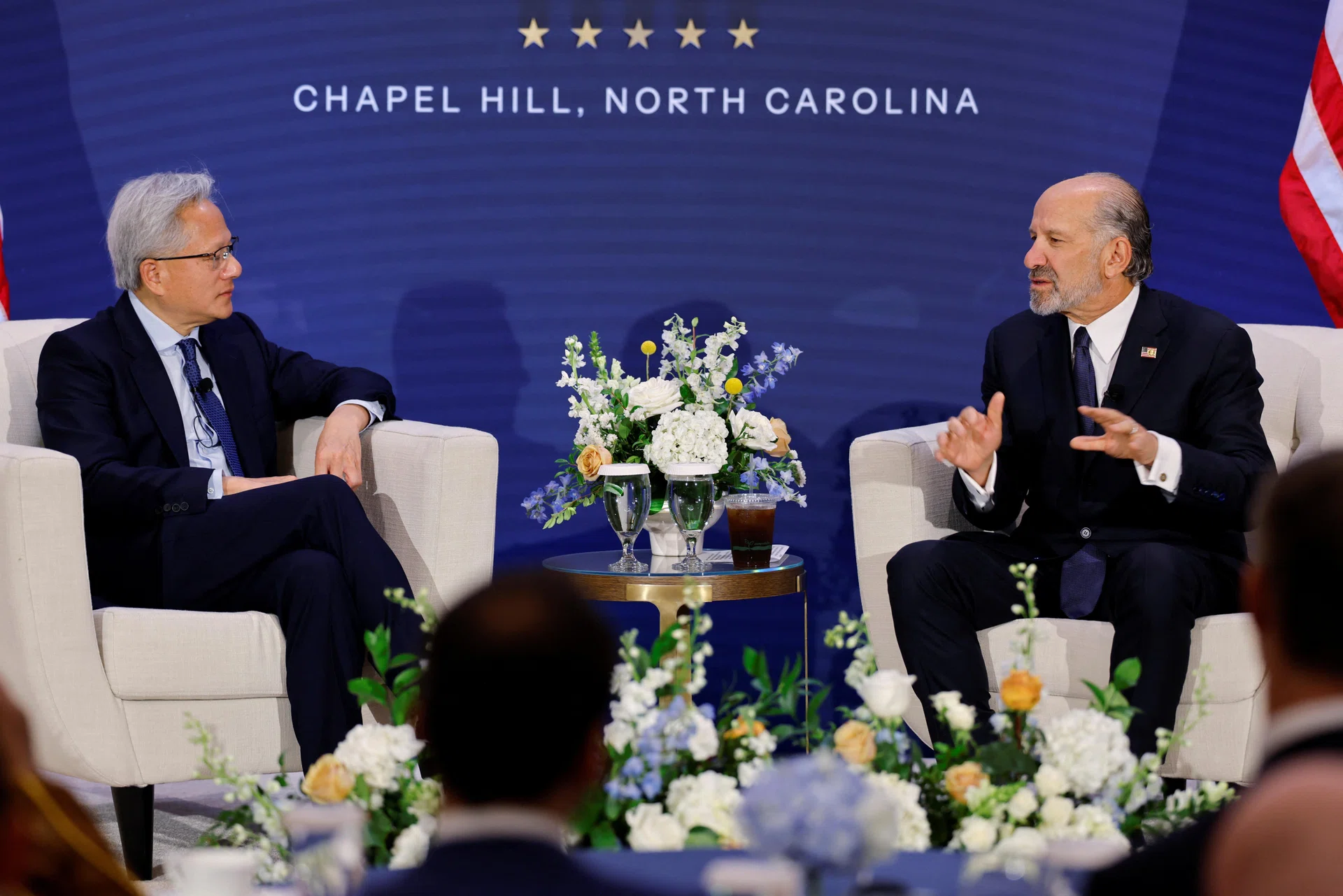
Lawmakers on Capitol Hill have summoned Nvidia Chief Executive Jensen Huang and United States Commerce Secretary Howard Lutnick to appear for congressional testimony, escalating federal scrutiny into the world's most valuable semiconductor designer. The demand for testimony comes amid an intensifying push in Washington for a formal congressional inquiry into Nvidia's operations and market position. At the same time, the proceedings have coincided with quiet discussions among senior White House officials over whether Lutnick should be removed from his cabinet post, according to reporting by The Business Times.
Key facts
What happened
Congressional committees have broadened their oversight of the artificial intelligence and semiconductor sectors by calling the key figures presiding over hardware manufacturing and federal trade oversight to testify. The development, first reported by The Business Times, involves formal requests for Jensen Huang, who co-founded Nvidia in 1993 and built it into the preeminent supplier of graphics processing units (GPUs) powering modern generative AI, to answer questions directly before federal lawmakers.
Simultaneously, lawmakers issued a summons to Commerce Secretary Howard Lutnick, whose department exercises jurisdiction over international export controls, domestic manufacturing subsidies, and national security trade determinations. The coordinated summons indicates that congressional investigators are looking not only at corporate conduct within the private sector but also at how executive branch agencies have monitored, regulated, and enforced policies governing advanced microelectronics.
Alongside the congressional action, internal friction has emerged within the executive branch. High-ranking White House officials have engaged in separate internal deliberations regarding Secretary Lutnick's standing, weighing whether to seek his departure from the administration. While the specific grounds for those discussions were not detailed in initial accounts, the convergence of congressional questioning and executive branch instability places the leadership of the Commerce Department under acute pressure.
Why it matters
This confrontation brings unprecedented political attention to the narrow choke point of global artificial intelligence computing. Nvidia designs the specialized accelerators that train and execute large language models, commanding an estimated market share exceeding 80 percent in data center AI chips. Any formal congressional inquiry into the company carries immediate systemic implications for global technology valuations, artificial intelligence deployment, and the broader tech supply chain.
For the commercial sector, legislative scrutiny of Nvidia typically intersects with two distinct legal axes: competition law and national security export compliance. Allegations regarding dominant market practices—such as customer bundling, proprietary software lock-in via its CUDA programming architecture, and allocation practices during supply shortages—have previously drawn the attention of domestic and international antitrust authorities. A public grilling on Capitol Hill exposes these intricate technical and commercial arrangements to legislative cross-examination, creating potential momentum for statutory revisions or formal regulatory enforcement actions.
For governance and international diplomacy, Secretary Lutnick's involvement links domestic political disputes directly to the administration of technology trade restrictions. The Department of Commerce, through its Bureau of Industry and Security (BIS), controls the administrative machinery that dictates which advanced computing architectures may be sold abroad, particularly to strategic competitors like China. If lawmakers are questioning the Commerce Department's oversight of semiconductor firms while the secretary's own position is being debated within the West Wing, it signals potential turbulence in how US technology policy is administered. Such institutional friction affects global supply chains, international trade partnerships, and domestic industrial subsidies under federal programs.
The background
The technological race to develop artificial intelligence has made high-performance semiconductors a core pillar of United States national security and economic statecraft. Beginning in October 2022, the federal government enacted sweeping export controls administered by the Commerce Department's Bureau of Industry and Security. Those measures prohibited the sale of top-tier AI training chips—such as Nvidia’s A100 and H100 graphics processors—to entities in China and certain other designated jurisdictions without an explicit federal license.
When Nvidia responded by engineering modified hardware architectures tailored to fall just beneath the technical performance thresholds established by the Commerce Department—such as the A800 and H800 models—regulators updated their controls in October 2023. Those revised rules established lower interconnect bandwidth caps and total processing performance metrics, effectively barring the revised chips and prompting the design of further modified variants, including the H20. Throughout this period, lawmakers on Capitol Hill, particularly members of committees tasked with national security and competition with China, repeatedly pushed for stricter regulatory enforcement, warning that commercial workarounds could undermine national security objectives.
At the same time, Nvidia's rapid expansion into a multi-trillion-dollar enterprise drew heightened interest from competition regulators. The United States Department of Justice and the Federal Trade Commission have monitored concentration across the artificial intelligence technology stack, looking into how hardware allocations, software frameworks, and strategic acquisitions—such as Nvidia’s purchase of run:ai—might affect fair competition in cloud computing. Overseas, European authorities and the French competition regulator conducted inquiries and targeted searches relating to graphics card distribution.
Against this landscape, the leadership of the Department of Commerce occupies an inherently delicate role. The secretary oversees the distribution of tens of billions of dollars authorized under the 2022 CHIPS and Science Act, designed to onshore semiconductor fabrication, while simultaneously enforcing aggressive trade limits that restrict the international revenues of domestic chipmakers. Howard Lutnick, formerly the longtime chief executive of financial services firm Cantor Fitzgerald, took charge of this portfolio with a mandate covering trade policy, tariff administration, and technology restrictions. Given the friction between national security hawks favoring complete trade embargoes and corporate leaders navigating legal compliance to maintain export revenues, the Commerce Department frequently operates at the center of intense inter-agency and congressional dispute.
Reaction
Neither Nvidia nor the Department of Commerce immediately issued formal statements regarding the congressional summonses or the reports of internal White House discussions. Chief executives and cabinet officials summoned to testify before congressional panels typically work through their respective legislative affairs teams and legal counsels to establish the terms, format, and timing of any scheduled appearance.
In standard practice on Capitol Hill, appearances can be arranged either voluntarily through formal committee invitations or under the threat of compulsory process, such as subpoenas. In previous inquiries involving high-profile technology executives, corporate leadership often submits detailed written testimony defending their compliance with all applicable export regulations, highlighting investments in domestic innovation, and emphasizing adherence to fair market principles.
Within the executive branch, reports regarding potential personnel changes among cabinet secretaries routinely trigger standard deflections or administrative reviews. If congressional committees formally schedule a public hearing date, committee chairs from panels such as the House Foreign Affairs Committee, the House Select Committee on the Strategic Competition Between the United States and the Chinese Communist Party, or the Senate Committee on Commerce, Science, and Transportation are anticipated to release formal opening statements detailing the scope of their investigation.
What we don't know yet
Several substantive details remain unconfirmed in public records. The specific congressional committee or joint body issuing the summons has not been publicly specified, leaving the formal jurisdiction and legislative scope of the inquiry undefined. It is not yet clear whether the demand was issued under a bipartisan mandate, which subcommittees are leading the effort, or whether formal subpoenas have been signed or merely threatened.
Furthermore, the precise factual focus of the proposed inquiry remains ambiguous. It is currently unverified whether lawmakers are primarily investigating compliance with existing semiconductor export restrictions to foreign destinations, probing potential market dominance and commercial practices, or reviewing the Commerce Department's internal regulatory decision-making and licensing determinations.
On the executive side, the exact nature of the White House discussions regarding Secretary Lutnick's status remains opaque. It is unknown what specific policy disagreements, administrative actions, or political tensions prompted senior aides to contemplate his departure, nor is it clear whether the discussions have reached the level of a formal presidential recommendation or remain confined to advisory staff debates.
What to watch
The trajectory of this regulatory episode will be determined by several checkable milestones over the coming weeks:
This account is based on original reporting published by The Business Times.
How this story was produced
This report was written by The Global Wire newsroom from reporting first published by The Business Times. We verify the core facts against the original report, write our own account, and add the background and consequences a short wire item leaves out. Drafting is AI-assisted inside an editor-supervised pipeline, and every story is checked for accuracy of attribution, structure and duplication before it appears — full detail in our AI and funding disclosure.
Spotted an error? Tell us at corrections@horizonglobalnews.com and read our corrections policy or editorial standards.






Reader comments
Loading comments…