

Beauer Restructures Caravan Lineup With Cuboid X6 Expandable Six-Sleeper
French manufacturer Beauer has overhauled its caravan architecture, launching a boxy six-person trailer alongside an expanded product range.
By The Global Wire Newsroom · Reported from C C Weiss
Link preview · horizonglobalnews.com
Beauer Restructures Caravan Lineup With Cuboid X6 Expandable Six-Sleeper
French manufacturer Beauer has overhauled its caravan architecture, launching a boxy six-person trailer alongside an expanded product range.
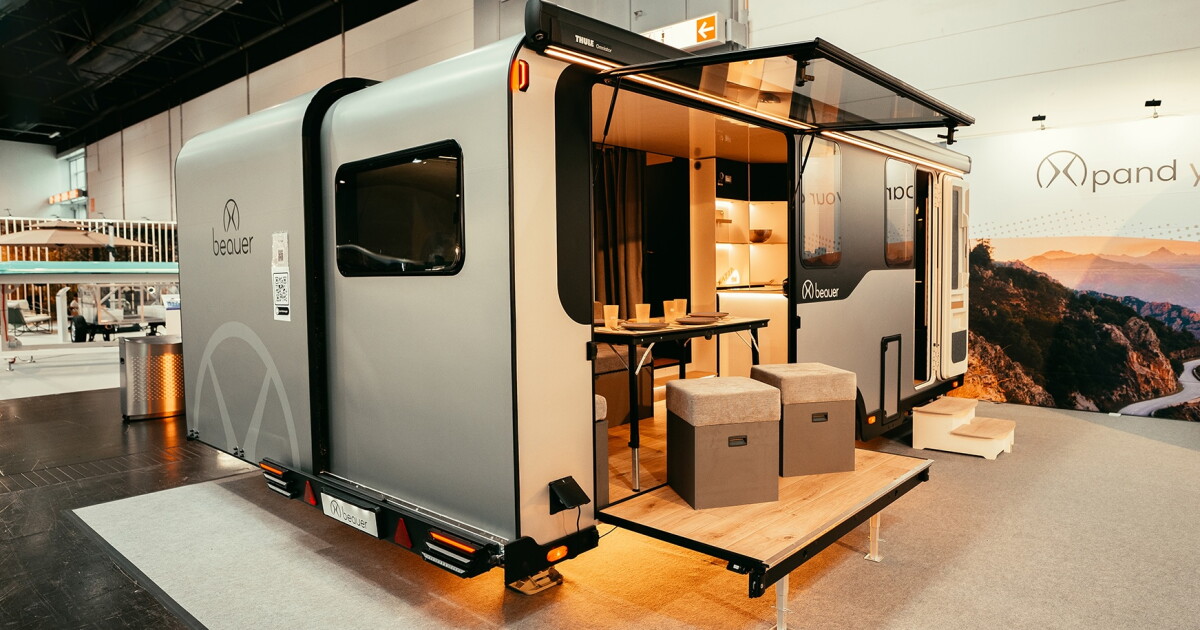
French caravan manufacturer Beauer has overhauled its product catalogue, unveiling an all-new six-sleeper expandable trailer designated as the X6, according to reporting by C C Weiss. The newly developed model represents a decisive architectural departure from the company's established commercial identity, abandoning the rounded, cylindrical bodywork that characterised its previous generations in favour of a sharp-edged cuboid form. Designed to double its internal floor area through mechanical deployment at camp, the X6 functions as an adaptable mobile residence equipped with an integrated outdoor living space. The launch forms part of a wider product reshuffle that also introduces a larger X8 triple-expanding caravan to the European market.
Key facts
What happened
Beauer, based in France and known internationally for its telescoping leisure vehicles, has enacted a comprehensive realignment of its caravan catalogue, according to reporting by C C Weiss. Central to this strategic transition is the retirement of the brand's signature curvilinear profile for its medium-to-large capacity platforms. In place of the cylindrical aesthetic that defined its operations for over a decade, Beauer introduced the X6, an all-new caravan capable of sleeping six individuals that relies on an uncompromising cuboid geometry.
Mechanically, the X6 uses the company's signature sliding body technology to transform between road transit mode and stationary living mode. While moving, the caravan remains within standard vehicular lane parameters, minimizing frontal surface area. Once unhitched and stabilized on site, the mechanical structure activates, doubling its internal volume to create a self-contained tiny home layout. The newly configured exterior shell also incorporates an integrated outdoor porch configuration, allowing occupants to bridge indoor amenities with their immediate outdoor surroundings.
This structural pivot accompanies the simultaneous introduction of the X8, a larger triple-expander platform designed to offer maximum interior volume among Beauer's multi-module offerings. By concurrently developing the X6 and the X8, the French firm has restructured its market hierarchy, repositioning the six-sleeper bracket as a versatile bridge between lightweight weekend touring units and semi-permanent micro-dwellings.
Why it matters
The architectural transition from rounded bodies to cuboid enclosures reflects fundamental economic and practical realities within the leisure vehicle and compact housing sectors. While curved, aerodynamic teardrop shapes offer aesthetic distinction and minor drag reductions during transit, they severely compromise interior usable space. Straight interior walls allow cabinet makers, appliance engineers, and furniture designers to install standardized components without the costly custom curving required in cylindrical trailers. For a six-sleeper configuration, vertical sidewalls substantially increase interior headroom, upper-cabinet storage capacity, and bunk clearances, directly addressing consumer demands for extended four-season habitability.
Furthermore, the evolution of the X6 underscores the blurring boundary between traditional holiday caravans and movable tiny homes. As housing affordability strains urban markets across Western Europe and North America, consumers increasingly view versatile, fully insulated trailers not merely as holiday equipment, but as auxiliary dwelling units, mobile telecommuting offices, and rental assets. The inclusion of a porch feature directly accommodates this hybrid residential use case. By offering a six-person sleeping envelope inside an expandable footprint, the vehicle targets extended families and co-living groups who would otherwise require large, heavy commercial motorhomes that carry significantly higher purchase prices, road tax brackets, and regulatory maintenance demands.
The background
Beauer entered the European recreational vehicle industry under the leadership of inventor Éric Beau, who conceived the patented telescoping concept in the late 2000s. The company gained global recognition with the launch of the Beauer 3X, a compact, rounded trailer resembling a horizontal cylinder when towed. Through a motorized, concentric nested shell system operated via a single electrical switch, the 3X could expand outward on both sides, tripling its interior floor space from approximately 4 square metres in transit mode to roughly 12 square metres in stationary mode in about 60 seconds. The mechanism allowed a small footprint trailer to provide amenities typically reserved for much larger, cumbersome caravans.
Following the technical success of the original 3X platform, the French manufacturer gradually expanded its engineering catalogue. It introduced the 2X, which doubled its volume via a single lateral slide-out, and the 3X Plus, a scaled-up variant configured for four to six occupants offering roughly 28 square metres of deployed space. The company also adapted its nesting slide-out modules for commercial light cab-chassis vehicles through its 3XC motorhome concept. Across all these iterations, Beauer retained a distinctive, curved styling language that distinguished its brand identity from conventional, boxy European touring caravans.
Throughout this manufacturing evolution, Beauer operated within the strict legal framework governing European road vehicles. Under European Union Directive 2006/126/EC, drivers holding a standard Category B motor vehicle licence are restricted to towing trailers where the combined Maximum Authorised Mass of the towing car and the trailer does not exceed 3,500 kilograms. Towing configurations exceeding that threshold require either the supplementary B96 training endorsement, which permits combinations up to 4,250 kilograms, or a dedicated Category B+E driving licence. By engineering expandable bodies on lightweight chassis frameworks, manufacturers like Beauer have consistently attempted to maximize deployed residential volume while staying beneath restrictive towing weight thresholds.
Reaction
The introduction of a box-like silhouette has generated considerable discussion across recreational vehicle engineering forums and dealership networks across continental Europe. Automotive design analysts have noted that while Beauer's historic, rounded silhouettes served as effective marketing signatures that drew widespread public curiosity, the operational realities of customer usage favored conventional square angles for interior living ergonomics.
Industry observers anticipate formal evaluation of the X6 at major continental European camping and tourism exhibitions, most notably the Salon des Véhicules de Loisirs in France and CMT Stuttgart in Germany, which serve as the primary venues where leisure vehicle fabricators collect formal consumer orders and dealer contracts. Competing manufacturers within the specialized slide-out niche have not issued public evaluations of the new platform, but component suppliers have indicated that the shift toward orthogonal cabinetry simplifies serial manufacturing compared to bespoke curved furnishings.
What we don't know yet
Significant technical and financial specifications for the Beauer X6 remain undisclosed in the initial announcements. Complete dimensions—including its exact road transit length, overall width, deployed interior square footage, and ceiling clearance heights—have not been detailed. Crucially, the platform's unladen curb weight and Gross Vehicle Weight Rating remain unspecified. These figures are critical for prospective European buyers, as they determine whether the caravan can be legally hauled by conventional family crossovers under standard Category B licence restrictions or if an upgraded towing credential is mandatory.
Additionally, neither pricing structures nor delivery timeframes have been released. It is unclear whether the cuboid structure relies on mechanical slide seals identical to Beauer's established curved concentric shells, or if the company had to develop entirely new weatherstripping, thermal insulation breaks, and drainage channels for the flat-roofed profile. Potential distribution outside the European Union, including federal safety homologation requirements for the United States or Australian markets, also remains unaddressed.
What to watch
The commercial success of the X6 will hinge on several forthcoming institutional and operational milestones over the coming months. Observers should track the release of verified technical data sheets from the French homologation authorities, such as the regional directional directorates for environment, planning and housing (DREAL), which confirm axle ratings, braking systems, and roadworthiness compliance.
Prospective buyers and market analysts will also be watching for the formal announcement of recommended retail pricing. Production ramp-up timelines at Beauer's domestic assembly facilities will indicate whether the company can move the X6 from low-volume custom fabrication to structured serial production. Furthermore, consumer reception will be tested when working prototypes undergo public scrutiny during upcoming national caravan trade exhibitions, where the longevity, wind resistance, and thermal efficiency of the flat-panel telescoping joints will be evaluated under real-world conditions.
This article incorporates reporting originally published by C C Weiss.
How this story was produced
This report was written by The Global Wire newsroom from reporting first published by C C Weiss. We verify the core facts against the original report, write our own account, and add the background and consequences a short wire item leaves out. Drafting is AI-assisted inside an editor-supervised pipeline, and every story is checked for accuracy of attribution, structure and duplication before it appears — full detail in our AI and funding disclosure.
Spotted an error? Tell us at corrections@horizonglobalnews.com and read our corrections policy or editorial standards.





Reader comments
Loading comments…